
US Presidents Quiz
How the Scales are Structured
Who Usually Takes This Test?
See How You Compare
Below is a preview of how scores are typically distributed across each scale.
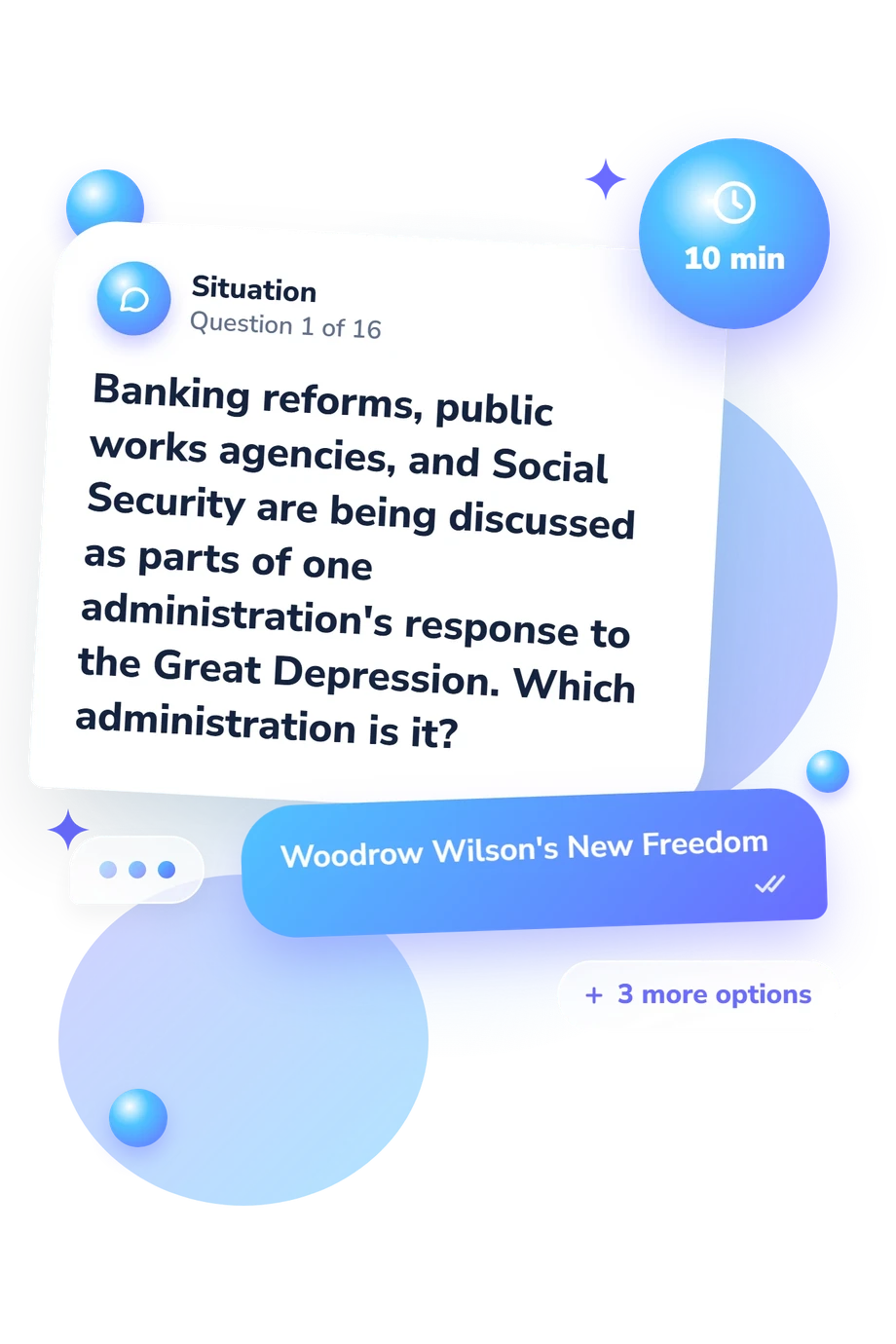
Example Questions From the Test
- Harry S. Truman
- Dwight D. Eisenhower
- Franklin D. Roosevelt
- Lyndon B. Johnson
- Gerald Ford
- Richard Nixon
- Jimmy Carter
- Lyndon B. Johnson
- Bill Clinton
- Barack Obama
- Donald Trump
- George W. Bush
US Presidents Quiz - Description and methodology of the test
For readers who want a broad check of presidential-history knowledge, this presidents quiz offers a focused way to connect US leaders with major decisions and events. It suits curious learners, students, and history-minded adults seeking an overall indication of what they know and whether core history merits review. As a presidential history quiz, it spans multiple eras and asks what each administration did, not merely when it served.
What This Assessment Explores
For anyone taking a quiz about US presidents, the assessment tests recognition through historical context. Items connect leaders with programs, laws, conflicts, executive actions, constitutional episodes, and institutional precedents. Coverage spans reform, foreign affairs, civil rights, war, executive power, and territorial change.
The result is one overall knowledge profile; the questions cover these themes:
- Domestic reform asks you to link programs and social legislation to the correct president.
- Foreign affairs and war asks you to place crises and military decisions under the appropriate administration.
- Constitutional leadership asks you to recognize executive orders, impeachment, resignation, and presidential precedents.
- Presidential legacy asks you to connect landmark actions with the responsible leader.
US Presidents Knowledge runs from 0-16: Foundational 0-6, Developing 7-12, and Accomplished 13-16. These bands describe increasing command across eras.
Methodology and Evidence Base
Each item presents a historical prompt with four answer choices and asks you to select the president that best fits it. Clues refer to policies, events, laws, executive actions, wars, and institutional precedents, so recognition depends on context rather than unsupported recall. This makes it a presidential knowledge test built around meaningful associations, not reciting names.
Scoring is direct: each correct answer contributes one point, and the total is read through the displayed bands. The questionnaire produces one overall total rather than separate scores for individual themes.
Its evidence base is adjacent recognition research: Putnam et al. (2021) examined recognition of American presidents, while Roediger and DeSoto (2016) studied recognition of presidential names. Milkis and Nelson (2021) provide historical context for linking administrations with institutions, policies, and crises. These sources offer related findings and background, but they do not validate this contextual knowledge questionnaire.
Results can vary with coursework, media exposure, interest in particular eras, and momentary retrieval. Because the test samples selected associations, it cannot represent every aspect of presidential knowledge or historical reasoning.
- Putnam, Adam L., Sarah Madison Drake, Serene Y. Wang, and K. Andrew DeSoto. “Collective memory for American leaders: Measuring recognition for the names and faces of the US presidents.” PLOS ONE 16, no. 7 (2021): e0255209. 10.1371/journal.pone.0255209
- Roediger, Henry L., III, and K. Andrew DeSoto. “Recognizing the Presidents: Was Alexander Hamilton President?” Psychological Science 27, no. 5 (2016): 644-650. 10.1177/0956797616631113
- Milkis, Sidney M., and Michael Nelson. The American Presidency: Origins and Development, 1776-2021. 9th ed. CQ Press, 2021.
Updated: