
UK General Knowledge Quiz
How the Scales are Structured
Who Usually Takes This Test?
See How You Compare
Below is a preview of how scores are typically distributed across each scale.
Example Questions From the Test
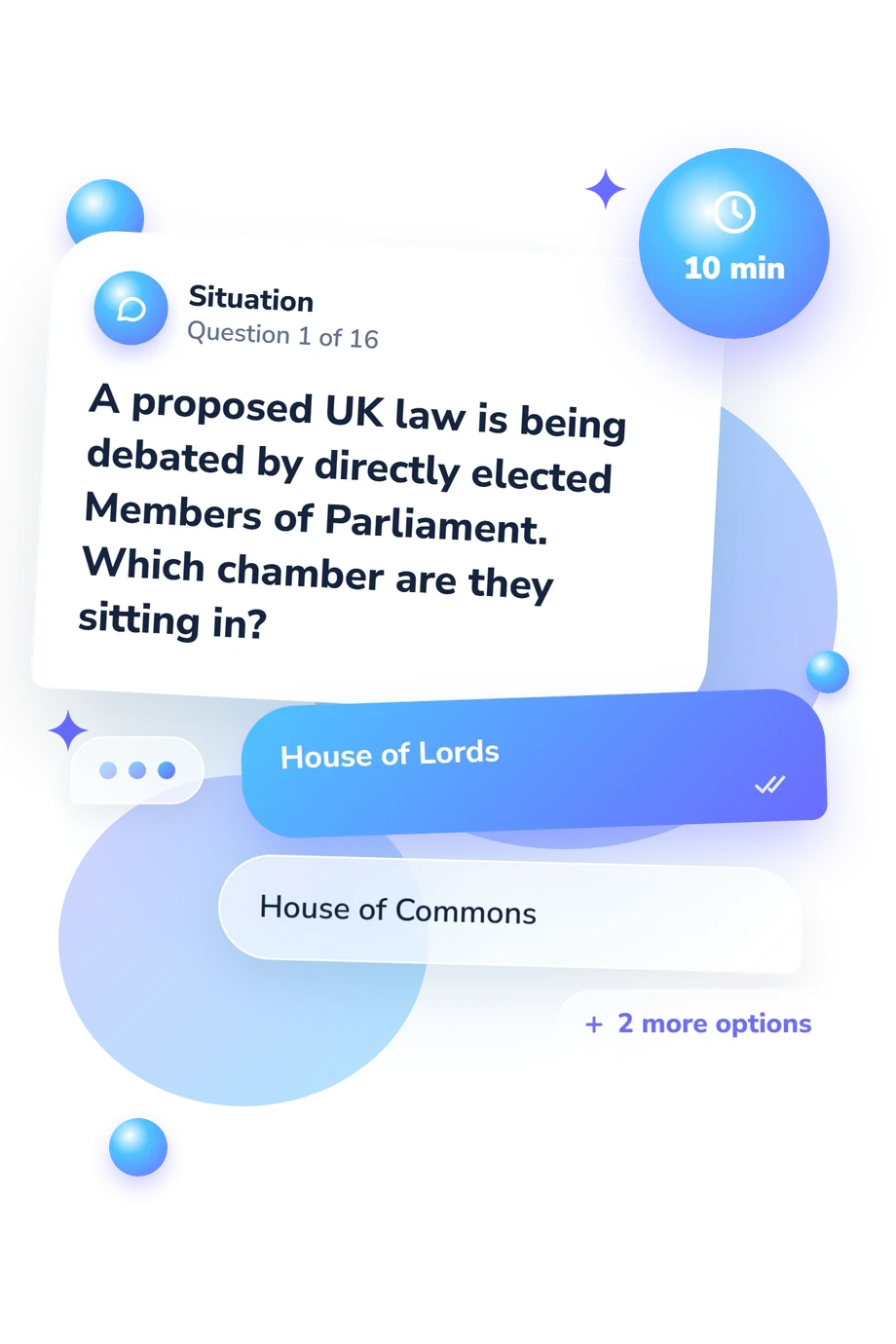
- House of Lords
- House of Commons
- Supreme Court
- Privy Council
- Humber Estuary
- Thames Estuary
- Severn Estuary
- Solway Firth
- The Equator
- The Tropic of Cancer
- The Prime Meridian
- The International Date Line
UK General Knowledge Quiz - Description and methodology of the test
Whether you are revising British facts, testing your recall, or choosing a light learning activity, the UK General Knowledge Quiz with Answers offers a structured way to examine knowledge of the country’s past and present. A UK general knowledge test can suit curious adults and learners who want a clear snapshot rather than a personality profile. The result gives an overall indication of performance across the questionnaire’s topics.
What This Assessment Explores
Questions span civic institutions, geography, history, science, literature, currency, symbols and landmarks. Scenarios ask you to identify a chamber, court, place, person or event, while direct items test recognition of widely taught facts. Its mix of trivia quiz questions and answers about the UK gives a broad snapshot rather than a specialist profile.
The main thematic areas are:
- Civic life shows how well you recognize Parliament, courts, constituent countries and public arrangements.
- Places and identity indicate recall of rivers, estuaries, postcodes, mountains, patron saints and the Union Flag.
- History, science and culture reflect knowledge of monarchs, evolution, currency, literature and Shakespeare.
The reported scale is UK General Knowledge (0-16 correct answers). Foundations to build covers 0-6; Developing knowledge covers 7-12; Strong knowledge covers 13-16, from core gaps to broad, accurate command of UK history, geography, culture and institutions.
Methodology and Scientific Basis
Each item presents a question or scenario with four answer choices. Choosing one option means that performance reflects correct recognition and selection in a fixed-response format. The scenarios cover civic institutions, geography, history, science, literature, currency and cultural symbols, while requiring a single factual choice rather than a written explanation.
The result reflects the number of correct answers and is interpreted through the displayed bands.
The closest conceptual reference is the General Knowledge Test described by Irwing and colleagues in 2001, which treats general knowledge as a broad ability with separable components. That perspective fits this range of subjects, but the online questionnaire is not presented as an adaptation or validation of the published instrument.
Furnham and Chamorro-Premuzic’s 2006 work connects general knowledge with intelligence and personality; those relationships are not additional traits scored here. Tourangeau and colleagues’ 2016 work shows that wording and response format can affect knowledge estimates. The British general knowledge quiz is a performance snapshot: its bands are descriptive, not population norms for this questionnaire, and scores may vary with education, cultural exposure, attention and guessing.
- Irwing, Paul, Tommy Cammock, and Richard Lynn. "Some evidence for the existence of a general factor of semantic memory and its components." Personality and Individual Differences 30, no. 5 (2001): 857-871. 10.1016/S0191-8869(00)00078-7
- Furnham, Adrian, and Tomas Chamorro-Premuzic. "Personality, intelligence and general knowledge." Learning and Individual Differences 16, no. 1 (2006): 79-90. 10.1016/j.lindif.2005.07.002
- Tourangeau, Roger, Aaron Maitland, and H. Yanna Yan. "Assessing the Scientific Knowledge of the General Public: The Effects of Question Format and Encouraging or Discouraging Don't Know Responses." Public Opinion Quarterly 80, no. 3 (2016): 741-760. 10.1093/poq/nfw009
Updated: