
Transcription and Translation Quiz
How the Scales are Structured
Who Usually Takes This Test?
See How You Compare
Below is a preview of how scores are typically distributed across each scale.
Example Questions From the Test
- 5′-UAC GGA-3′
- 5′-AUG CCU-3′
- 3′-AUG CCU-5′
- 5′-ATG CCT-3′
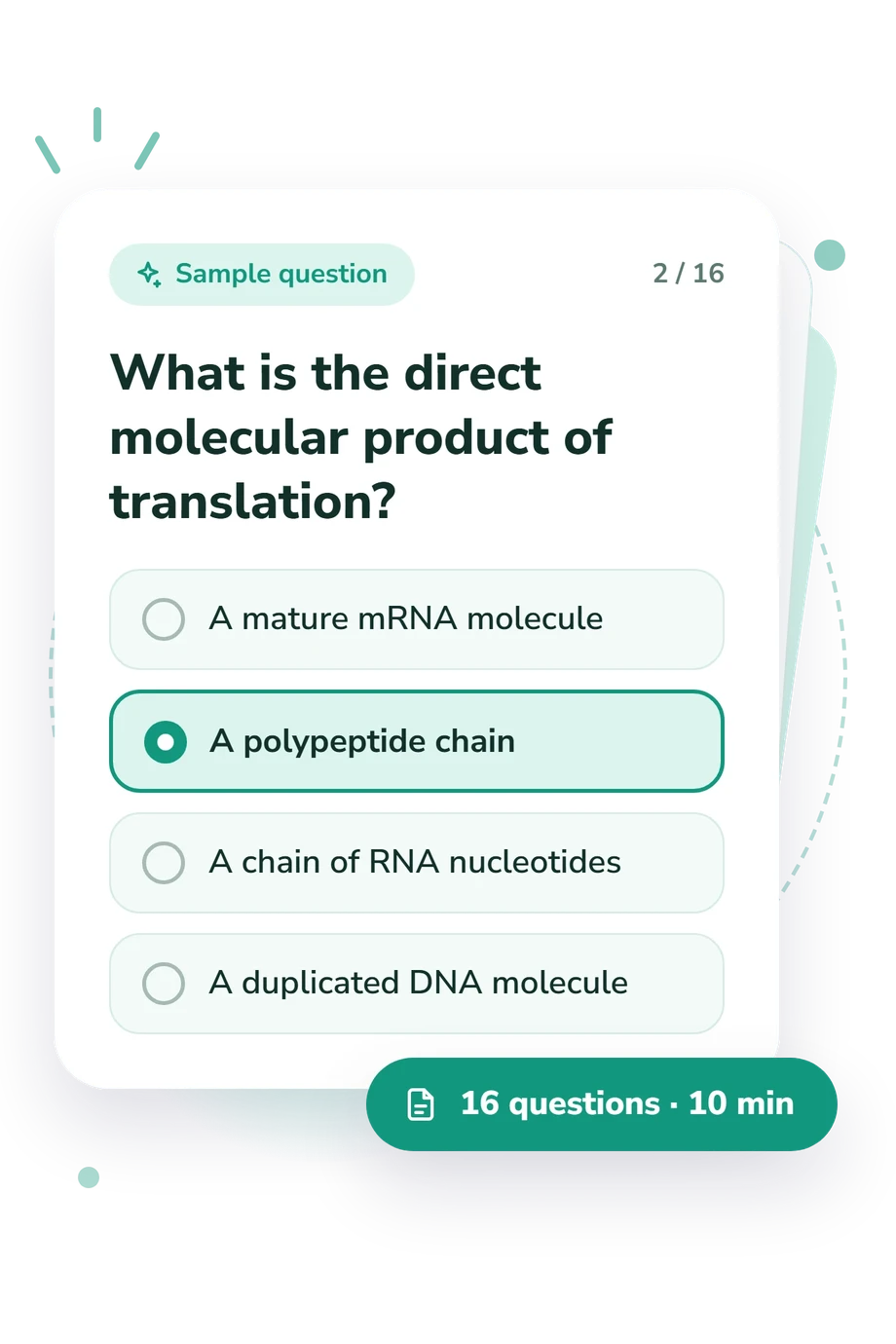
- A mature mRNA molecule
- A polypeptide chain
- A chain of RNA nucleotides
- A duplicated DNA molecule
- Transcription initiation
- Translation elongation
- RNA splicing
- DNA replication termination
Transcription and Translation Quiz - Description and methodology of the test
For students and curious learners who want to test whether the central dogma is more than memorized vocabulary, this transcription and translation quiz offers a focused knowledge check. It is useful before biology exams or during review because this transcription and translation practice quiz helps you connect molecular events rather than recite isolated terms. Its transcription questions can show which steps in gene expression deserve another look.
What This Assessment Measures
The assessment follows information flow from DNA to RNA and from RNA to protein. It covers strand direction, pairing, codons, anticodons, promoters, ribosomes, reading frames, and RNA processing.
The practice questions ask you to identify products, locate processes, and predict effects of sequence or molecular changes, making this transcription quiz useful for connecting transcription and translation.
The result draws on three thematic groups:
- DNA-to-RNA relationships show whether you can apply strand direction, base pairing, and RNA polymerase function.
- Protein synthesis and regulation show whether codons, ribosome movement, termination, and promoter effects form a coherent sequence.
- RNA processing and sequence consequences show whether you can interpret splicing, stop signals, and frame-shifting insertions.
Transcription and Translation Knowledge (0-16) is shown as Foundation to build (0-6), which signals partial recognition; Developing knowledge (7-12), which indicates core mechanisms with some application gaps; or Strong knowledge (13-16), which reflects accurate, integrated understanding.
Methodology and Scientific Basis
Each item presents a stem with four answer choices. One RNA transcription quiz item may require antiparallel reading and complementary bases; another asks what a stop codon does at the ribosome.
The questionnaire presents one total score with descriptive bands, helping you decide whether to revisit foundations, applications, or integrated mechanisms. An item linking a DNA sequence to translation through mRNA may flag a possible confusion about codons or reading frames without proving a general deficiency.
The questionnaire is conceptually consistent with the CDCI, but is not an adaptation of it. One DNA translation quiz item follows a DNA sequence through mRNA to translation and may reveal mixed conceptions about genetic information flow, a concern documented by Uhl and colleagues.
Prior instruction, current attention, and confidence can affect performance on multiple-choice items. Use the result to choose review topics and check difficult points through wider biology study.
- Newman DL, Snyder CW, Fisk JN, Wright LK. Development of the Central Dogma Concept Inventory (CDCI) Assessment Tool. CBE-Life Sciences Education. 2016;15(2):ar9. 10.1187/cbe.15-06-0124
- Uhl JD, Sripathi KN, Saldanha JN, Moscarella RA, Merrill J, Urban-Lurain M, Haudek KC. Introductory biology undergraduate students' mixed ideas about genetic information flow. Biochemistry and Molecular Biology Education. 2021;49(3):372-382. 10.1002/bmb.21483
Updated: