
Tort Law Quiz
How the Scales are Structured
Who Usually Takes This Test?
See How You Compare
Below is a preview of how scores are typically distributed across each scale.
Example Questions From the Test
- Assault only, because battery always requires a bodily wound
- Battery, because harmful or offensive contact can qualify without physical injury
- Negligence, because every uninjured contact is evaluated under reasonable care
- False imprisonment, because the shove briefly affected Jordan's movement
- Intent, offensive contact, publication, and damages
- Duty, intent, reliance, and punishment
- A promise, consideration, breach, and loss
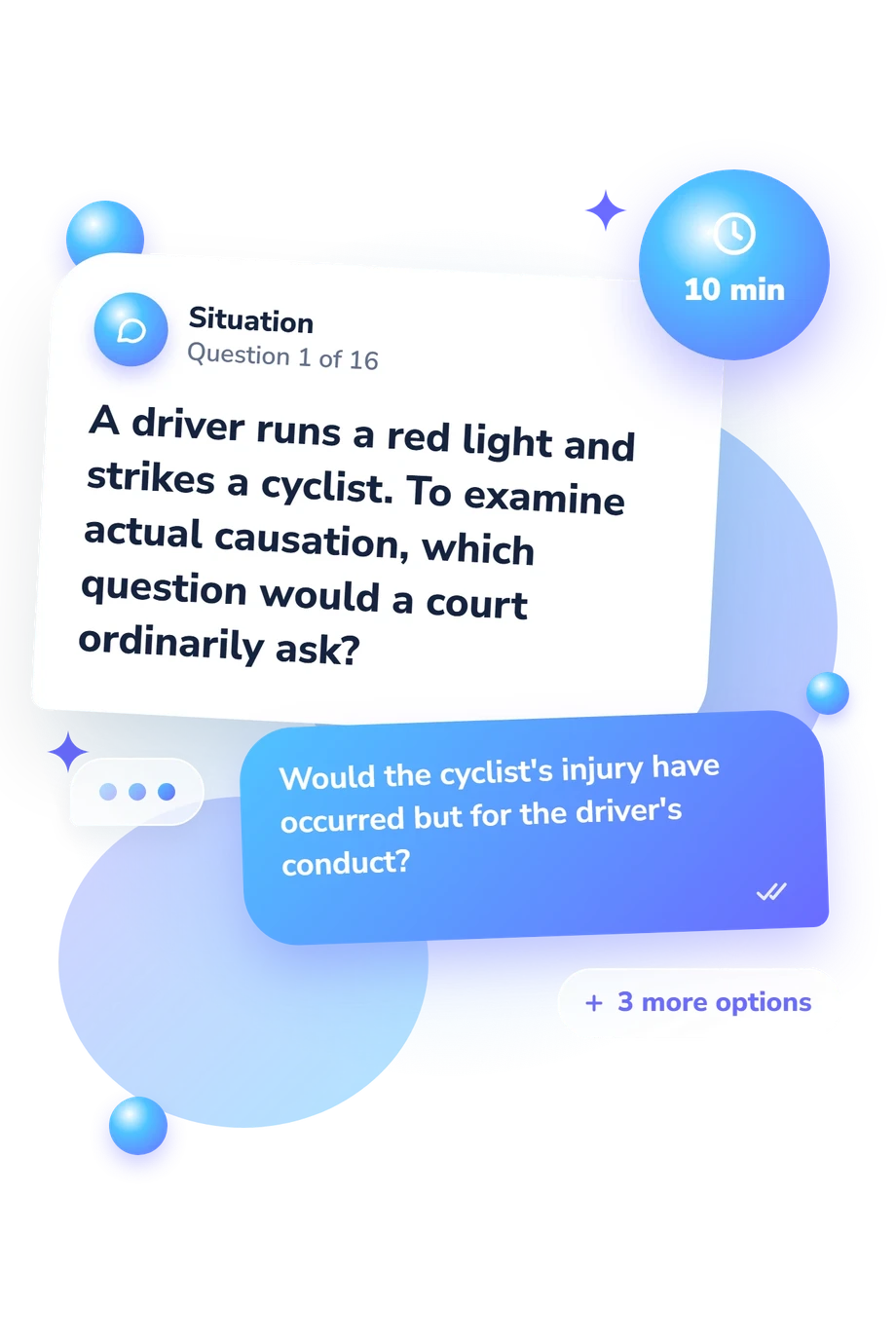
- Duty, breach, actual and proximate causation, and damages
- To impose imprisonment for conduct that threatens the public
- To determine whether legislation is constitutional
- To enforce promises made in valid agreements
- To provide remedies for legally recognized injuries or wrongs
Tort Law Quiz - Description and methodology of the test
Designed for students, law learners, and curious readers, this assessment checks how clearly you recognize common civil wrongs and connect facts to legal rules. As a tort law practice quiz, it uses short fact patterns to test core reasoning and shows which tort-law distinctions you can apply and which areas merit review. Its tort law quiz questions serve as fact-pattern exercises for focused, deliberate study.
What This Assessment Explores
The questionnaire examines doctrines governing civil liability. Its scenarios distinguish intentional wrongs from negligence, connect conduct with injury, and test how defenses or remedies alter outcomes.
The result uses one knowledge scale. Its three bands show how consistently you recognize core rules and apply them to familiar facts. Performance on this tort quiz is best read as a study profile.
These are the main areas represented:
- Intentional torts show whether you identify contact, threats, confinement, reputational harm, or property interference.
- Negligence tests duty, breach, actual and proximate causation, foreseeability, and damages.
- Consent and fault allocation show how you apply consent, comparative negligence, and contributory negligence.
- Strict liability tests whether abnormally dangerous activities can create liability without ordinary negligence.
- Punitive damages and tort law’s civil-remedy function show how you distinguish punishment and deterrence from remedies for legally recognized wrongs.
Methodology and Scientific Basis
Each item presents a short fact pattern with four answer choices. Competing analyses require matching doctrine to facts rather than recalling definitions. The result is reported on the displayed 0-16 Tort Law Knowledge scale and interpreted through Foundations to Build (0-6), Developing Command (7-12), and Strong Command (13-16); the questionnaire does not specify how responses become points.
These tort law questions can serve as study prompts. Their coverage is conceptually consistent with Dobbs, Hayden, and Bublick (2011), the Second and Third Restatements, and the wrongs-based account associated with Goldberg and Zipursky (2020). These sources cover duties, protected interests, causation, defenses, and remedies, but do not establish this questionnaire as an adaptation, validated copy, or standardized administration.
As presented, this is an online educational questionnaire: its displayed bands are educational categories, and no standardized population interpretation or reliability evidence is established for it. Results can reflect prior coursework, wording choices, and understanding of general common-law principles. Because tort rules vary by jurisdiction and disputes depend on fuller facts, use the result to target study rather than resolve a legal question.
- Dobbs, Dan B., Paul T. Hayden, and Ellen M. Bublick. The Law of Torts. 2nd ed., 4 vols. St. Paul, MN: West, 2011.
- American Law Institute. Restatement of the Law, Second, Torts. 4 vols. St. Paul, MN: American Law Institute Publishers, 1965, 1977, 1979.
- American Law Institute. Restatement of the Law, Third, Torts: Liability for Physical and Emotional Harm. 2 vols. St. Paul, MN: American Law Institute Publishers, 2010-2012.
- Goldberg, John C. P., and Benjamin C. Zipursky. Recognizing Wrongs. Cambridge, MA: Belknap Press of Harvard University Press, 2020. 10.2307/j.ctvt9k64k
Updated: