
To vs. Too Quiz
How the Scales are Structured
Who Usually Takes This Test?
See How You Compare
Below is a preview of how scores are typically distributed across each scale.
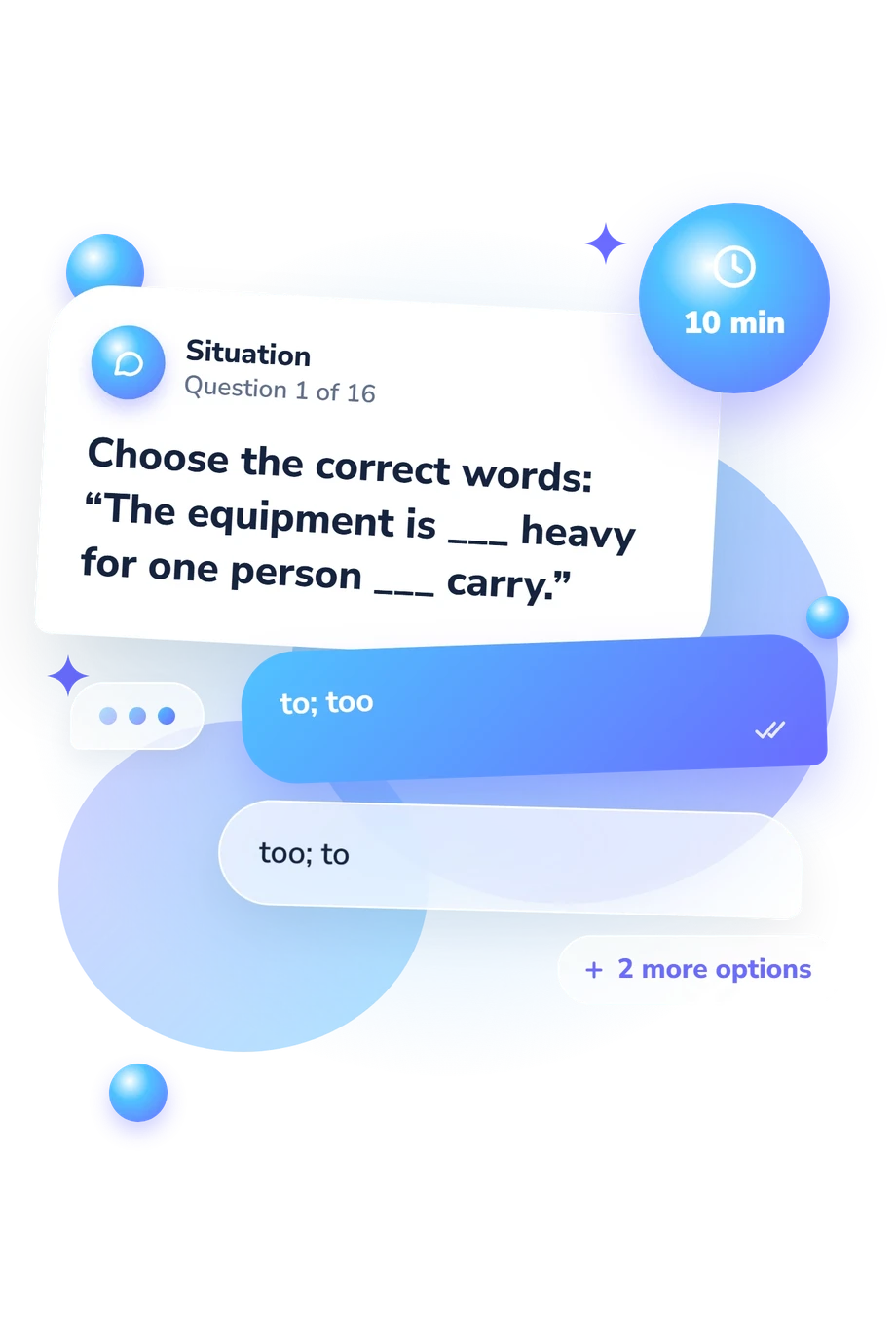
Example Questions From the Test
- to; too
- too; to
- too; too
- to; to
- The cold exceeds what the speaker can tolerate.
- The theater is cold in addition to being crowded.
- The word introduces the action “stay.”
- The speaker is moving toward a cold theater.
- to; to
- too; to
- to; too
- too; too
To vs. Too Quiz - Description and methodology of the test
Readers who want to distinguish two common English forms can use the To and Too Quiz to check choices based on meaning and grammar. It suits learners, writers, and anyone seeking a practical refresher before editing everyday messages. The questions focus on decisions that often look simple but change meaning when context shifts. This English grammar quiz highlights current strengths and the distinctions most worth revisiting.
What This Assessment Explores
At the centre of the assessment is the distinction between “to” and “too” in context. It checks whether you can identify “to” as a destination marker or part of an infinitive, and recognise “too” when it means also or expresses excess. As a quiz about distinguishing “to” from “too,” it tests whether those meanings stay clear across several blanks.
Its questions group into three practical abilities:
- Word choice measures whether you can select the form that fits a sentence.
- Meaning recognition shows whether you can explain what “too” contributes in context.
- Editing and inference reveal whether you can correct an error and draw the intended meaning.
The displayed scale, To vs. Too Knowledge (0-16), summarizes performance as Foundations to Review (0-6), Developing Knowledge (7-12), or Strong Knowledge (13-16).
Methodology and Evidence Base
Each question uses four answer choices and asks for a selection, an interpretation, a grammatical role, an inference, or a correction. The format moves beyond memorising definitions: a respondent must use sentence meaning to decide whether the word signals direction, an infinitive, addition, or excess.
The score is the number of correct responses across the item set. The displayed bands are descriptive correct-answer categories, not population norms or diagnostic thresholds. This to and too test is therefore best read as a focused learning check that identifies which distinctions deserve more practice.
Its grammatical approach is consistent with the analyses in Carter and McCarthy (2006) and with the broader functional account associated with Huddleston and Pullum. Those works support the categories tested here, but this online questionnaire should not be described as a validated adaptation of either published source.
Performance can vary with attention, prior instruction, and familiarity with editing conventions. Honest answers give the most useful snapshot, while a single result cannot capture every aspect of written English or explain why an error occurred.
- Carter, Ronald, and Michael McCarthy. Cambridge Grammar of English: A Comprehensive Guide. Cambridge University Press, 2006. 973 pp. ISBN 978-0-521-58166-0.
- Huddleston, Rodney, and Geoffrey K. Pullum. The Cambridge Grammar of the English Language. Cambridge University Press, 2002. 1,842 pp. 10.1017/9781316423530.
Updated: