
The Crucible Character Matching Quiz
How the Scales are Structured
Who Usually Takes This Test?
See How You Compare
Below is a preview of how scores are typically distributed across each scale.
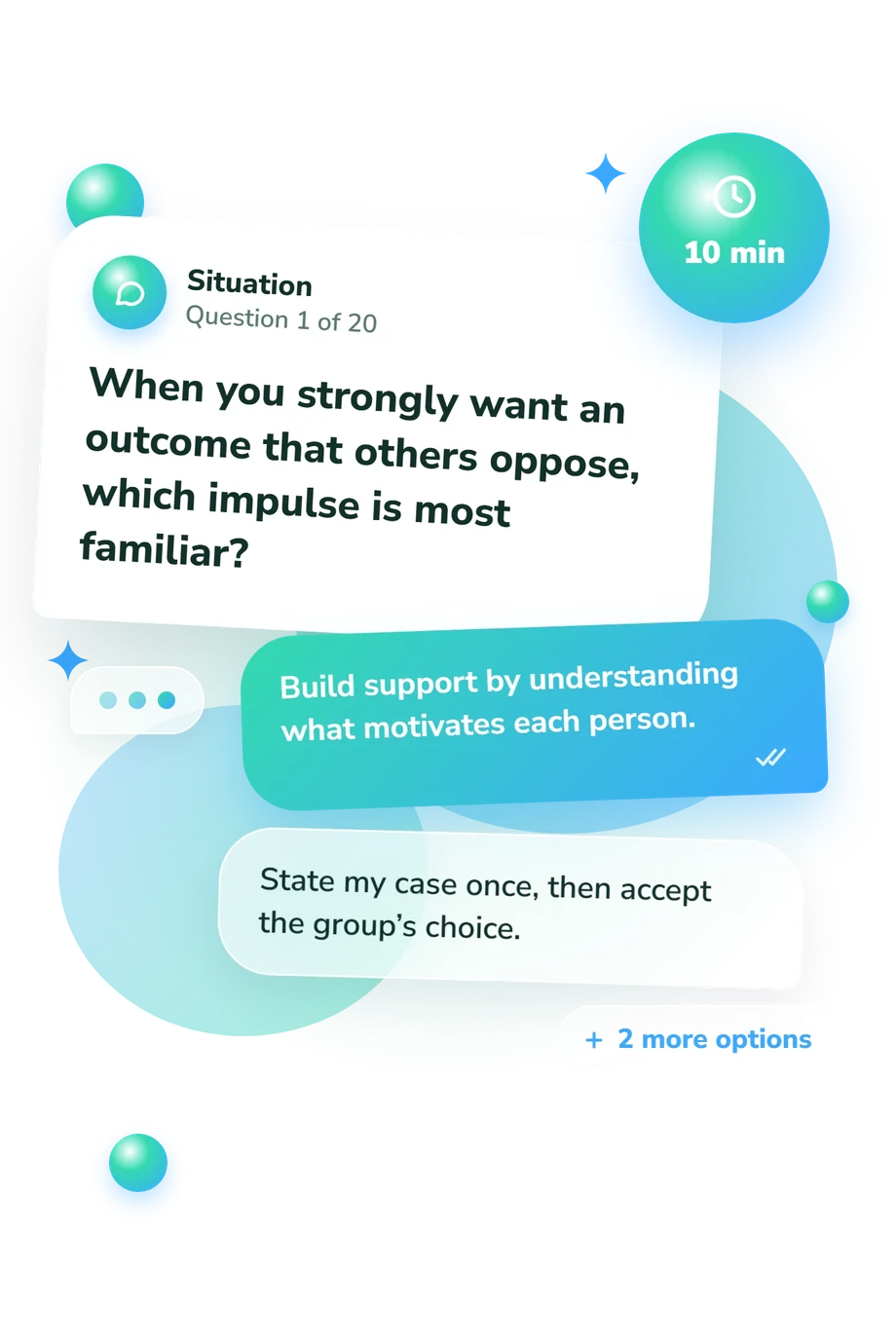
Example Questions From the Test
- Build support by understanding what motivates each person.
- State my case once, then accept the group’s choice.
- Keep negotiating until a workable compromise appears.
- Gather stronger evidence before raising it again.
- I refine my argument and return with stronger support.
- I keep pressing the point in direct, unmistakable language.
- I look for a better-positioned person to raise it.
- I conserve my effort for a dispute I can influence.
- Keeping the matter separate from the person I am now.
- Choosing the right time and setting to explain it.
- Protecting the people who could be affected by disclosure.
- Refusing to preserve my name through a lie.
The Crucible Character Matching Quiz - Description and methodology of the test
Readers drawn to moral choices and character comparison can use the crucible character matching quiz to relate their own responses to five figures in Arthur Miller’s play. This Arthur Miller character quiz connects dilemmas about loyalty, authority, evidence, and responsibility with thematic character affinities. The result shows the strongest profile or a blended profile when scores are within one point of the highest.
What This Assessment Explores
The questions examine influence, trust, conscience, evidence, authority, and pressure. The quiz compares character resemblance, not moral approval, across five profiles. This quiz about The Crucible characters groups thematic qualities rather than judging whether a figure is admirable. Profiles include:
- Abigail Williams Affinity (0-12) shows intensity and leverage: Different instincts (0-4), Strategic streak (5-8), or Strong affinity (9-12).
- Elizabeth Proctor Affinity (0-12) reflects restraint and trust: Expressive contrast (0-4), Measured resemblance (5-8), or Strong affinity (9-12).
- Giles Corey Affinity (0-12) reflects skepticism and plain dealing: Diplomatic contrast (0-4), Independent resemblance (5-8), or Strong affinity (9-12).
- John Proctor Affinity (0-12) captures independence and conscience: Quiet contrast (0-4), Shared tension (5-8), or Strong affinity (9-12).
- Reverend Hale Affinity (0-12) captures expertise and self-correction: Instinct-led contrast (0-4), Thoughtful resemblance (5-8), or Strong affinity (9-12).
Methodology and Evidence
Each item presents a social or ethical dilemma with four choices. The options vary in their treatment of pressure, loyalty, authority, evidence, and conflict, so the respondent selects the impulse that feels familiar. As a Crucible character quiz, the format turns those choices into comparative affinity scores rather than symptom or ability ratings.
Scoring is profile-based: the highest profile score is the strongest affinity, while scores within one point of the highest form a blended result. This is a comparative literary reading, not a personality type, diagnosis, or fixed identity. The bands indicate degrees of resemblance or contrast rather than approval of any character.
The literary framework is Arthur Miller’s play The Crucible, where characters confront reputation, conscience, power, evidence, and responsibility. The questionnaire’s themes are conceptually consistent with Hooti’s 2011 account of identity, Hooti and Ghaderi’s 2015 analysis of justice and law, and Jeihouni and Hooti’s 2018 study of Proctor’s truth-telling. Self-report remains a limitation: current circumstances, selective memory, and impression management can influence the result, which works best as a prompt for reflection.
- Miller, Arthur. The Crucible: A Play in Four Acts. New York: Viking Press, 1953.
- Hooti, Noorbakhsh. The Quest for Identity in Arthur Miller's The Crucible. Journal of English and Literature, 2(3), 2011, pp. 68-74. Article B7E831D1017.
- Hooti, Noorbakhsh, and Ali Ghaderi. Event, Iterability, and Justice Practiced in the Sense of Law: A Derridean Reading of Arthur Miller's The Crucible. 3L: The Southeast Asian Journal of English Language Studies, 21(1), 2015, pp. 81-90. 10.17576/3L-2015-2101-08
- Jeihouni, Mojtaba, and Noorbakhsh Hooti. Because It Is My Name!: Miller, Proctor, and Parrhesia in The Crucible. Orbis Litterarum, 73(2), 2018, pp. 103-126. 10.1111/oli.12158
Updated: