
The Crucible Act 2 Quiz
How the Scales are Structured
Who Usually Takes This Test?
See How You Compare
Below is a preview of how scores are typically distributed across each scale.
Example Questions From the Test
- He is waiting for Reverend Hale to perform the ceremony
- He believes baptism should occur only in adulthood
- Elizabeth refuses to let the child enter the meeting house
- He does not see the light of God in Reverend Parris
- She thinks Hale will accuse her of stealing it from the church
- She fears Abigail and the other girls will retaliate against her
- She expects the judges to punish her for leaving work early
- She believes Elizabeth will dismiss her from the household
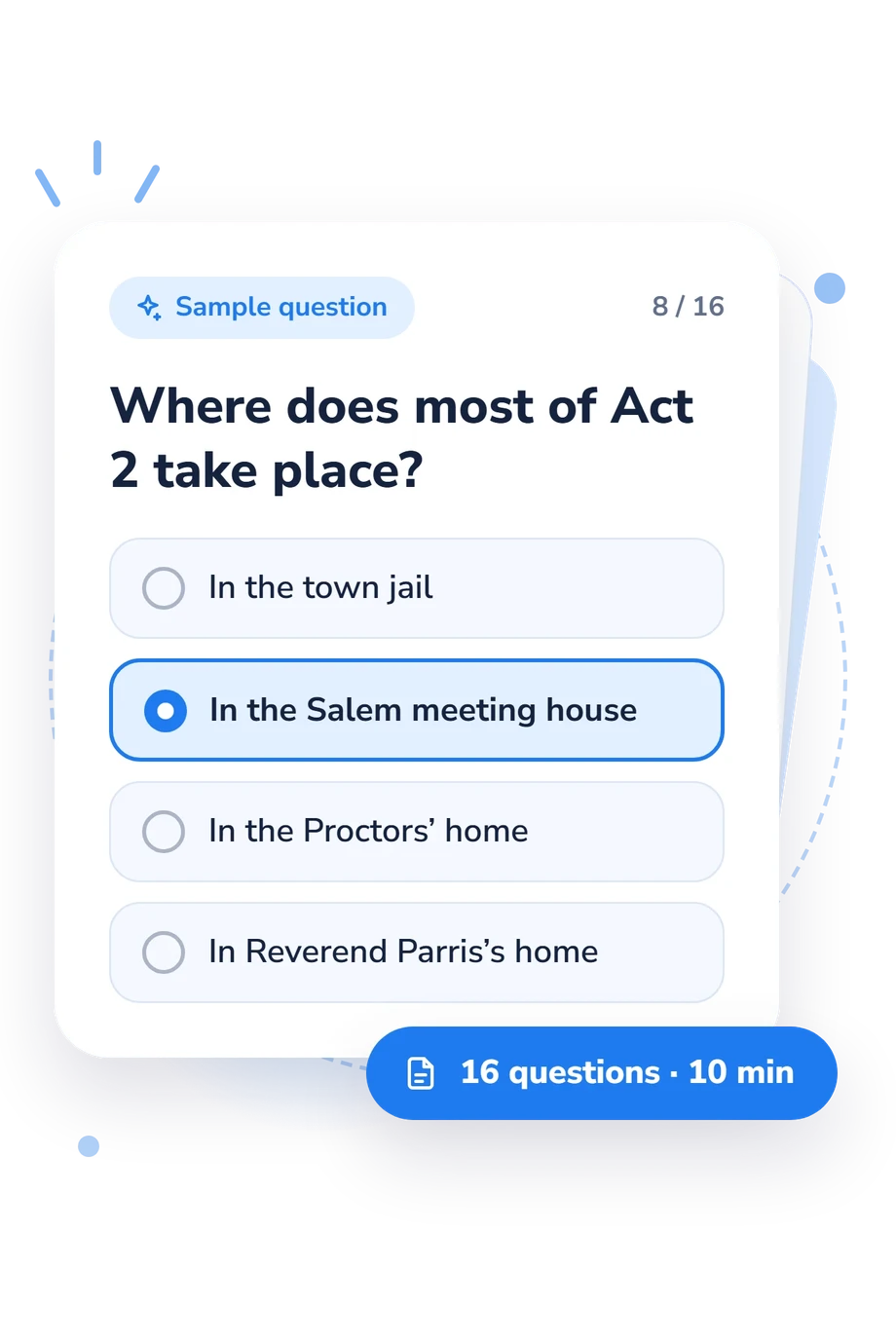
- In the town jail
- In the Salem meeting house
- In the Proctors’ home
- In Reverend Parris’s home
The Crucible Act 2 Quiz - Description and methodology of the test
Readers who want to check how securely they understand Miller’s courtroom drama can use The Crucible Act 2 Quiz as a focused review of the play’s turning point. It suits students, teachers preparing discussion, and anyone revisiting the act’s moral pressure, character relationships, and cause-and-effect sequence. As an Act 2 literature quiz, this assessment can show whether a missed detail reflects plot memory or an overlooked motive.
What This Assessment Explores
Act II sets private marriage tension beside public accusations, so the assessment combines factual recall with connected interpretation. It asks readers to link actions, dialogue, and symbols with the pressures shaping John, Elizabeth, Mary Warren, Abigail, Hale, and the court. The Crucible Act II quiz is a reading-comprehension and interpretation exercise.
The result is most useful when read through these thematic areas:
- Plot sequence shows whether you can place key events in dramatic order.
- Character motives indicate whether you can explain choices under pressure.
- Dramatic irony shows what the audience knows before characters do.
- Themes and conflicts reveal how guilt, authority, and truth collide.
One displayed scale, The Crucible Act 2 Knowledge (0-16), uses Foundations to Revisit (0-6), Developing Understanding (7-12), and Strong Understanding (13-16). The bands describe increasing command of events, irony, conflicts, and thematic development.
Methodology and Evidence Base
Each item presents four answer choices and asks for the most accurate account of an event, motive, symbol, or relationship. In this Crucible Act 2 questionnaire, close reading matters: selecting an answer depends on connecting a detail such as the poppet or forgotten commandment with the larger conflict it exposes. The resulting total is read through the displayed knowledge bands rather than treated as a diagnosis or personality profile.
The content is anchored in Crucible (Miller, 1953), the source play that supplies the tested events, characters, imagery, and moral conflicts. Hooti and Ghaderi (2015) provide a complementary reading of law, repetition, accusation, and unstable justice. The questionnaire is conceptually consistent with that literary analysis, but it is not an adaptation of the article’s method.
This is an online selected-response questionnaire, not a published standardized instrument. Its score has no stated norm group, reliability estimate, or independent validation, so the bands describe performance on this set of questions rather than population cutoffs. Results can also vary with memory, prior classroom teaching, and how a reader weighs an ambiguous interpretation. Reviewing missed items against the relevant scene and dialogue makes the result more useful for study.
- Miller, Arthur. The Crucible: A Play in Four Acts. New York: Viking Press, 1953.
- Hooti, Noorbakhsh, and Ali Ghaderi. “Event, Iterability, and Justice Practiced in the Sense of Law: A Derridean Reading of Arthur Miller’s The Crucible.” 3L: The Southeast Asian Journal of English Language Studies 21, no. 1 (2015): 81-90. 10.17576/3L-2015-2101-08
Updated: