
Thanksgiving Quiz
How the Scales are Structured
Who Usually Takes This Test?
See How You Compare
Below is a preview of how scores are typically distributed across each scale.
Example Questions From the Test
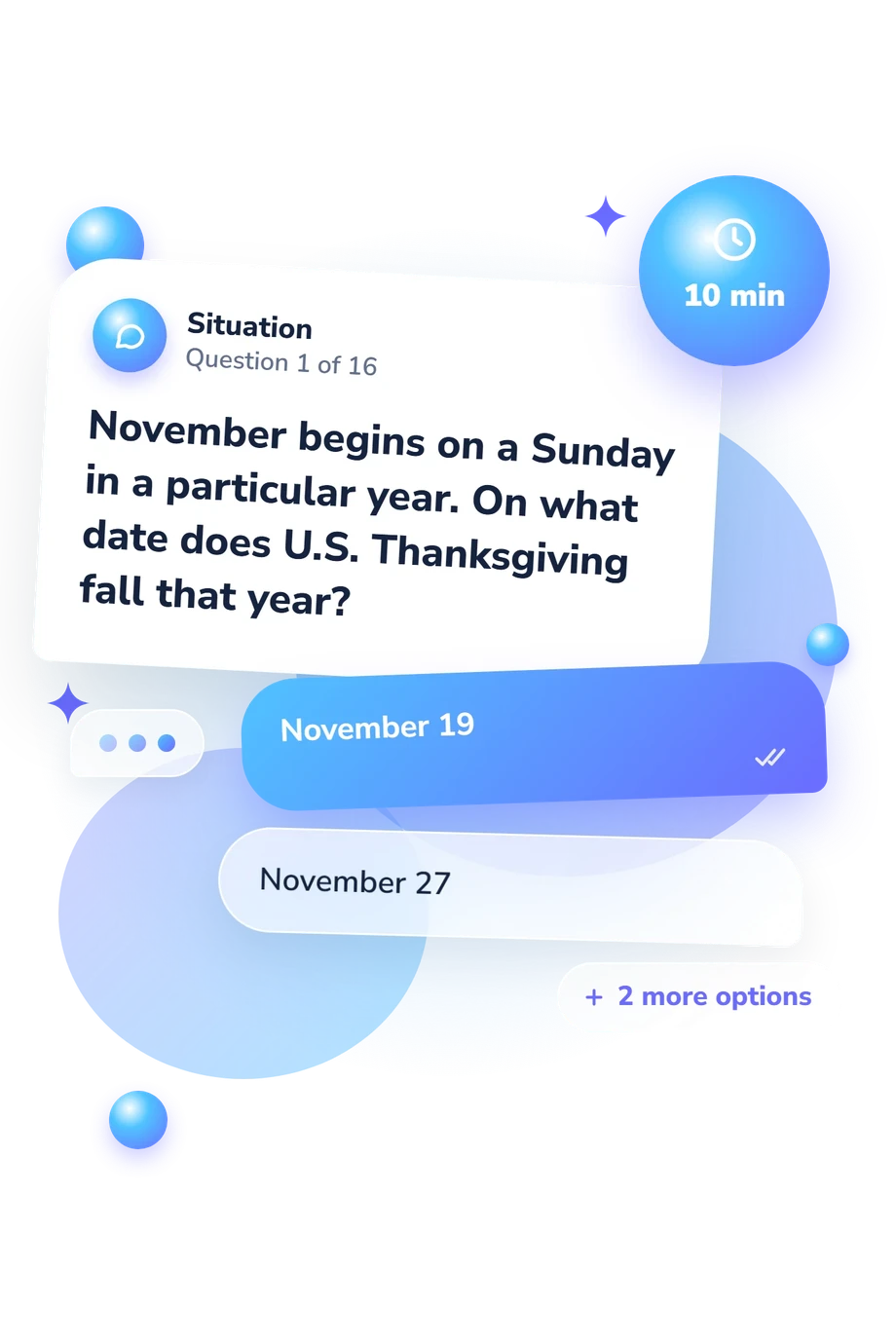
- November 19
- November 27
- November 26
- November 29
- Virginia
- Rhode Island
- Massachusetts
- Connecticut
- The first Monday in September
- The fourth Thursday in November
- The second Monday in October
- The third Monday in October
Thanksgiving Quiz - Description and methodology of the test
Readers who want to test their understanding of the holiday can use this thanksgiving quiz to connect familiar customs with history, evidence, and practical knowledge. It is intended for curious learners, families, teachers, and seasonal trivia fans who want a result with more substance than a list of fun facts. A thanksgiving trivia quiz format keeps the activity approachable while rewarding careful reading and informed judgment.
What This Assessment Explores
Questions connect holiday history with evidence, culture, and practical decisions. They cover the 1621 Plymouth gathering, Wampanoag context, federal rules, public traditions, food safety, and familiar symbols. As a thanksgiving day quiz, it suits readers seeking cultural understanding as well as recall.
It groups the result into three areas:
- History and evidence show how well you connect dates and sources while distinguishing records from later stories.
- Traditions and culture indicate whether you recognize symbols, foods, celebrations, and national customs.
- Practical knowledge shows whether you apply basic guidance to cooking and leftover storage.
The Thanksgiving Knowledge scale runs from 0-16 correct answers. Emerging (0-6) reflects partial basics; Developing (7-12) shows a solid foundation; Strong (13-16) indicates broad, accurate knowledge. These bands describe performance on this questionnaire.
Methodology and Evidence Base
Each item gives a short scenario or direct question with four choices. Selecting the best answer produces a count of correct responses, not a personality or opinion profile. The thanksgiving day quiz questions move across chronology, source recognition, historical perspective, cultural knowledge, and practical application.
Methodologically, it is conceptually consistent with First Thanksgiving HAT, the historical-thinking assessment work of Smith, Breakstone, and Wineburg (2019). It is not an adaptation of their instrument; the relationship is limited to task design that asks readers to weigh evidence and context.
NMAI guidance supports treating the 1621 gathering as a specific encounter involving Wampanoag people and English colonists, rather than a simple national origin story. Mourt’s Relation supports items about a surviving period account, and USDA Food Safety and Inspection Service guidance supports the cooking and storage questions.
No population norms or standardized diagnostic cutoffs are presented. The result reflects performance on this question set and may vary with guessing, prior exposure, cultural familiarity, and attention. Occasional lightness makes it a funny quiz for Thanksgiving gatherings without displacing accuracy.
- Smith, Mark, Joel Breakstone, and Sam Wineburg. “History Assessments of Thinking: A Validity Study.” Cognition and Instruction, vol. 37, no. 1, 2019, pp. 118-144. 10.1080/07370008.2018.1499646
- National Museum of the American Indian. “The ‘First Thanksgiving’: How Can We Tell a Better Story?” Native Knowledge 360°, Smithsonian Institution, n.d.
- Winslow, Edward, and William Bradford. A Journal of the Pilgrims at Plymouth: Mourt’s Relation. Edited by Dwight B. Heath, Corinth Books, 1963.
- U.S. Department of Agriculture, Food Safety and Inspection Service. “Happy Thanksgiving!” 2024.
Updated: