
Surgical Instruments Quiz
How the Scales are Structured
Who Usually Takes This Test?
See How You Compare
Below is a preview of how scores are typically distributed across each scale.
Example Questions From the Test
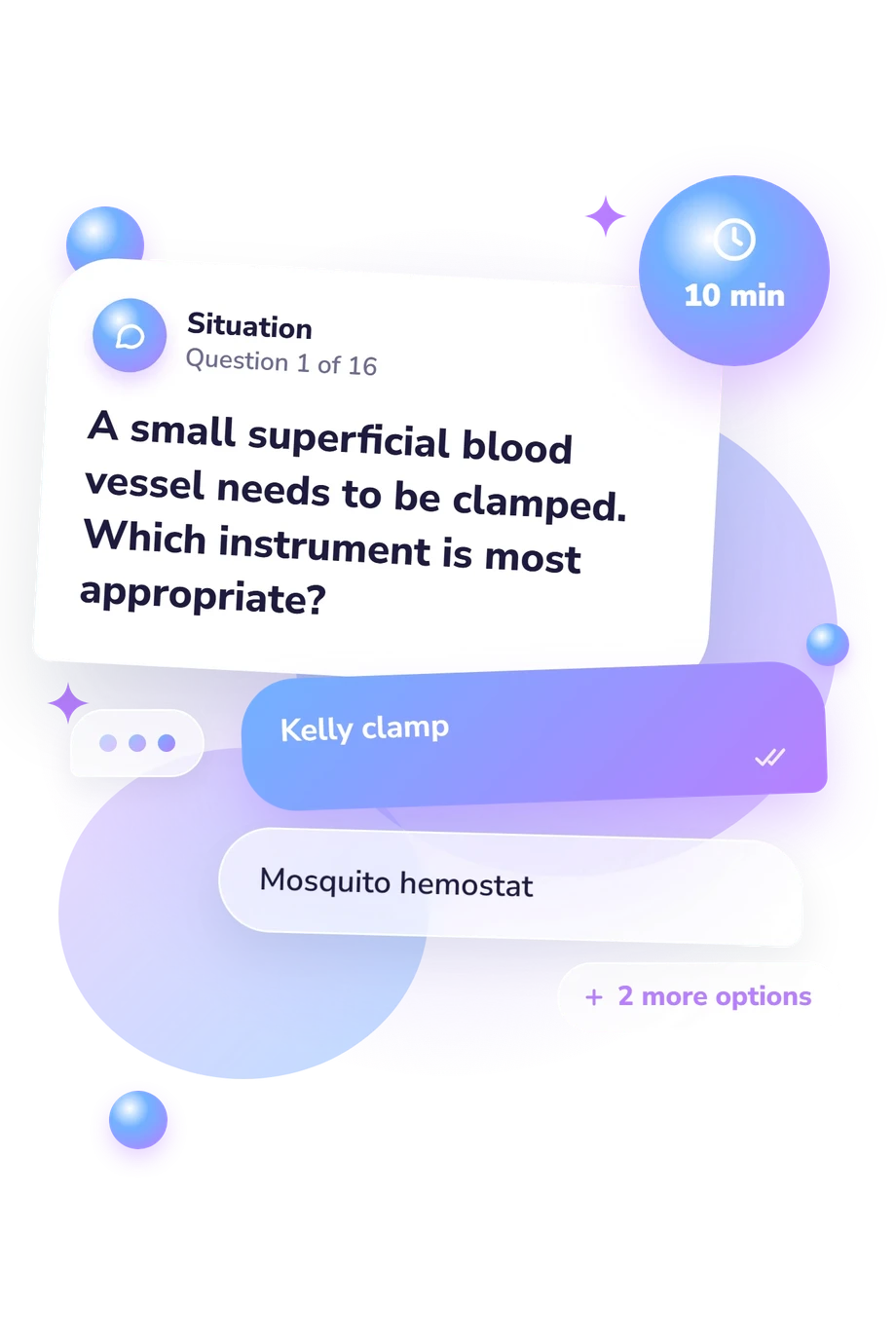
- Kelly clamp
- Mosquito hemostat
- Rochester-Pean clamp
- Crile clamp
- Metzenbaum scissors
- Tenotomy scissors
- Iris scissors
- Mayo scissors
- Allis tissue forceps
- Backhaus towel clamp
- Babcock forceps
- Foerster sponge forceps
Surgical Instruments Quiz - Description and methodology of the test
Students, trainees, and educators can use the surgical instruments quiz to connect instrument names with the tasks they support. This free quiz on surgical instruments suits readers building foundational operating-room vocabulary before supervised practice. The questions ask readers to identify instruments, match their features with functions, and practise recognition across common operating-room tools. The result offers a broad indication of overall knowledge.
What This Assessment Measures
The items measure functional recognition of surgical instrument functions: connecting an instrument’s construction with an appropriate task or handling situation. Questions cover closure, vessel control, incision, grasping, exposure, suction, scraping, and preparation before sterilization. They also distinguish delicate from firm handling and acceptable from excessive tissue trauma.
The questions group recognition into four practical dimensions:
- Instrument identification links names with visible features and typical uses.
- Tissue handling shows whether choices reflect delicacy, grip, and acceptable trauma.
- Procedural selection matches tools to cutting, clamping, closure, exposure, suction, or scraping.
- Processing awareness reflects opening hinged or ratcheted instruments so agents can reach their surfaces.
Results are shown in three unvalidated educational bands: Foundation-building (0-6) signals review needs; Developing knowledge (7-12) shows many correct distinctions; Strong overview (13-16) shows broad coverage. These are educational summaries, not professional cutoffs.
Methodology and Evidence Base
Each question presents an operating-room or preparation scenario with four answer choices. The respondent selects the instrument or handling step that best fits the purpose, so the format tests applied recognition rather than names alone. This format makes practice with surgical instruments concrete without requiring equipment.
The questionnaire reports a Surgical Instruments Knowledge score from 0-16 as an educational summary of recognition across instrument names, visible features, functions, handling situations, and preparation steps.
The content is conceptually consistent with Playing with Tweezers, which treats instrument identification and setup as learnable procedural knowledge. This questionnaire is not an adaptation of that game. Akbari et al. report related evidence on knowledge and performance in serious-game operating-room education, while Nemitz describes instrument features and uses.
These sources support subject matter, not reliability, validity, norms, or standardization. Guessing, terminology familiarity, attention, and differences in prior practice can affect results; the score cannot establish clinical competence or guide instrument choice during care, where local protocols and supervision take priority.
- Paim, Crislaine Pires Padilha, and Silvia Goldmeier. "Development of an Educational Game to Set Up Surgical Instruments on the Mayo Stand or Back Table: Applied Research in Production Technology." JMIR Serious Games 5, no. 1 (2017): e1. DOI 10.2196/games.6048
- Akbari, Fakhridokht, Morteza Nasiri, Neda Rashidi, Sahar Zonoori, Leila Amirmohseni, Jamshid Eslami, Camellia Torabizadeh, Fahimeh Sadat Havaeji, Marzieh Beigom Bigdeli Shamloo, Crislaine Pires Padilha Paim, Mehran Naghibeiranvand, and Masoomeh Asadi. "Comparison of the Effects of Virtual Training by Serious Game and Lecture on Operating Room Novices’ Knowledge and Performance About Surgical Instruments Setup: A Multi-Center, Two-Arm Study." BMC Medical Education 22, article 268 (2022). DOI 10.1186/s12909-022-03351-5
- Nemitz, Renee. "Surgical Instrumentation: An Interactive Approach." 4th ed. Elsevier, 2022. ISBN 978-0-323-77693-6
Updated: