
Subnetting Quiz
How the Scales are Structured
Who Usually Takes This Test?
See How You Compare
Below is a preview of how scores are typically distributed across each scale.
Example Questions From the Test
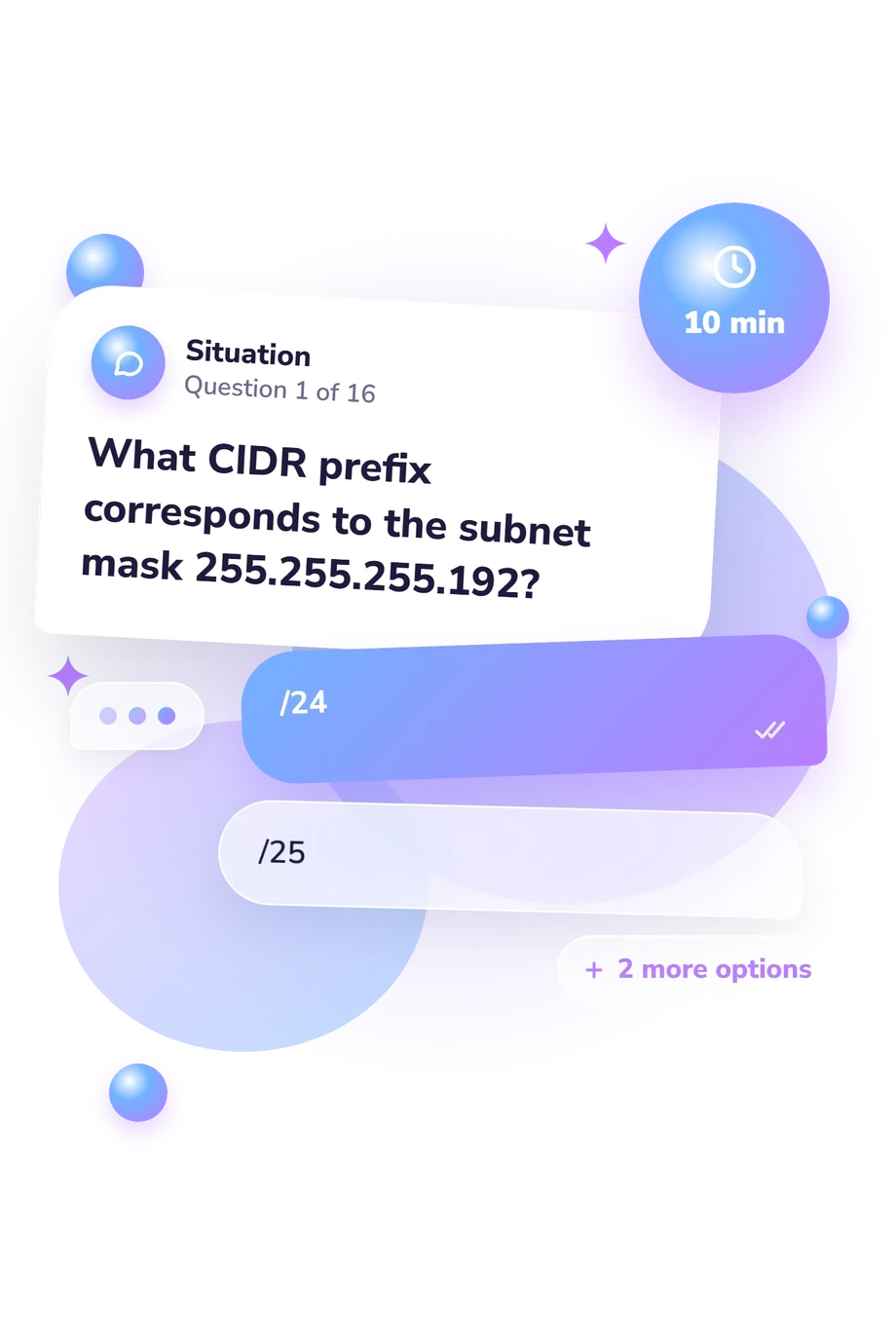
- /24
- /25
- /26
- /27
- They are adjacent and do not overlap.
- They overlap only at 10.0.0.64.
- The /25 range is entirely contained within the /26 range.
- The /26 range is entirely contained within the /25 range.
- 32
- 28
- 30
- 14
Subnetting Quiz - Description and methodology of the test
For learners building network fundamentals and practitioners refreshing IPv4 skills, the subnetting quiz offers a focused way to examine reasoning through prefixes, masks, address ranges, and host capacity. As a CIDR subnetting practice tool, this assessment can show which calculation patterns deserve more practice, while the result reflects performance on core addressing tasks rather than overall networking expertise. It is useful when you want a clear starting point for targeted revision.
What This Assessment Explores
These items test operational IPv4 subnetting rather than terminology in isolation. They ask you to translate CIDR prefixes and masks, identify network and broadcast addresses, calculate host capacity, determine block-size increments, compare ranges, and summarize adjacent networks. Learners can use the result to check foundations, while practitioners can refresh calculation patterns.
This questionnaire is a subnetting practice test that makes these areas visible, although the reported score combines them into one scale. The Subnetting Knowledge scale runs from 0-16 and uses these result bands:
- Foundations to reinforce (0-6) indicates that binary place values, CIDR notation, subnet masks, and address roles need review.
- Developing proficiency (7-12) indicates that many core operations are in place, with more practice useful for boundaries, sizing, and summaries.
- Strong proficiency (13-16) indicates consistent application of IPv4 subnetting concepts across calculations and practical scenarios.
Methodology and Evidence Base
Each question uses a multiple-choice format with four answer choices. One point is assigned for each correct answer, and the total is interpreted through the result bands stated above. The items cover prefix conversion, host capacity, subnet boundaries, aggregation, wildcard masks, and address roles, so performance reflects several common IPv4 operations.
Conceptually, the questionnaire functions as an IPv4 subnetting test and is consistent with Pummill and Manning (1995), whose tables clarify prefix length, masks, block sizes, and address counts. It also aligns with the traditional principles described by Mogul and Postel (1985) and the classless aggregation logic discussed by Fuller and Li (2006). The RFCs provide technical context; this questionnaire is conceptually consistent with their subnetting rules, with no psychometric validation.
The result is a snapshot of performance on the tested topics. No population norms, reliability estimates, or formal standardization are specified for this online version, and prior exposure or time pressure may affect performance. Reviewing missed items helps locate the concept behind an error, so use the score to guide targeted practice rather than infer broader networking competence.
- Pummill, Troy T., and Bill Manning. "Variable Length Subnet Table For IPv4." RFC 1878, Internet Engineering Task Force, December 1995. 10.17487/RFC1878.
- Mogul, Jeff, and Jon Postel. "Internet Standard Subnetting Procedure." RFC 950, Internet Engineering Task Force, August 1985. 10.17487/RFC0950.
- Fuller, Vince, and Tony Li. "Classless Inter-domain Routing (CIDR): The Internet Address Assignment and Aggregation Plan." RFC 4632, Internet Engineering Task Force, August 2006. 10.17487/RFC4632.
Updated: