
General Self-Esteem Assessment Test
How the Scales are Structured
Who Usually Takes This Test?
See How You Compare
Below is a preview of how scores are typically distributed across each scale.
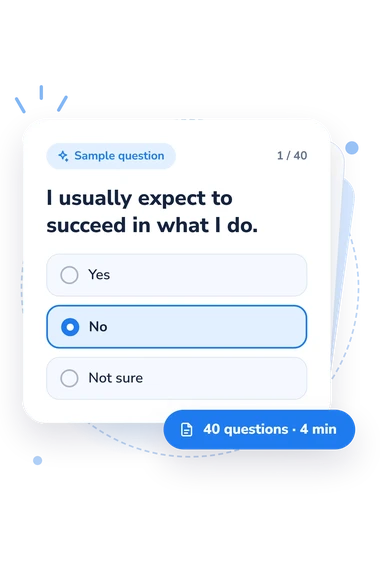
Example Questions From the Test
- Yes
- No
- Not sure
- Yes
- No
- Not sure
- Yes
- No
- Not sure
General Self-Esteem Assessment Test - Description and methodology of the test
People who want a clearer picture of how they evaluate themselves may use the General Self-Esteem Assessment Test as a structured self-reflection exercise. It focuses on confidence, self-worth, perceived competence, belonging, and reactions to achievement or difficulty. As a general self-esteem check, it can help a reader notice whether their current self-view tends to be supportive, balanced, or more self-critical.
What This Assessment Explores
The questionnaire examines how a person judges their abilities, value, social standing, and prospects. Its statements ask about expecting success, trusting one’s capabilities, feeling needed, comparing oneself with others, anticipating disapproval, and experiencing regret, fear, discouragement, or a sense of being blocked. Together, these themes describe broad self-evaluation rather than a single moment of confidence.
Readers who want to reflect on their general self-view can use this self-esteem questionnaire as a starting point for noticing patterns in confidence and self-criticism. The result shows the degree to which overall self-evaluation leans positive or critical.
The displayed Self-Esteem Scale spans -10-10 and is interpreted through three result bands:
- Low -10--4 indicates that negative or self-critical evaluations are prominent.
- Balanced -3-3 indicates a comparatively even view of personal strengths and limitations.
- High 4-10 indicates that positive self-evaluations and confidence are prominent.
Methodology and Scientific Basis
Each statement uses a three-way response format: Yes, No, or Not sure. The choices capture agreement, disagreement, and uncertainty, while the combined outcome gives a directional picture of self-regard. Since individual response values are not published, the score summarizes the overall response pattern; displayed bands show where it falls within the reported range.
Conceptually, the content aligns with the Rosenberg Self-Esteem Scale, a widely studied measure of global self-esteem. Research by Alessandri and colleagues and a cross-cultural meta-analysis by Gnambs and colleagues examine the published scale across samples; they support the construct’s relevance but do not establish norms, reliability, or factor structure for this online version.
The online format is a digital self-reflection questionnaire, not a documented standardized administration of the published scale. Interpret results in context: current mood, recent success or criticism, social comparison, memory, and honesty can influence self-report. Self-esteem test results are most useful alongside the item themes: a lower score suggests more self-critical responses, a higher score more positive self-appraisals, and a middle result greater balance in the reported self-view.
- Rosenberg, Morris. Society and the Adolescent Self-Image. Princeton, NJ: Princeton University Press, 1965.
- Alessandri, G., Vecchione, M., Eisenberg, N., and Laguna, M. On the Factor Structure of the Rosenberg (1965) General Self-Esteem Scale. Psychological Assessment, 27(2), 621-635, 2015. 10.1037/pas0000073
- Gnambs, Timo, Scharl, Anna, and Schroeders, Ulrich. The Structure of the Rosenberg Self-Esteem Scale: A Cross-Cultural Meta-Analysis. Zeitschrift für Psychologie, 226(1), 14-29, 2018. 10.1027/2151-2604/a000317