
St. Patrick's Day Quiz
How the Scales are Structured
Who Usually Takes This Test?
See How You Compare
Below is a preview of how scores are typically distributed across each scale.
Example Questions From the Test
- Peace between the traditions represented by green and orange
- Ireland's Atlantic coastline
- The robes worn by Patrick
- The winter season before March
- Welcome
- Health
- Friendship
- Good luck
- A seasonal harvest festival
- An anniversary of Irish independence
- A Christian feast commemorating Saint Patrick
- A pre-Christian winter-solstice rite
St. Patrick's Day Quiz - Description and methodology of the test
Readers preparing for a celebration, classroom activity, or conversation can use questions for a quiz on St Patrick's Day to check cultural knowledge without treating familiarity as a measure of identity or belief. The St Patrick's Day Quiz brings together Patrick's story, Christian observance, symbols, language, customs, and international traditions. A result highlights areas you recognize and subjects that may reward further exploration.
What This Test Measures
The questionnaire checks factual and cultural knowledge about St Patrick's Day, not personality or religious commitment. It covers Patrick's life, the Christian feast, symbols, language, customs, migration, and the boundary between legend and evidence. Anyone curious about Irish culture can use this trivia quiz about St Patrick's Day to test memory.
One catalogue scale, St. Patrick's Day Knowledge (0-16), summarizes performance. Emerging (0-6) means familiar features with room to explore history and Irish context; Developing (7-12) means major traditions are understood but details remain; Strong (13-16) indicates a well-rounded command of history, symbols, and cultural setting.
The main themes are:
- History and folklore distinguish Patrick's life, Christian tradition, and later legend.
- Symbols, language, and customs cover the flag, shamrock, Irish expressions, food, parades, and public celebration.
- Global reach links migration with the holiday's presence beyond Ireland.
Methodology and Evidence Base
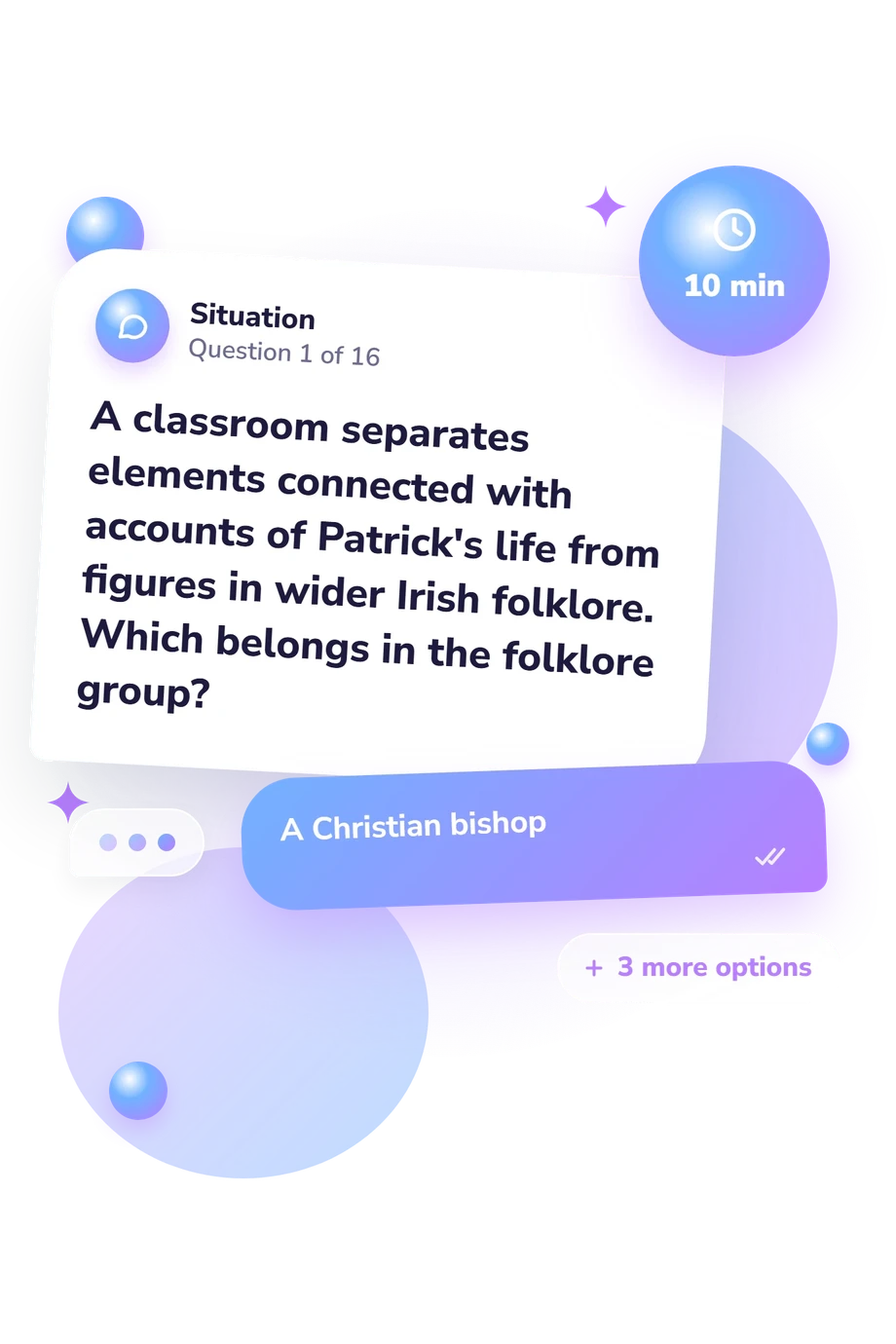
Each item presents a factual prompt with four fixed choices. Questions ask respondents to identify folklore, interpret a toast or symbol, recognize a date or place, or distinguish evidence from legend. This is a performance-based factual questionnaire, not an agreement scale or personality inventory.
The total reflects correct responses across the set and is reported on the catalogue's knowledge scale. Calling it a St Patty's Day quiz does not change its meaning: the result is a snapshot of recall and cultural understanding. The online questionnaire is non-standardized, with no published norms for ranking or clinical classification, so interpret the score descriptively.
Its content is conceptually consistent with Cronin and Adair (2002), who examine the holiday's traditions and international development. Flechner (2019) helps separate Patrick's historical record from later legend, while Bieler's edition, with Fergus Kelly's contribution, provides primary Patrician texts relevant to questions about Patrick's writings. The questionnaire is not an adaptation of these works.
Prior study, cultural familiarity, attention, and wording can affect performance, so read the result as a learning snapshot, not a complete measure of historical knowledge.
- Mike Cronin and Daryl Adair, The Wearing of the Green: A History of St Patrick's Day, Routledge, 2002.
- Roy Flechner, Saint Patrick Retold: The Legend and History of Ireland's Patron Saint, Princeton University Press, 2019, 10.2307/j.ctvc77fj4.
- Ludwig Bieler, ed., with a contribution by Fergus Kelly, The Patrician Texts in the Book of Armagh, Scriptores Latini Hiberniae 10, Dublin Institute for Advanced Studies, 1979.
Updated: