
Sports Quiz
How the Scales are Structured
Who Usually Takes This Test?
See How You Compare
Below is a preview of how scores are typically distributed across each scale.
Example Questions From the Test
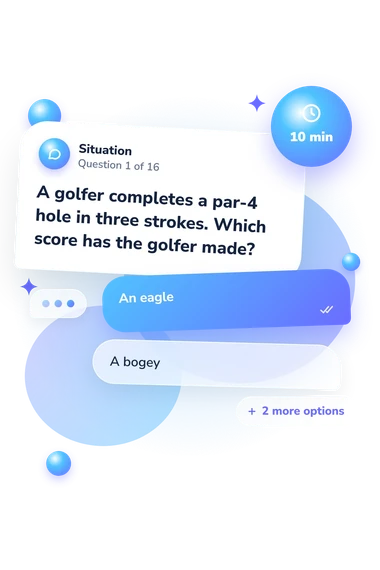
- An eagle
- A bogey
- An albatross
- A birdie
- A fault by the player who hit it
- Out
- A let requiring the rally to be replayed
- In
- A split decision
- A majority draw
- A technical knockout
- A unanimous decision
Sports Quiz - Description and methodology of the test
People who want to test how confidently they read sporting situations can use this sports quiz, whether they are spectators, learners, or active players. The result gives them a reference point for what they currently know, rather than measuring physical performance. People who enjoy a sports trivia quiz will find the four-choice format approachable while requiring precise judgments about rules, scores, and terminology.
What This Assessment Measures
This assessment measures sports knowledge rather than athletic ability. Its situations ask readers to identify rules, scores, terms, and competition conventions. It suits spectators, learners, and players comparing sports.
Its cross-sport coverage makes this a free quiz about sports, broader than a single-discipline quiz; familiarity with one sport does not determine the result. The score reflects breadth, not just recognition.
The questions group into three areas:
- Rules and scoring show whether you can identify rulings and connect points, strokes, runs, and distances with meaning.
- Terminology shows whether you recognize names for results, techniques, and achievements.
- Formats show whether you understand rotations, sequences, boundaries, and win conditions.
The catalogue reports Sports Knowledge (0-16), measuring broad knowledge of established rules, scoring systems, terms, and competition formats. Foundation (0-6) reflects core recognition; Developing (7-12), solid general knowledge with gaps; Strong (13-16), broad, accurate understanding.
Methodology and Evidence Base
Each item presents a prompt with four answer choices. The respondent selects one option and receives a result on that displayed scale. No weighting or point-allocation rule is documented, so no further scoring mechanism should be inferred.
The format suits people who enjoy quiz games about sports, testing recall and rule application across disciplines. It is an online self-reflection activity, not a standardized examination. Because the questionnaire is free to take online, it offers a convenient way to review general sports knowledge.
The method is conceptually consistent with the Soccer Common Content Knowledge Test (Lee et al., 2018), which organizes common sport knowledge through defined areas. This questionnaire is conceptually consistent with the soccer measure but is not an adaptation of it.
Tsuda et al. (2021) adds tennis knowledge evidence, while Weiss (1969) provides testing context. Neither establishes reliability, validity, or norms for this questionnaire.
Interpret the result as a snapshot of knowledge. Guessing, wording comprehension, memory, sport familiarity, and attention can affect performance, and one broad score may hide uneven strengths. Use it to identify topics to revisit.
- Lee, Han J., Ko, Bomna, Ward, Phillip, Lee, Tae-Koo, Higginson, Kelsey, He, Yaohui, and Lee, Yun-Soo. (2018). Development and Validation of a Common Content Knowledge Test for Soccer. Korean Journal of Sport Science, 29(4), 650-662. 10.24985/kjss.2018.29.4.650
- American Association for Health, Physical Education, and Recreation. (1969). Knowledge and Understanding in Physical Education. Washington, DC: American Association for Health, Physical Education, and Recreation. Chapter by Raymond A. Weiss, Standardized Tests, pp. 117-121.
- Tsuda, Emi, Ward, Phillip, Kim, Junyoung, He, Yaohui, Sazama, Debra, and Brian, Ali. (2021). The Tennis Common Content Knowledge Measure Validation. European Physical Education Review, 27(3), 654-665. 10.1177/1356336X20982629
Updated: