
Southeast Asia Quiz
How the Scales are Structured
Who Usually Takes This Test?
See How You Compare
Below is a preview of how scores are typically distributed across each scale.
Example Questions From the Test
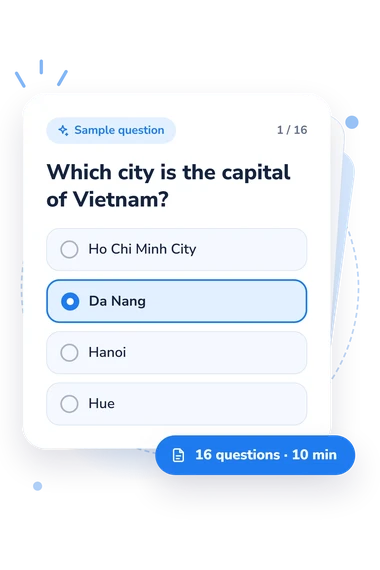
- Ho Chi Minh City
- Da Nang
- Hanoi
- Hue
- Vietnam
- The Philippines
- Thailand
- Indonesia
- Laos
- Myanmar
- Malaysia
- Cambodia
Southeast Asia Quiz - Description and methodology of the test
Readers who want to check their grasp of a region through concrete facts may turn to the Southeast Asia Quiz for a focused assessment. Its format makes it a practical Southeast Asia knowledge test for learners, travelers, teachers, and anyone revisiting the region. The questions test regional understanding, while the result places performance in a broad regional-knowledge band rather than identifying a specific topic to review.
What This Assessment Explores
Questions connect countries, capitals, borders, islands, landmarks, currencies, languages, and traditions. Short travel- or research-style scenarios put direct recall into context, giving the Southeast Asia geography questions practical relevance.
Key areas include:
- Countries and capitals show whether you identify political locations.
- Physical geography shows whether you reason from islands, coastlines, borders, and neighbors.
- Landmarks and history show whether you connect sites with places and traditions.
- Culture and civic details show whether you recognize currencies, languages, and national contexts.
Designed for general readers, it suits learners and travelers. Questions reward applied recall, not personality traits. Southeast Asia Knowledge spans 0-16: Building Foundations (0-6) reflects recognition of some regional facts; Developing Knowledge (7-12) indicates a useful grasp with room to strengthen links among places, cultures, and landmarks; Strong Knowledge (13-16) indicates broad, accurate knowledge across factual and scenario-based questions.
Methodology and Scientific Basis
Each item uses four-option multiple choice and presents one fact or short scenario. Questions cover political and physical geography, history, religion, language, and everyday regional knowledge. The scoring logic is a bounded summary: performance becomes one displayed scale rather than separate topic scores.
Geography items assess verbal knowledge of locations, borders, and islands. Descriptions of coastlines, divided islands, and landmark settings require reasoning from words, not visual map practice. The format therefore suits readers checking Southeast Asian countries and capitals in context.
Content is conceptually consistent with Rush’s 2018 regional treatment, while Gupta and Andaya and Andaya provide subject-matter context for spatial relationships, history, and culture. These books frame the facts and scenarios; they do not validate this questionnaire, supply its scoring model, or make it an adaptation of their works.
The displayed bands describe performance on this set rather than population standing, so the result is not a complete measure of regional expertise. Scores may reflect prior study, travel, media exposure, wording familiarity, or guessing.
- James R. Rush. Southeast Asia: A Very Short Introduction. Oxford University Press, 2018. 10.1093/actrade/9780190248765.001.0001.
- Avijit Gupta, editor. The Physical Geography of Southeast Asia. Oxford University Press, 2005. 10.1093/oso/9780199248025.001.0001.
- Barbara Watson Andaya and Leonard Y. Andaya. A History of Early Modern Southeast Asia, 1400-1830. Cambridge University Press, 2015. 10.1017/CBO9781139051323.
Updated: