
Solutions Quiz
How the Scales are Structured
Who Usually Takes This Test?
See How You Compare
Below is a preview of how scores are typically distributed across each scale.
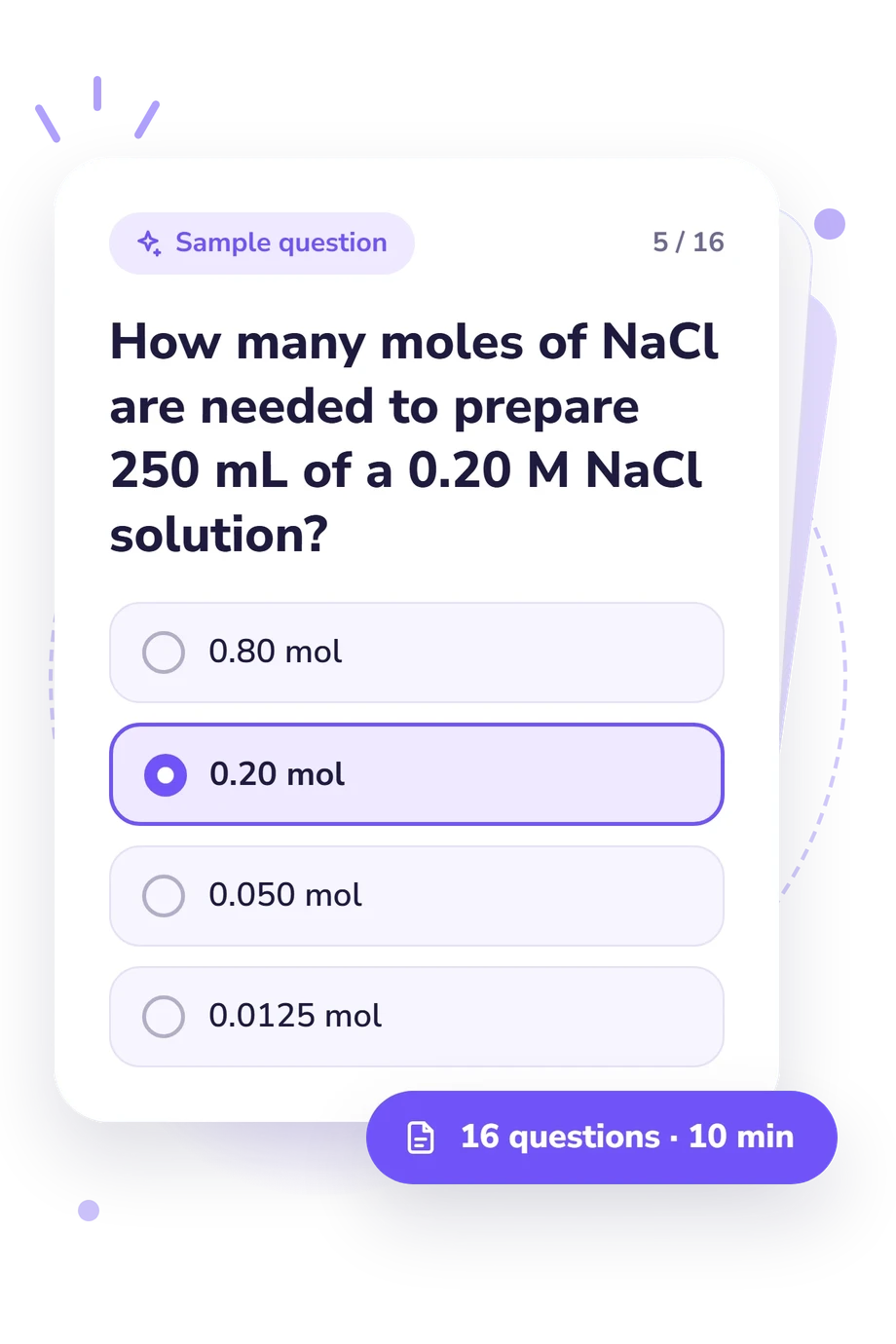
Example Questions From the Test
- 0%
- 3%
- 050%
- 19%
- 6 g/L
- 25 g/L
- 36 g/L
- 40 g/L
- 20 M
- 10 M
- 050 M
- 30 M
Solutions Quiz - Description and methodology of the test
Students reviewing general chemistry, laboratory preparation, or quantitative problem solving can use this assessment to check how accurately they apply solution composition and concentration. The solutions quiz focuses on whether familiar formulas translate into correct choices in practical scenarios. This chemistry quiz offers focused solution chemistry practice, helping you identify a topic to revisit before further calculation practice or laboratory work.
What This Assessment Explores
The questions connect solution composition with measurable concentration. They cover mass percent, grams per liter, parts per million, molarity, ion concentration, and mole calculations. Other items test dilution, evaporation, aliquots, mixing, absorbance, and volumetric glassware.
That makes it useful for introductory chemistry learners seeking solution concentration practice and checking whether formulas remain usable in laboratory-style situations. After completing the quiz, use your answers to identify whether a mistake came from units, concentration definitions, conservation of solute, or final volume.
The result is reported as Solutions Knowledge (0-16) in three bands:
- Foundations to strengthen (0-6) signals that concentration definitions, units, and solution volume need review.
- Developing knowledge (7-12) shows that central ideas are present, but calculations or dilution need practice.
- Strong knowledge (13-16) indicates a consistent command across common chemistry situations.
Methodology and Scientific Basis
Each item uses selected response: a chemistry situation or definition is followed by four choices, and the respondent selects the option that fits the conditions. The set combines conceptual recognition with short calculations, so success depends on interpreting units and relationships as well as recalling formulas.
Chemistry 2e (Flowers et al., 2019) provides the reference framework for concentration, molarity, dilution, and solution calculations. IUPAC terminology supports precise composition language, while Harris and Miller's NISTIR 7383 supports the laboratory context for volumetric equipment and measurement.
This questionnaire is conceptually consistent with those sources and is presented as a knowledge quiz. The result is a learning profile from these chemistry items; its displayed bands are intended to guide topic review, while item weighting and psychometric precision are not specified.
Performance can vary with recent study, unit familiarity, and attention during calculation. Use the outcome to choose review topics, then test understanding on new problems rather than memorizing the answers from this solution concentration quiz.
- Flowers, Paul, Klaus Theopold, Richard Langley, and William R. Robinson. Chemistry 2e. OpenStax, Houston, TX, 2019.
- International Union of Pure and Applied Chemistry. IUPAC Compendium of Chemical Terminology, 5th ed., online version 5.0.0. 2025. 10.1351/goldbook.
- Harris, Georgia L., and Val R. Miller. NISTIR 7383, Selected Procedures for Volumetric Calibrations (2019 Ed). National Institute of Standards and Technology, 2019. 10.6028/NIST.IR.7383-2019
Updated: