
Social Credit Quiz
How the Scales are Structured
Who Usually Takes This Test?
See How You Compare
Below is a preview of how scores are typically distributed across each scale.
Example Questions From the Test
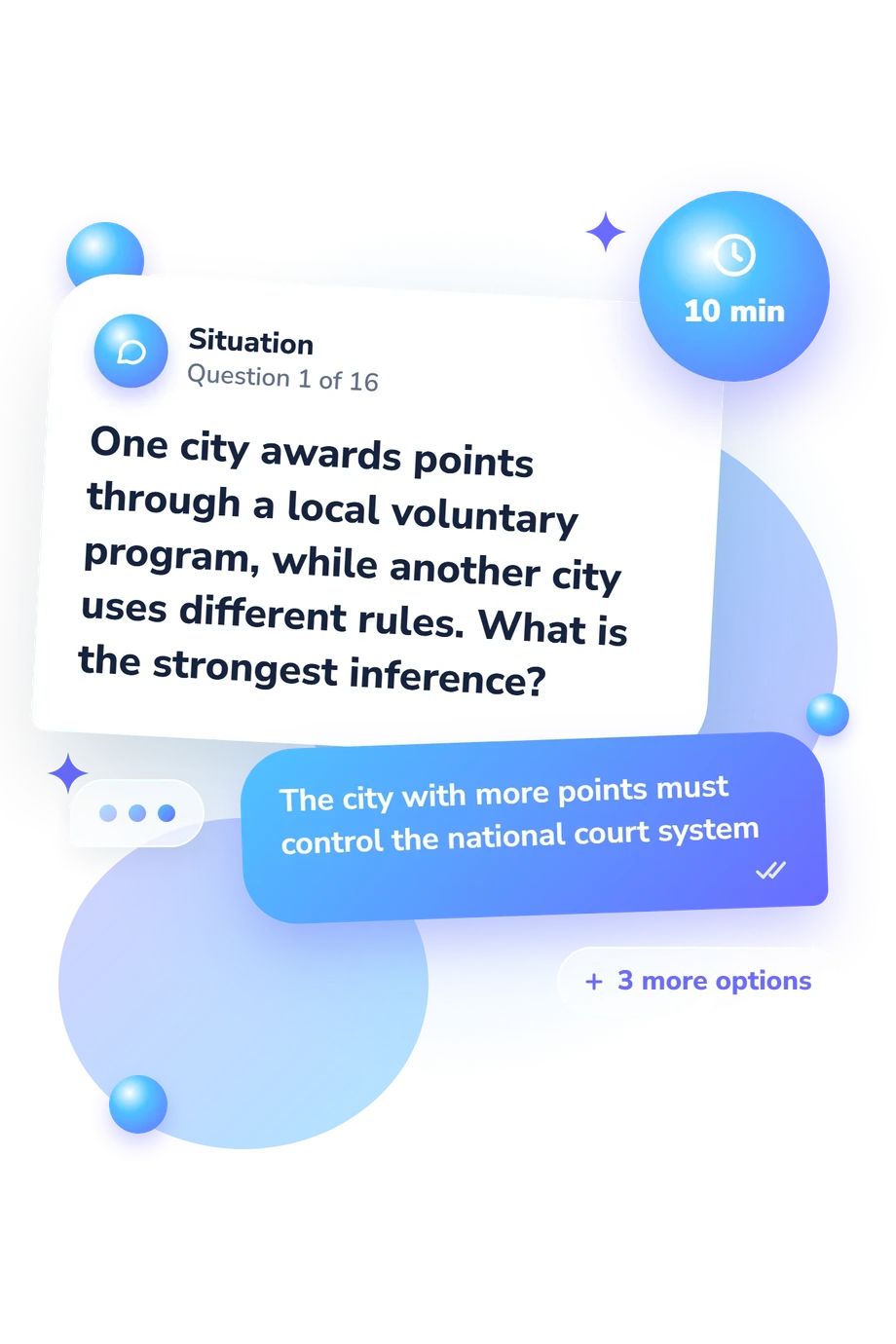
- The city with more points must control the national court system
- Both cities are secretly applying an identical nationwide citizen algorithm
- Neither program can involve any government agency
- Local pilots can differ and should not automatically be treated as universal national policy
- One nationwide algorithm that gives every resident a continuously updated behavior score
- A collection of government-led systems that record and share information about legal, regulatory, and contractual compliance
- A consumer lending score calculated solely from borrowing and repayment history
- A public-opinion rating based mainly on posts, likes, and personal relationships
- The violation could enter regulatory records and influence scrutiny or eligibility in relevant administrative processes
- Every customer of the company would inherit the violation
- Its chief executive would automatically receive the lowest possible personal score
- The company would immediately lose access to all banking services nationwide
Social Credit Quiz - Description and methodology of the test
Readers who want to test competing explanations of China’s governance systems can use this social credit quiz to examine whether a public claim fits the evidence. It suits curious non-specialists, students, and anyone trying to distinguish a broad national narrative from a narrower program or enforcement measure. As a China social-credit quiz, it rewards careful reading of claims rather than familiarity with internet slogans.
What This Assessment Explores
This questionnaire asks readers to distinguish China’s social-credit framework from local pilots, sector records, court enforcement, and private commercial products. The questionnaire tests whether a claim describes one documented mechanism, rather than treating every initiative as a universal score assigned to everyone; as a Chinese social credit test quiz, it focuses on that distinction.
These areas show the questionnaire’s checks:
- Social Credit Knowledge (0-16) summarizes records, enforcement, corporate coverage, local variation, and misconceptions; Foundation to build (0-6), Developing knowledge (7-12), and Strong knowledge (13-16) mark increasing understanding. This is educational, not an official assessment.
- National scope and local variation show whether a city’s program is mistaken for national policy.
- Compliance and enforcement show how specific duties can affect records, procedures, incentives, or restrictions.
- Corporate and private scoring distinctions clarify why business records and commercial products are not one government score.
Methodology and Evidence Base
Each item presents several answer choices and asks for the most accurate statement about a scenario or distinction. In this format, the task is recognition and interpretation rather than personal behavior. This social credit test quiz records a knowledge score and accompanying band description, not a person’s official record or legal status.
Liu (2019) describes multiple social-credit systems rather than one all-purpose national score, a distinction reflected in the questionnaire. The State Council’s 2014 planning document gives context for policy language, while Engelmann and colleagues explain why sanctions and rewards can vary across settings. Lin and Milhaupt discuss corporate compliance, another distinction represented in the questions. The questionnaire’s distinctions are conceptually consistent with these works.
The displayed bands describe performance on this test about China’s social credit and should not be interpreted as population norms or clinical cutoffs. Performance can also reflect prior reading, exposure to misleading claims, current context, and interpretation of wording.
- Liu, Chuncheng. 2019. "Multiple Social Credit Systems in China." Economic Sociology: The European Electronic Newsletter, 21(1), 22-32. 10.2139/ssrn.3423057.
- State Council of the People’s Republic of China. 2014. "Planning Outline for the Construction of a Social Credit System (2014-2020)." State Council Document No. 21, June 14, 2014.
- Engelmann, Severin, Mo Chen, Felix Fischer, Ching-yu Kao, and Jens Grossklags. 2019. "Clear Sanctions, Vague Rewards: How China’s Social Credit System Currently Defines ‘Good’ and ‘Bad’ Behavior." Proceedings of the Conference on Fairness, Accountability, and Transparency, 69-78. 10.1145/3287560.3287585.
- Lin, Lauren Yu-Hsin, and Curtis J. Milhaupt. 2023. "China’s Corporate Social Credit System: The Dawn of Surveillance State Capitalism?" The China Quarterly, 256, 835-853. 10.1017/S030574102300067X.
Updated: