
Slavery Quiz
How the Scales are Structured
Who Usually Takes This Test?
See How You Compare
Below is a preview of how scores are typically distributed across each scale.
Example Questions From the Test
- Forced labor in all territories under its control
- The legal status of slavery itself
- The slave trade, but not slavery itself
- All commercial activity connected with slavery
- The French Revolution of 1848
- The Haitian Revolution
- The American Revolution
- The Latin American Congress of Panama
- The Tenth Amendment
- The Thirteenth Amendment
- The Fourteenth Amendment
- The Fifteenth Amendment
Slavery Quiz - Description and methodology of the test
People seeking a structured way to review the history of human enslavement can use this slavery quiz to check knowledge rather than personal opinion. Readers and learners who want to review the history of slavery can use the quiz to examine definitions, events, institutions, resistance, and legacies. It offers an overall performance result and invites review of individual answers for subjects worth studying further.
What This Assessment Measures
The assessment examines how slavery operated across law, labor, trade, resistance, emancipation, and memory. Questions ask readers to distinguish slavery from slave trading, indentured servitude, and other coerced labor, then connect rules or events with systems.
Across the questionnaire, this slave quiz combines definitions, dates, historical scenarios, and source-interpretation tasks, requiring respondents to identify terms, place events in context, and assess evidence. The result gives an overall knowledge-performance band; reviewing individual answers can identify subjects for further study.
These themes describe what respondents are asked to recognize:
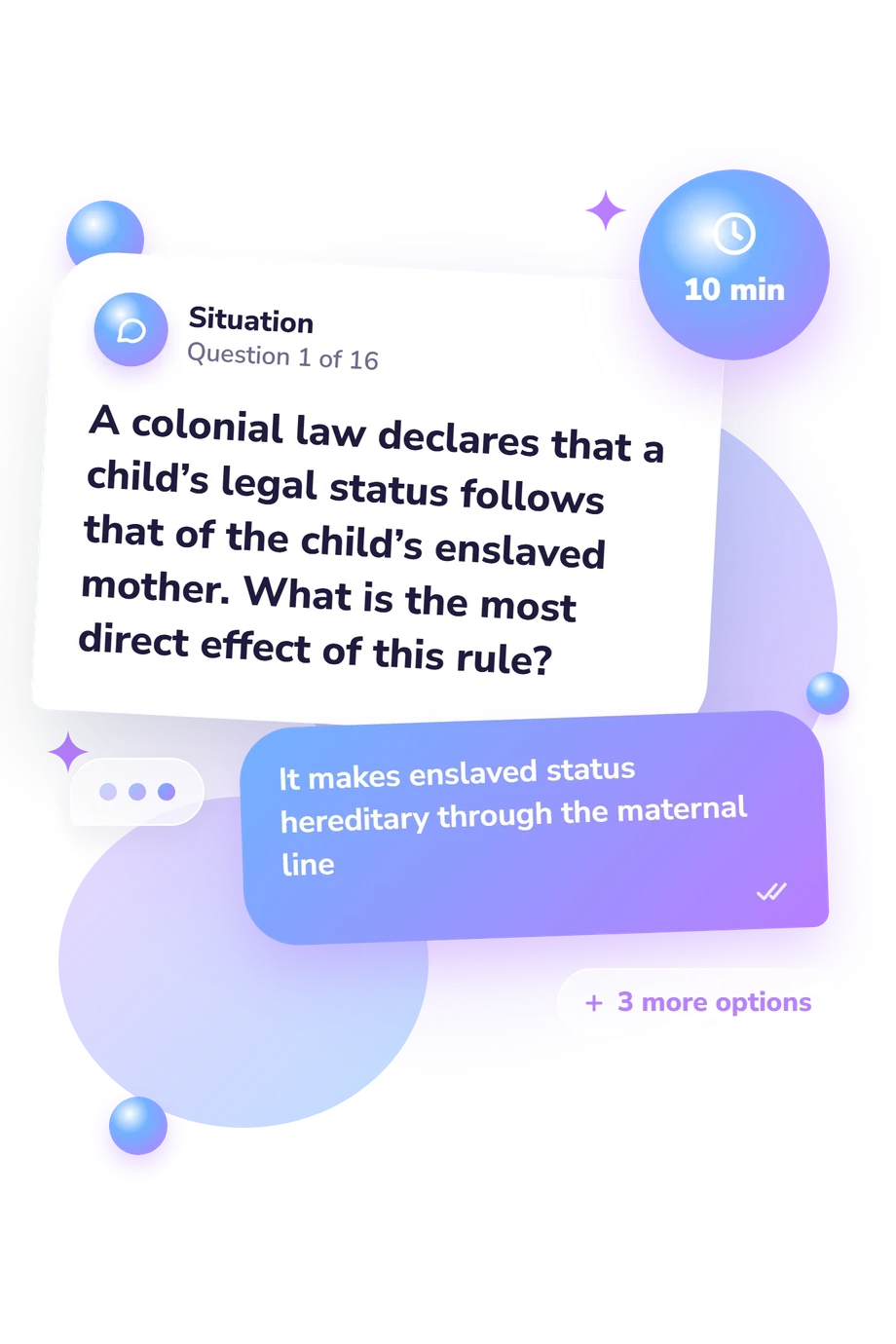
- Definitions and law explain how status, ownership, inheritance, and emancipation shaped systems of enslavement.
- Trade and labor connect forced movement, plantations, commodities, and commercial profit.
- Resistance and evidence show how actions, records, and source context affect historical interpretation.
- Legacies and memory link abolition, Juneteenth, and contemporary exploitation to the longer history.
Methodology and Evidence Base
Each item presents a question with four answer choices, and the respondent selects the best answer. The fixed-choice format tests recognition, comparison, chronology, and evidence interpretation rather than agreement or personal experience.
Scoring counts correct responses across the quiz. Slavery Knowledge, 0-16, summarizes that total: Foundations to build, 0-6; Developing knowledge, 7-12; and Strong knowledge, 13-16. The bands describe performance on these items.
The questionnaire is a fixed-choice slavery knowledge assessment, and its result summarizes performance on the included items. Historical accounts by Davis, Eltis and Richardson, and Patterson provide context for changing institutions, Atlantic forced migration and commerce, and domination and social status. The quiz content is conceptually consistent with these works, not adapted from or validated by them. The 2022 estimates from the ILO, Walk Free, and IOM support the reference to modern slavery, including forced labour, trafficking, debt bondage, and forced marriage.
Wording, item selection, and prior knowledge can influence performance, so the score reflects these questions rather than expertise across every region and period.
- Davis, David Brion. Inhuman Bondage: The Rise and Fall of Slavery in the New World. Oxford University Press, 2006. 10.1093/oso/9780195140736.001.0001
- Eltis, David, and David Richardson. Atlas of the Transatlantic Slave Trade. Yale University Press, 2010.
- Patterson, Orlando. Slavery and Social Death: A Comparative Study. Harvard University Press, 1982.
- International Labour Organization, Walk Free, and International Organization for Migration. Global Estimates of Modern Slavery: Forced Labour and Forced Marriage. Geneva: International Labour Organization, 2022. 10.54394/CHUI5986
Updated: