
Simp Quiz
How the Scales are Structured
Who Usually Takes This Test?
See How You Compare
Below is a preview of how scores are typically distributed across each scale.
Example Questions From the Test
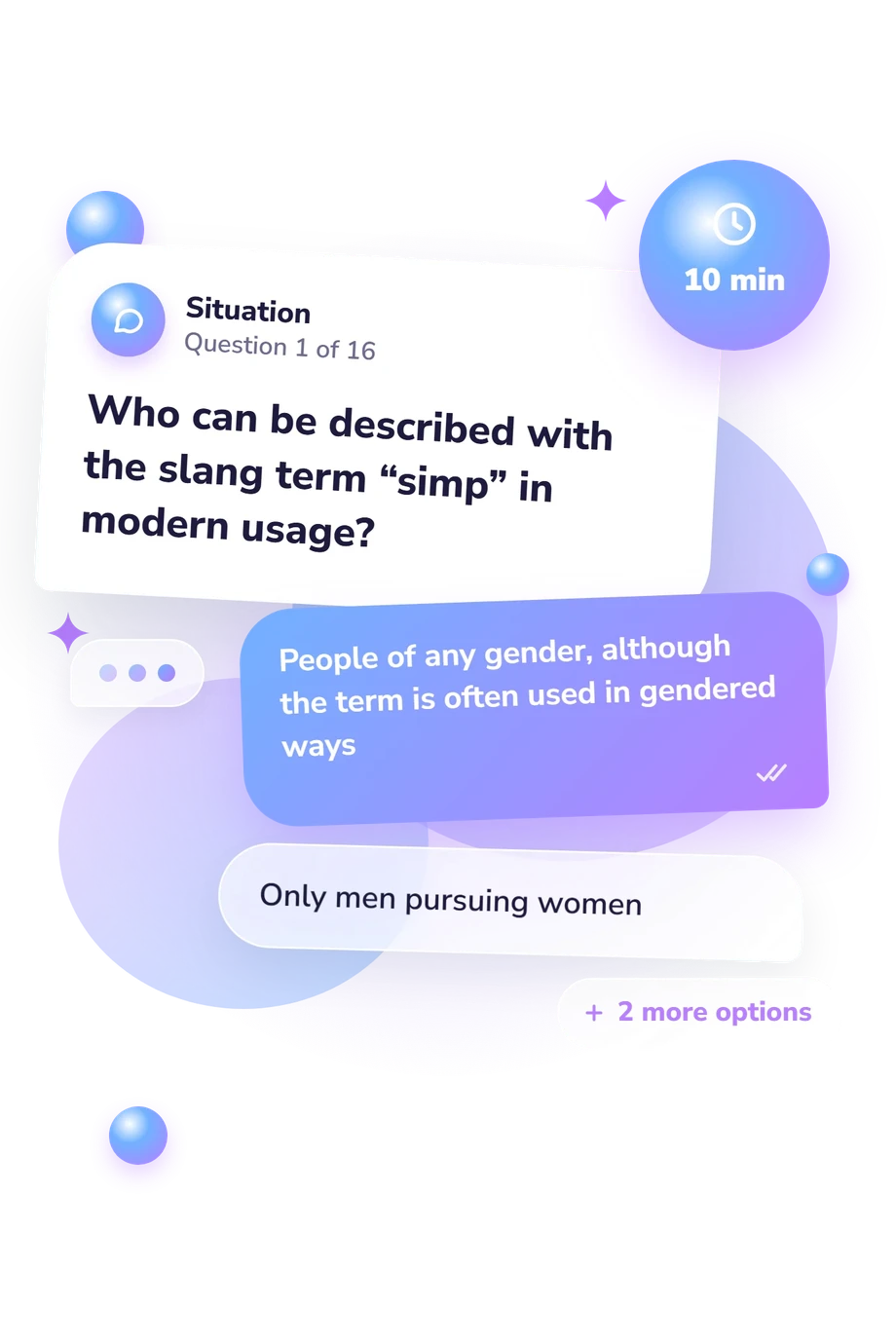
- People of any gender, although the term is often used in gendered ways
- Only men pursuing women
- Only paying followers of online creators
- Only people who have never been in a relationship
- The person uses a nickname and prefers sending text messages
- The person lives far away and has different hobbies
- The person repeatedly requests urgent money while avoiding verifiable live contact
- The person replies slowly during work hours
- Buying a partner a birthday present that fits within a planned budget
- Helping a friend once when they are having a difficult week
- Paying for dinner after mutually agreeing to treat the other person
- Repeatedly sending money one cannot afford in the hope that it will secure romantic attention
Simp Quiz - Description and methodology of the test
People who want to think more clearly about internet labels and their social meaning may use this simp quiz as an educational exercise. This online slang quiz helps readers decide whether they understand a label’s context before applying it to themselves or someone else. The result offers a starting point for interpreting affection, generosity, and boundaries without treating a slang term as a fixed judgment.
What This Assessment Explores
The questionnaire asks readers to separate ordinary care from attention, money, praise, or rescuing that becomes one-sided or costly. It treats simp as context-dependent internet slang, not a fixed personality type, so the result concerns understanding rather than a judgment about character or relationships. It is an educational quiz about relationship boundaries: items ask readers to recognize voluntary, affordable care and openness to refusal.
These themes test one overall understanding, not separate traits:
- Slang context shows how tone and shared norms change the label’s meaning.
- Reciprocity shows how care and effort can move both ways without a rigid tally.
- Boundaries show that accepting no, keeping limits, and avoiding pressure matter to the concept.
- Parasocial examples show how paid contact can be mistaken for private intimacy.
Simp Knowledge ranges from 0-16: Foundations to build (0-6), Developing context (7-12), and Strong understanding (13-16).
Methodology and Scientific Basis
Each item presents a question with four answer choices. The major question types cover definitions, scenarios, slang history, and relationship concepts, including reciprocity, rejection, financial pressure, parasocial contact, and overinvestment. The responses produce one displayed educational total; the examples are not presented as separate trait scores.
Its closest conceptual comparison is Simping Scale (Ho et al., 2026), which addresses excessive and obsessive romantic behavior. This questionnaire is conceptually consistent with that work, but it is not identified here as that published instrument. Dalzell and Victor (2015) support the slang context, while Horton and Wohl’s framework, clarified by Dibble, Hartmann, and Rosaen (2016), distinguishes mediated familiarity from mutual intimacy.
As an educational self-reflection quiz, it asks readers to recognize distinctions rather than treating the label as a fixed verdict. Interpret the result by considering whether effort is reciprocal, whether a clear no is accepted, and whether spending or rescuing is used to obtain affection. Performance may reflect prior familiarity with the slang, interpretation of ambiguity, or guessing; choosing one of four answers also simplifies conceptual understanding rather than proving motive or relationship quality.
- Ho, Daniel, Kenneth Tan, Norman P. Li, and Lester Sim. (2026). The (Simp)le Truth About Excessive and Obsessive Romantic Behaviors in Men. Journal of Personality. Online ahead of print. 10.1111/jopy.70082
- Dalzell, Tom, and Terry Victor, eds. (2015). The New Partridge Dictionary of Slang and Unconventional English (2nd ed.). Routledge.
- Horton, Donald, and R. Richard Wohl. (1956). Mass Communication and Para-Social Interaction: Observations on Intimacy at a Distance. Psychiatry, 19(3), 215-229. 10.1080/00332747.1956.11023049
- Dibble, Jayson L., Tilo Hartmann, and Sarah F. Rosaen. (2016). Parasocial Interaction and Parasocial Relationship: Conceptual Clarification and a Critical Assessment of Measures. Human Communication Research, 42(1), 21-44. 10.1111/hcre.12063
Updated: