
Should I Marry Him Quiz
How the Scales are Structured
Who Usually Takes This Test?
See How You Compare
Below is a preview of how scores are typically distributed across each scale.
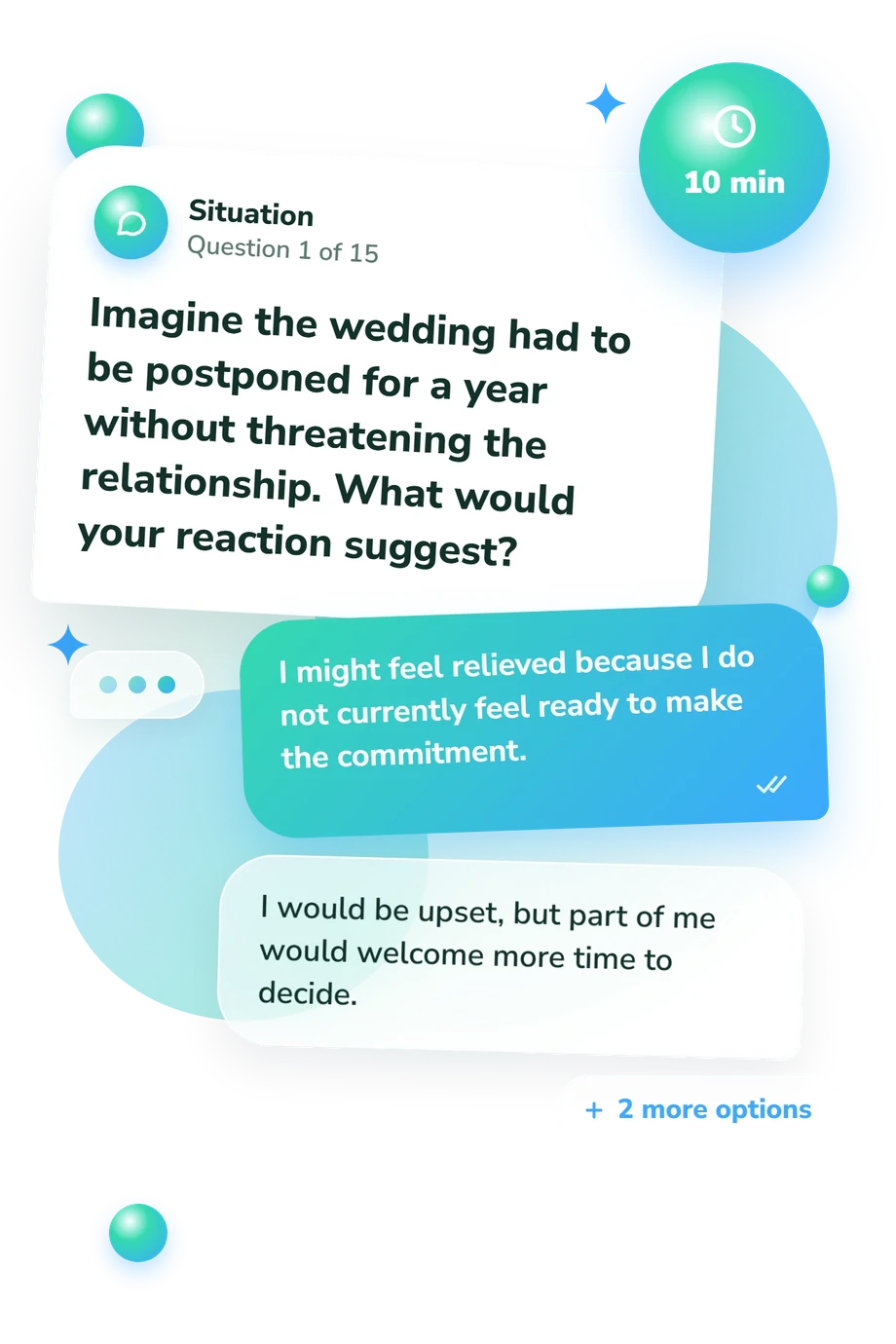
Example Questions From the Test
- I might feel relieved because I do not currently feel ready to make the commitment.
- I would be upset, but part of me would welcome more time to decide.
- I would be disappointed while also seeing value in using the time to prepare.
- I would still feel confident in the commitment, even though I would dislike the delay.
- I push them aside because considering them feels too threatening to the relationship or plans.
- I revisit them privately but struggle to identify what they are telling me.
- I examine them and discuss at least some of them, though a few remain unsettled.
- I can explore them honestly, seek perspective when useful, and allow them to inform my decision.
- Our location or career priorities conflict in a way we have not found a workable path through.
- We know it could become an issue but have avoided exploring what each person might sacrifice.
- We have discussed our priorities and could negotiate, although the answer would depend on circumstances.
- We understand each other’s priorities and have a shared method for weighing careers, place, and sacrifice.
Should I Marry Him Quiz - Description and methodology of the test
People considering marriage can use the Should I Marry Him Quiz to slow down a consequential decision and examine it from several angles. Rather than offering a snap answer, this should we get married quiz turns a consequential decision into structured reflection, helping separate personal uncertainty from affection and outside pressure. The intended reader is someone who wants discussion points rather than a verdict when deciding whether commitment feels right.
What This Assessment Explores
Readiness means more than wedding excitement. The items examine whether commitment feels freely chosen, doubts can be explored, and unresolved concerns are addressed. They also consider openness, influence, repair, and practical conversations about shared life. This marriage readiness assessment shows clear areas and open questions.
Three result dimensions organize those themes:
- Free and Personal Readiness (0-15) reflects whether marriage feels freely chosen, meaningful, and realistic; Pause & clarify (0-5), Still discerning (6-10), and Grounded readiness (11-15) mark the bands.
- Partnership Foundation (0-15) reflects trust, mutual influence, openness, and repair; Needs attention (0-5), Mixed foundation (6-10), and Strong foundation (11-15) show relationship support.
- Shared Future Alignment (0-15) reflects how clearly long-term choices have been explored without favoring a lifestyle; Major unknowns (0-5), Partial alignment (6-10), and Clear alignment (11-15) show clarity.
They identify topics for discussion, not a decision made for you.
Methodology and Scientific Basis
Each item presents a relationship situation with four ordered response options. They move from avoidance, pressure, or uncertainty toward discussion, shared influence, repair, and realistic planning. The format captures patterns across decisions and interactions rather than a yes-or-no impression. The situations cover doubts, conflict, emotional support, shared decisions, money, roles, children, careers, and future plans.
As an online self-report questionnaire, it supports premarital self-reflection while examining personal readiness, relationship processes, and future alignment; its focus is conceptually consistent with Lavner, Karney, and Bradbury (2012), whose study connected premarital uncertainty with later marital outcomes. Its themes also align with PREPARE, examined by Fowers and Olson (1986, 1992), especially communication, conflict, finances, roles, and expectations. This questionnaire is not a direct administration of that instrument.
The result presents three profile dimensions and interprets them through the displayed bands; higher results generally indicate more readiness, stronger relational processes, or clearer alignment within a dimension, not a prediction about the future or a partner’s intentions.
Self-report makes the result sensitive to current circumstances, self-awareness, and willingness to answer honestly. Fear, coercion, threats, or physical harm require attention regardless of any score.
- Lavner, J. A., Karney, B. R., and Bradbury, T. N. (2012). Do Cold Feet Warn of Trouble Ahead? Premarital Uncertainty and Four-Year Marital Outcomes. Journal of Family Psychology, 26(6), 1012-1017. 10.1037/a0029912
- Fowers, B. J., and Olson, D. H. (1986). Predicting Marital Success with PREPARE: A Predictive Validity Study. Journal of Marital and Family Therapy, 12(4), 403-413. 10.1111/j.1752-0606.1986.tb00673.x
- Fowers, B. J., and Olson, D. H. (1992). Four Types of Premarital Couples: An Empirical Typology Based on PREPARE. Journal of Family Psychology, 6(1), 10-21. 10.1037/0893-3200.6.1.10
Updated: