
Should I Get an Abortion Quiz
How the Scales are Structured
Who Usually Takes This Test?
See How You Compare
Below is a preview of how scores are typically distributed across each scale.
Example Questions From the Test
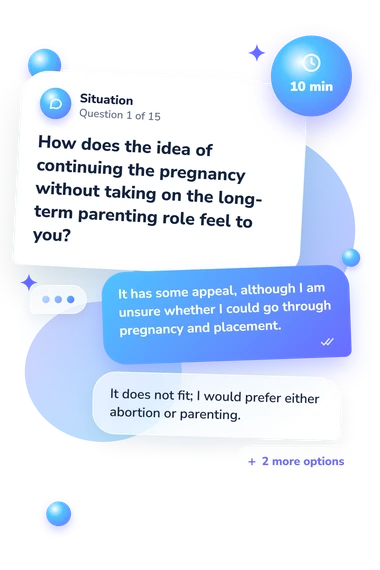
- It has some appeal, although I am unsure whether I could go through pregnancy and placement.
- It does not fit; I would prefer either abortion or parenting.
- It fits my wish to continue the pregnancy while having another family parent the child.
- I would consider it, but it currently feels less aligned than another option.
- It conflicts with values that are central to the choice I would make.
- It could fit my values, but another option presently feels somewhat closer.
- It fits my values clearly enough that I would seriously prefer it.
- Some of my values support it while others pull me toward continuing the pregnancy.
- The picture feels meaningful and closely connected to the future I want.
- I can see some rewarding elements, but the overall future does not feel like my preferred one.
- The picture does not fit how I want my life to develop.
- The picture has genuine appeal alongside serious concerns about what it would require.
Should I Get an Abortion Quiz - Description and methodology of the test
People considering options during an uncertain or complex pregnancy can use the Should I Get an Abortion Quiz to organise competing feelings about abortion, adoption, and parenting. This abortion quiz is intended for personal reflection when values, relationships, practical support, and imagined futures all matter. It shows which option currently feels most aligned, where ambivalence remains, and what may deserve fuller discussion.
What This Assessment Explores
Rather than asking only whether abortion feels acceptable, the assessment compares abortion, adoption, and parenting. Questions address personal values, imagined futures, support, emotional responses, responsibilities, adoption arrangements, and practical demands. This should-I-have-an-abortion quiz clarifies preference and ambivalence without treating uncertainty as inconsistency.
The result groups that reflection into three dimensions:
- Abortion Alignment (0-15) shows how closely ending the pregnancy fits current wishes: Limited alignment (0-5), Mixed alignment (6-10), or Strong alignment (11-15).
- Adoption Alignment (0-15) shows how closely pregnancy and placement fit current values: Limited alignment (0-5), Mixed alignment (6-10), or Strong alignment (11-15).
- Parenting Alignment (0-15) shows how closely continuing the pregnancy and raising the child fit current wishes: Limited alignment (0-5), Mixed alignment (6-10), or Strong alignment (11-15).
Methodology and Evidence Base
Each item is a self-report prompt with four response choices. The options describe a value, imagined situation, practical constraint, or likely emotional response, so respondents select the statement that fits best rather than answer factual knowledge questions. Responses are combined into three alignment scores; scores within one point are read as a blended result, preserving competing preferences instead of forcing one winner.
That structure makes the questionnaire a pregnancy decision quiz shaped around preference, ambivalence, support, relationships, and certainty. Sisson et al. (2017) is the closest subject match because it examined how women seeking abortion considered adoption. Fuentes et al. (2023), Klann and Wong (2020), and Rowland et al. (2021) add evidence on adoption views, psychological and relational influences, and certainty or intention. The questionnaire is conceptually consistent with these studies, not an adaptation or validated reproduction of any cited instrument.
The scores are unvalidated reflective summaries, not recommendations or medical or legal cutoffs. Self-report can shift with current circumstances, self-awareness, emotional state, or coercion, so interpret the pattern alongside independent information about medical care, adoption law, and practical support.
- Sisson, Gretchen, Lauren Ralph, Heather Gould, and Diana Greene Foster. Adoption Decision Making among Women Seeking Abortion. Women's Health Issues 27, no. 2 (2017): 136-144. 10.1016/j.whi.2016.11.007
- Fuentes, Liza, Megan L. Kavanaugh, Lori F. Frohwirth, Jenna Jerman, and Nakeisha Blades. Adoption is just not for me: How abortion patients in Michigan and New Mexico factor adoption into their pregnancy outcome decisions. Contraception: X 5 (2023): 100090. 10.1016/j.conx.2023.100090
- Klann, Elyssa M., and Y. Joel Wong. A Pregnancy Decision-Making Model: Psychological, Relational, and Cultural Factors Affecting Unintended Pregnancy. Psychology of Women Quarterly 44, no. 2 (2020): 170-186. 10.1177/0361684320904321
- Rowland, Brenly B., Corinne H. Rocca, and Lauren J. Ralph. Certainty and Intention in Pregnancy Decision-Making: An Exploratory Study. Contraception 103, no. 2 (2021): 80-85. 10.1016/j.contraception.2020.11.003