
Science Quiz
How the Scales are Structured
Who Usually Takes This Test?
See How You Compare
Below is a preview of how scores are typically distributed across each scale.
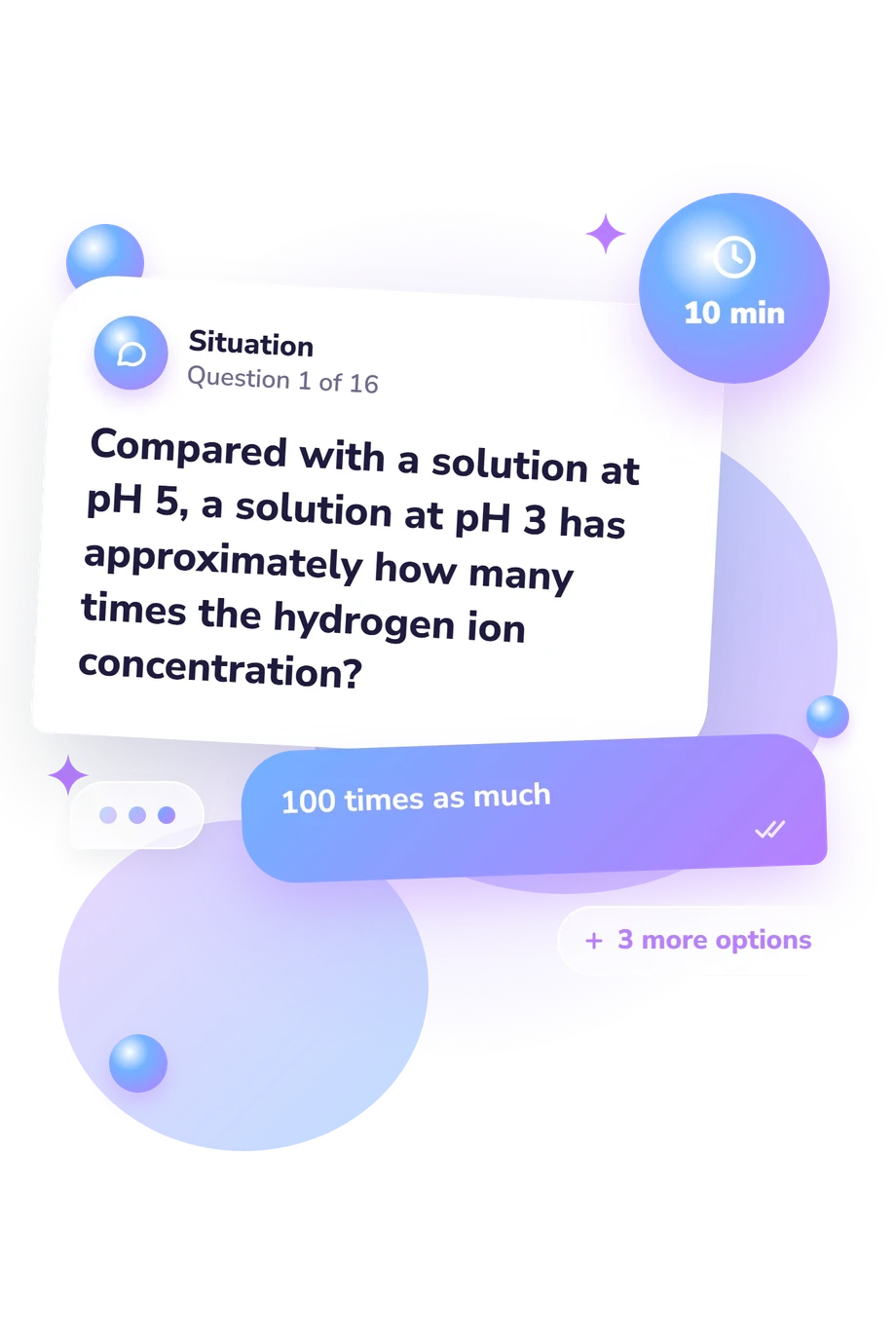
Example Questions From the Test
- 100 times as much
- Two times as much
- One-fifth as much
- One hundredth as much
- Reflection of heat inside the metal
- Convection through the solid spoon
- Evaporation from the spoon's handle
- Conduction through the metal
- Oxygen
- Carbon dioxide
- Nitrogen
- Hydrogen
Science Quiz - Description and methodology of the test
Designed for readers who want a quick check of broad scientific understanding, this science quiz samples the reasoning used in everyday explanations of natural phenomena. An online quiz about science keeps the format accessible while asking you to apply concepts rather than recognize isolated terms. The result can help students, curious adults, and lifelong learners see which areas feel secure and which merit focused review.
What This Assessment Measures
The questions span biology, chemistry, physics, Earth science, and space. They use short situations involving pH, plant growth, cells, heat, circuits, force, density, rocks, seasons, antibiotics, and lunar phases. The emphasis is on recognizing relationships and applying familiar principles, so the result describes broad conceptual knowledge rather than specialist expertise.
The main thematic groups represented here are:
- Biology shows how cells, membranes, photosynthesis, and natural selection explain living functions.
- Chemistry examines pH, atoms, elements, and antibiotic action as ideas about matter.
- Physics connects heat, circuits, force, acceleration, and density with observable events.
- Earth and space science interprets rocks, plate boundaries, seasons, light-years, and lunar phases.
Taken as a trivia quiz on science, these items reward understanding more than specialist detail. The profile is a snapshot across several domains, not a measure of every scientific ability.
Methodology and Evidence Base
Each item presents a question with four choices; the respondent selects the best answer. People who enjoy science-themed quiz games may find these short scenarios approachable. The format checks factual knowledge and application through brief scenarios rather than opinions or open-ended explanations. Science Knowledge runs from 0-16, with one point for each correct answer. Results fall into Foundations to Build (0-6), Developing Knowledge (7-12), or Strong Knowledge (13-16).
Conceptually, the set is closest to the Oxford Scientific Knowledge Scale (Durant et al., 1989), which connects public scientific understanding with engagement. This comparison is conceptual, not a claim that the questionnaire reproduces or adapts that instrument. Miller’s 1998 work on civic scientific literacy offers a related framework in which factual knowledge is one part of informed participation.
Those sources support the questionnaire’s direction but establish no population norms for this online version. The result is descriptive, not a validated credential or comprehensive measure of scientific literacy. For someone approaching a quiz on basic science, the categories can guide review. Guessing, prior exposure, wording, and attention may affect performance.
- Durant, J. R., Evans, G. A., & Thomas, G. P. (1989). The public understanding of science. Nature, 340(6228), 11-14. 10.1038/340011a0
- Miller, J. D. (1998). The measurement of civic scientific literacy. Public Understanding of Science, 7(3), 203-223. 10.1088/0963-6625/7/3/001
Updated: