
Scaffold Safety Quiz
How the Scales are Structured
Who Usually Takes This Test?
See How You Compare
Below is a preview of how scores are typically distributed across each scale.
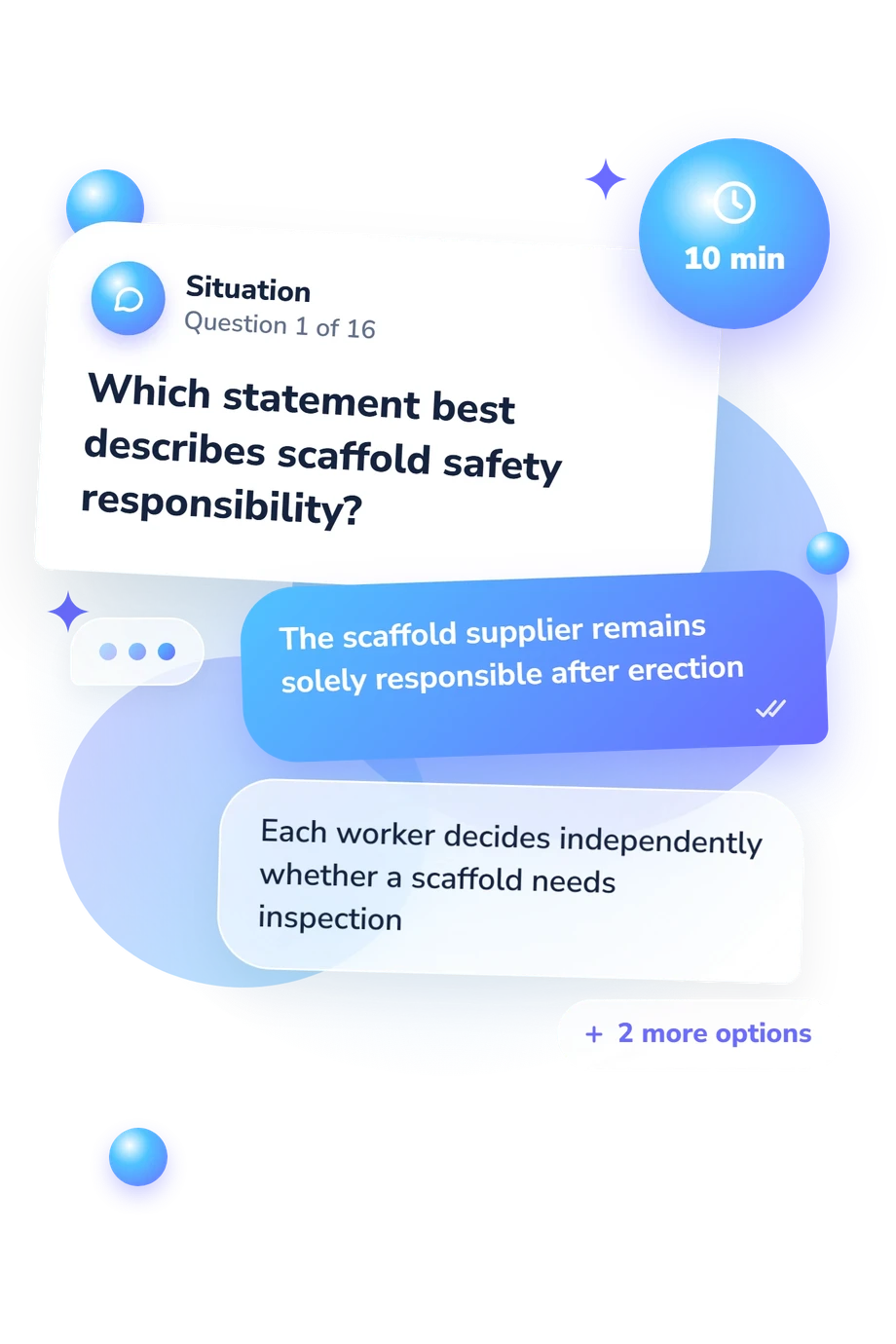
Example Questions From the Test
- The scaffold supplier remains solely responsible after erection
- Each worker decides independently whether a scaffold needs inspection
- Responsibility belongs only to the person who signs the scaffold tag
- The employer or controlling organization must provide required systems and oversight, designated competent people perform assigned inspections, and all users should follow controls and report hazards
- Keep it out of service until the required post-event inspection confirms it can be used
- Let the most experienced trade worker test the platform by walking on it
- Resume work because no damage is immediately visible
- Tighten only the connections that workers can reach from the ground
- To help prevent people from falling from open sides and ends
- To display the scaffold's maximum intended load
- To level the scaffold on uneven ground
- To stop all tools and materials from falling below
Scaffold Safety Quiz - Description and methodology of the test
Workers, supervisors, and learners who need a practical check of scaffold precautions can use this scaffold quiz to examine how they would respond to common site conditions. It focuses on judgment before and during scaffold use rather than isolated terminology. A scaffolding safety quiz of this kind can reveal topics to revisit in training or with competent-person guidance.
What This Assessment Explores
This assessment checks practical knowledge of responsibility, inspection, foundations, access, fall protection, electrical clearance, loading, and hazard response. The situations ask the reader to choose a safe action when conditions change, not merely recognize technical vocabulary.
Scaffold Safety Knowledge: 0-16 summarizes these judgments. Foundations to strengthen (0-6) means core controls need review; Developing knowledge (7-12) shows principles in progress; Strong knowledge (13-16) indicates broad understanding of general scaffold safety principles. The score from this scaffold knowledge quiz is an educational profile for targeted review.
The result covers three practical areas:
- Responsibilities and inspections show whether you recognize oversight duties, required checks, and the need to stop after damaging events.
- Stability and access indicate whether you can identify sound foundations, locked casters, approved entry, and unsafe platform changes.
- Protection, loading, and response reflect whether you recognize fall, electrical, falling-object, and overloading controls and report hazards promptly.
Methodology and Scientific Basis
Each item presents a short workplace situation or responsibility question with four answer choices. The best option follows the control expected in the described circumstance, while distractors model shortcuts such as relying on appearance, improvising access, removing braces, or continuing after damage. Answers are combined into the displayed knowledge result; no separate item-weighting or scoring formula is stated.
Liang et al. (2019) provides the closest research connection. Its competency-model perspective links scaffold-worker safety performance with relevant competencies and their interactions. This questionnaire is conceptually consistent with that focus, but it is not presented as an adaptation or validation of that study. OSHA's construction scaffold requirements supply operational reference points for inspection, foundations, access, loading, fall protection, electrical hazards, and falling objects.
As a scaffold safety assessment, it is an unvalidated educational score, not a certification. It has no stated population norms, reliability estimate, validity study, or equivalence to competent-person qualification. Results can be affected by training recency, attention, self-awareness, and interpretation of a scenario, and a strong result cannot verify that a particular scaffold is safe. Apply the result with local rules, the site plan, manufacturer instructions, and competent-person direction.
- Liang, Kongzheng, Ivan Wing Hong Fung, Chaohua Xiong, and Hanbin Luo. "Understanding the Factors and the Corresponding Interactions That Influence Construction Worker Safety Performance from a Competency-Model-Based Perspective: Evidence from Scaffolders in China." International Journal of Environmental Research and Public Health 16, no. 11 (2019): 1885. 10.3390/ijerph16111885
- Occupational Safety and Health Administration. "Safety and Health Regulations for Construction: 29 C.F.R. Part 1926, Subpart L-Scaffolds, §§ 1926.450-1926.454." U.S. Department of Labor, 1996, as amended.
Updated: