
Romeo and Juliet Quote Quiz
How the Scales are Structured
Who Usually Takes This Test?
See How You Compare
Below is a preview of how scores are typically distributed across each scale.
Example Questions From the Test
- She attended the family feast without permission
- She asks the Nurse to help Romeo escape Verona
- She admits that she secretly met Romeo in the garden
- She refuses the proposed marriage to Paris
- He discovers Juliet is a Capulet at the feast
- He learns that Rosaline has rejected him
- He kills Tybalt and realizes the likely consequences
- He is challenged by Paris at the tomb
- Why Romeo must belong to the Montague family
- Where Romeo is physically hiding
- Why Romeo entered the Capulet garden
- Whether Romeo truly heard her speak
Romeo and Juliet Quote Quiz - Description and methodology of the test
Readers who want to check their grasp of Shakespeare’s tragedy can use the Romeo and Juliet Quote Quiz to connect memorable lines with the characters, scenes, and ideas that give them meaning. It suits students, independent readers, and anyone returning to the play. As a Shakespeare quote quiz, it turns recall into a focused way to see which parts of the text deserve another look.
What the Test Measures
The questions test whether you can identify who speaks a line, locate it in the plot, and explain why its wording matters. They move beyond famous excerpts into family conflict, secrecy, haste, fate, shared responsibility, metaphor, oxymoron, and dark wordplay.
As a Romeo and Juliet quotations quiz, it is intended for readers who want to connect quotation knowledge with interpretation. The result reflects how securely you recognize speakers, situations, and the dramatic work a line performs.
The questions cover these thematic groups:
- Speaker and character recognition shows whether you can assign a line to the right figure.
- Scene and event context measures whether you can connect it with the surrounding plot.
- Figurative language and wordplay show whether you can interpret metaphor, oxymoron, pun, and double meaning.
- Dramatic meaning and consequences indicate how well you grasp desire, conflict, impulsiveness, grief, and shared loss.
Methodology and Evidence Base
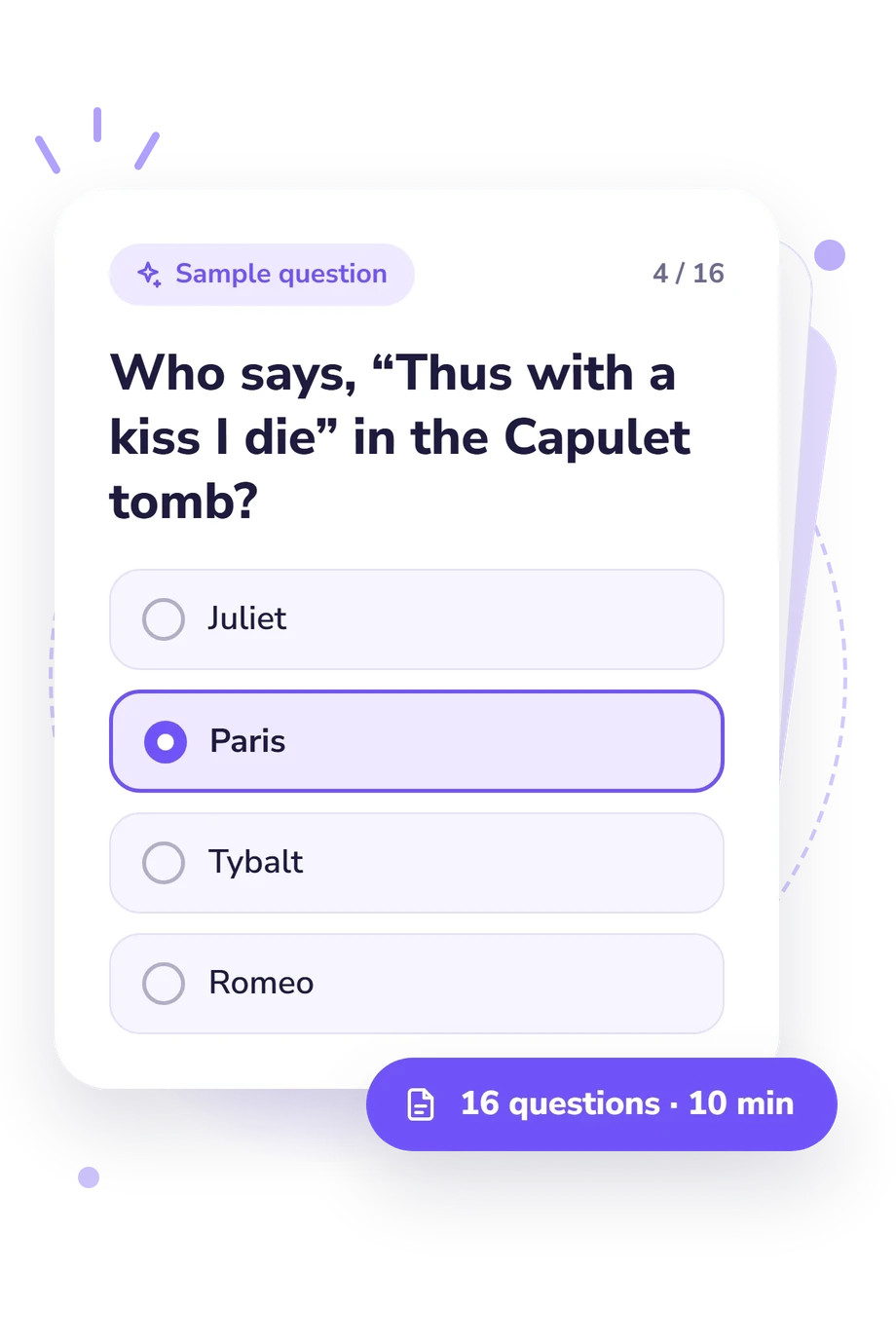
Each item presents a quotation or a question about one and offers four answer choices. The alternatives distinguish nearby possibilities, so success depends on linking language with speaker, scene, and dramatic situation rather than recognizing a line in isolation. By asking readers to connect language with speaker, scene, and dramatic situation, this Romeo and Juliet quote identification quiz rewards precise reading and contextual recall.
The result summarizes performance on the displayed Romeo and Juliet Quote Knowledge scale, scored from 0-16. The bands are Opening the Text (0-6), Developing Quote Knowledge (7-12), and Command of the Lines (13-16). Together, they describe a progression from recognizing some familiar language to understanding major quotations and then confidently connecting speakers, placement, and dramatic contribution.
The method is text-based rather than psychometric. Romeo and Juliet (Shakespeare) supplies the primary literary source, while James N. Loehlin’s editorial work supports wording, context, and interpretation. The questionnaire is conceptually consistent with the play, but it is not a standardized or normed literary instrument. Results can vary with prior study, the edition a reader knows, memory, and interpretive judgment, so the score is best used to guide rereading rather than define overall literary ability.
- Shakespeare, William. Romeo and Juliet. Edited by Barbara A. Mowat and Paul Werstine. New York: Washington Square Press, 2004.
- Shakespeare, William. Romeo and Juliet. Edited by James N. Loehlin. Cambridge: Cambridge University Press, 2002. 10.1017/9781316564011.
Updated: