
R&B Quiz
How the Scales are Structured
Who Usually Takes This Test?
See How You Compare
Below is a preview of how scores are typically distributed across each scale.
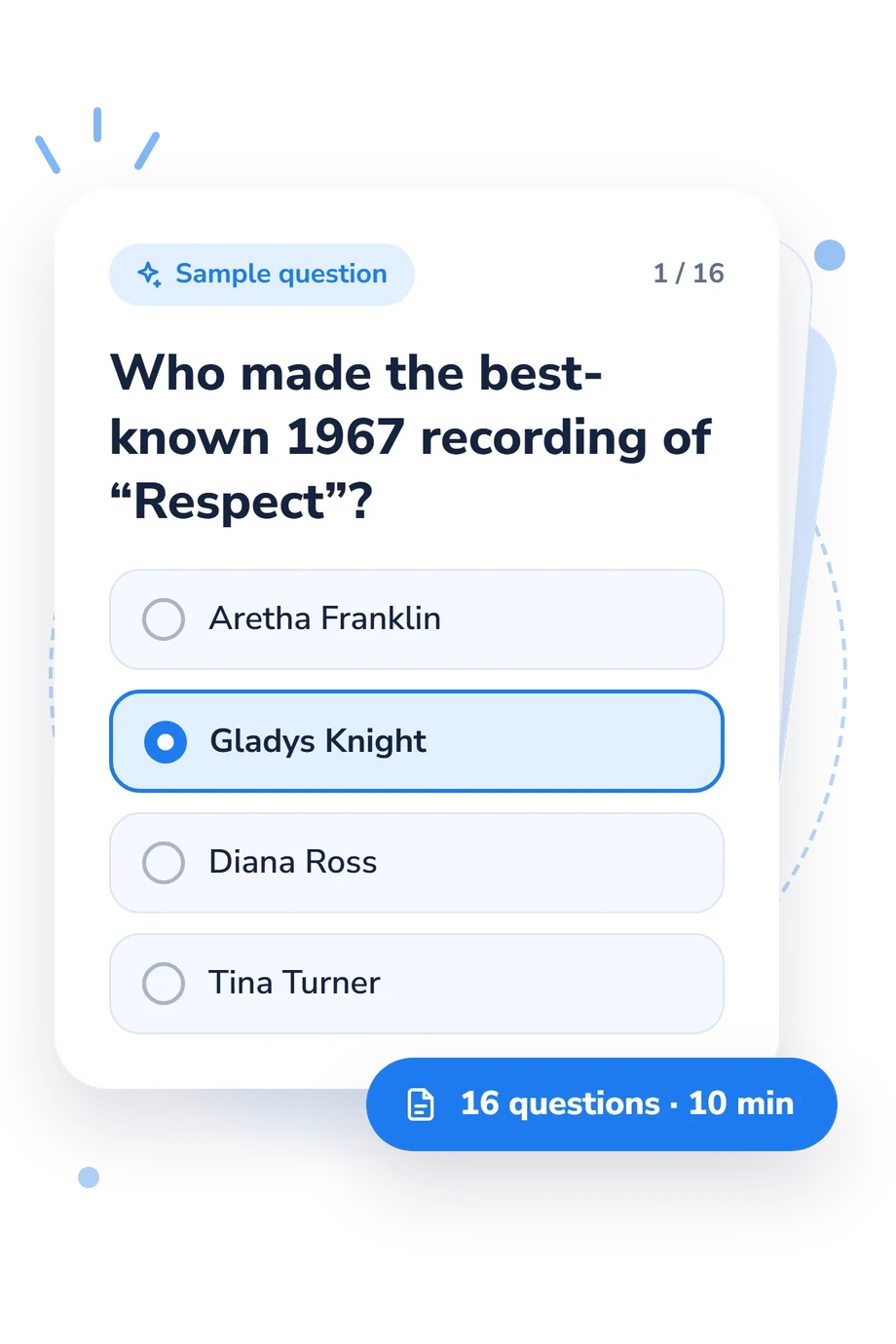
Example Questions From the Test
- Aretha Franklin
- Gladys Knight
- Diana Ross
- Tina Turner
- Isaac Hayes
- Barry White
- Luther Vandross
- Smokey Robinson
- Jodeci
- Bell Biv DeVoe
- Guy
- Boyz II Men
R&B Quiz - Description and methodology of the test
Anyone who wants to check their grasp of popular music history can use the R&B Quiz as a focused knowledge check. It suits listeners who enjoy classic soul, vocal groups, funk, contemporary production, or the connections among them. A result from this R&B music quiz indicates overall familiarity with R&B vocabulary, eras, recordings, and musical characteristics, while suggesting where further listening may be rewarding.
What This Assessment Explores
Rather than testing performance technique, this rhythm and blues quiz checks recognition and context across major eras and styles. It suits listeners, students, and fans who want to connect songs with the history around them. Questions cover artists, recordings, labels, genres, production choices, rhythmic features, and vocal terms.
The themes fall into four areas:
- Artists and recordings show whether you connect songs, albums, and performances with their creators.
- History and styles measure recognition of eras, labels, genre traditions, and production changes.
- Musical language checks your grasp of rhythm, groove, vocal technique, and terminology.
- Contextual clues reveal whether you can apply that knowledge to unfamiliar descriptions.
Together, responses contribute to R&B Knowledge: 0-16. Bands are Building the foundation (0-6), Developing knowledge (7-12), and R&B authority (13-16), reflecting breadth of knowledge rather than taste or musicianship.
Methodology and Evidence Base
The four-choice format asks for the most accurate response to each prompt, sometimes directly and sometimes through a short historical or musical scenario. It tests recognition and discrimination: knowing an artist, label, or recording matters, but so does distinguishing related styles, production signatures, and vocal techniques. Its structure makes this a factual R&B knowledge questionnaire with an educational emphasis rather than a preference survey.
White and Bronson (1993), Ripani (2006), George (2003), and McCourt (1983) provide historical and content context for chart history, landmark recordings, and changes across later decades. This is an original online knowledge questionnaire, so those books support its factual material rather than its scoring format; they do not establish psychometric validation, norms, or the displayed bands.
Interpret the result as a descriptive snapshot of recall. The questionnaire presents one knowledge score; it does not provide published norms or clinical cutoffs, and performance can shift with listening experience, recent exposure, guessing, or uncertainty about unfamiliar terminology. It is useful for choosing what to revisit, not for ranking personal taste or establishing expertise.
- White, Adam, and Fred Bronson. The Billboard Book of Number One Rhythm & Blues Hits. Billboard Books, 1993. ISBN 9780823082858.
- Ripani, Richard J. The New Blue Music: Changes in Rhythm & Blues, 1950-1999. University Press of Mississippi, 2006. ISBN 9781578068623.
- George, Nelson. The Death of Rhythm and Blues. Penguin Books, 2003. ISBN 9780142004081.
- McCourt, Tom. “Bright Lights, Big City: A Brief History of Rhythm and Blues, 1945-1957.” Popular Music & Society, vol. 9, no. 2, 1983, pp. 1-18. 10.1080/03007768308591209.
Updated: