
Quirk Quiz
How the Scales are Structured
Who Usually Takes This Test?
See How You Compare
Below is a preview of how scores are typically distributed across each scale.
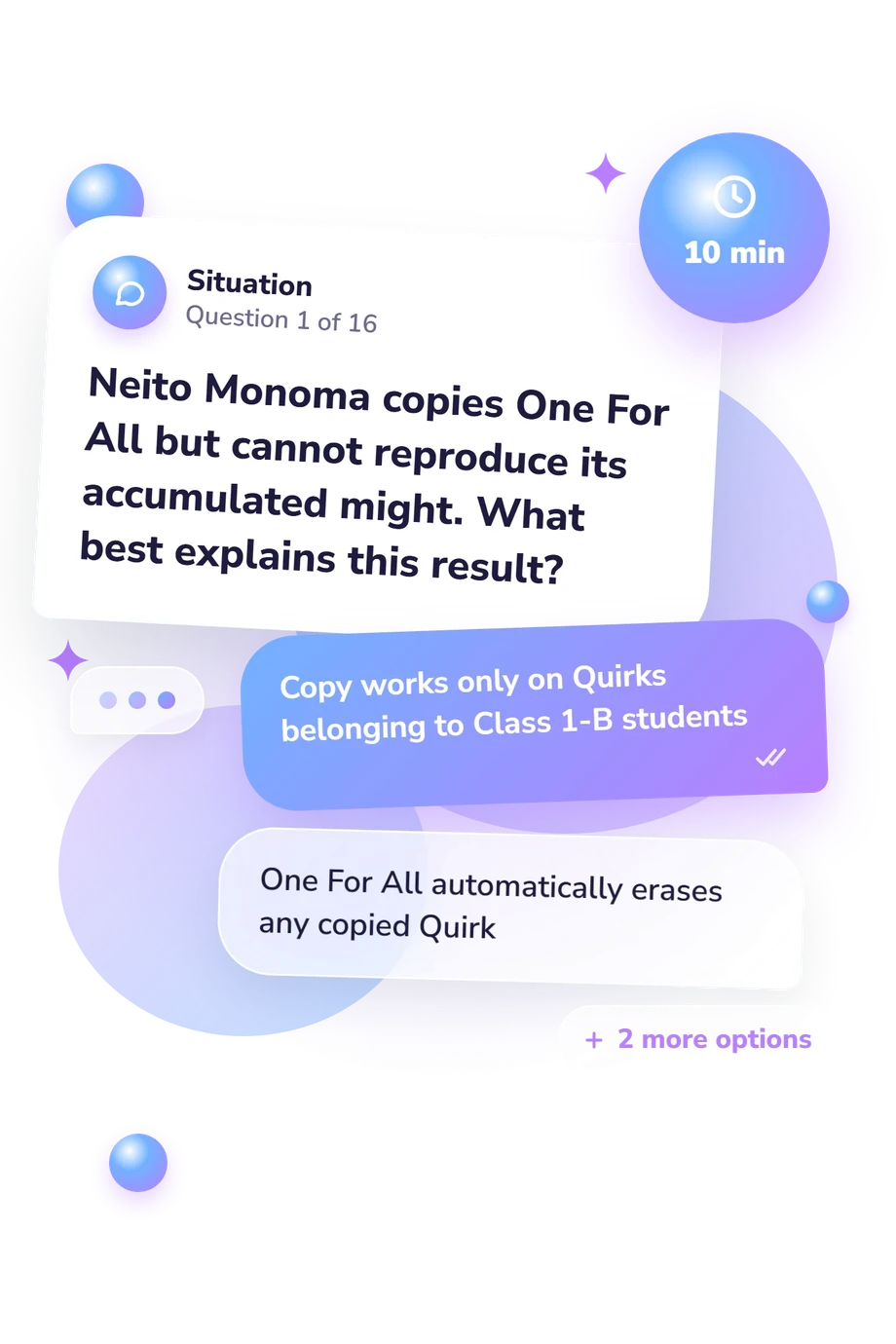
Example Questions From the Test
- Nitroglycerin-like sweat produced by glands in his palms
- Compressed air stored inside his forearms
- Electricity absorbed through his fingertips
- Combustible gas released from his lungs
- It becomes weaker and easier to restrain
- It becomes stronger and more aggressive
- It gains the ability to create fire
- It separates permanently from Tokoyami
- A combat technique that anyone can master through training
- A professional license granted by a hero school
- A support item surgically connected to its user
- A superhuman ability linked to an individual's biology
Quirk Quiz - Description and methodology of the test
Fans who want to understand the rules behind My Hero Academia can use this quirk quiz as a focused knowledge check. It suits readers who enjoy the series and want more than character recall: the items distinguish abilities, activation conditions, biological features, transfer rules, and practical limitations. As a My Hero Academia knowledge test, it turns canon recognition into a profile of current understanding.
What This Assessment Measures
The assessment measures factual command of the Quirk system rather than personality. Questions connect characters with mechanisms, triggers, weaknesses, and rules across biology, inheritance, environment, and control.
As an anime canon knowledge test, it suits readers checking established details, not which hero resembles them. The result is a knowledge level, not a personality type.
The displayed result uses one knowledge scale, while the questions fall into these thematic groups:
- Ability biology and activation show how a Quirk is tied to its user and which conditions affect use.
- Copying, erasure, inheritance, and environment test whether you can distinguish altered abilities from permanent traits.
- My Hero Academia Quirk Knowledge (0-16) counts correct answers: Canon Starter (0-6) means basic recognition; Developing Hero Scholar (7-12) means solid understanding with finer distinctions to revisit; Quirk Expert (13-16) means detailed command of abilities, conditions, counters, and commonly confused facts.
Methodology and Evidence Base
Each item presents four answer choices, and the respondent selects the option that matches established canon. The format tests discrimination: distractors change a Quirk’s biology, trigger, inheritance rule, or limitation, so success depends on understanding why an answer is correct rather than recognizing a name alone. The score totals correct responses and is interpreted through the displayed result bands.
Ultra Analysis and the original My Hero Academia manga provide content references for the terminology, ability mechanics, conditions, transfer rules, and character details tested here. The questionnaire applies a canon-knowledge method: each item asks the respondent to distinguish an established fact from plausible but incorrect alternatives. These references support the subject matter, but they do not make the online questionnaire a published adaptation or validated psychological measure.
As a My Hero Academia trivia test, it is best interpreted as a snapshot of remembered canon knowledge. Performance may change with viewing or reading history, attention, translation choices, and uncertainty about details explained gradually. The bands are descriptive labels for this questionnaire, not population norms, and the result cannot establish expertise beyond the questions represented here.
- Kohei Horikoshi. My Hero Academia: Ultra Analysis-The Official Character Guide. VIZ Media LLC, 2021. ISBN 9781974724475.
- Kohei Horikoshi. My Hero Academia, Vol. 1. VIZ Media LLC, 2015. ISBN 9781421582696.
- Kohei Horikoshi and Hideyuki Furuhashi; illustrated by Betten Court. My Hero Academia: Vigilantes, Vol. 1. VIZ Media LLC, 2018. ISBN 9781974701599.
- Jason Gendler. "Creative Use of Superhero Powers in My Hero Academia." Imagining the Impossible: International Journal for the Fantastic in Contemporary Media, 2026. 10.7146/imaginingtheimpossible.157931.
Updated: