
Punk Rock Quiz
How the Scales are Structured
Who Usually Takes This Test?
See How You Compare
Below is a preview of how scores are typically distributed across each scale.
Example Questions From the Test
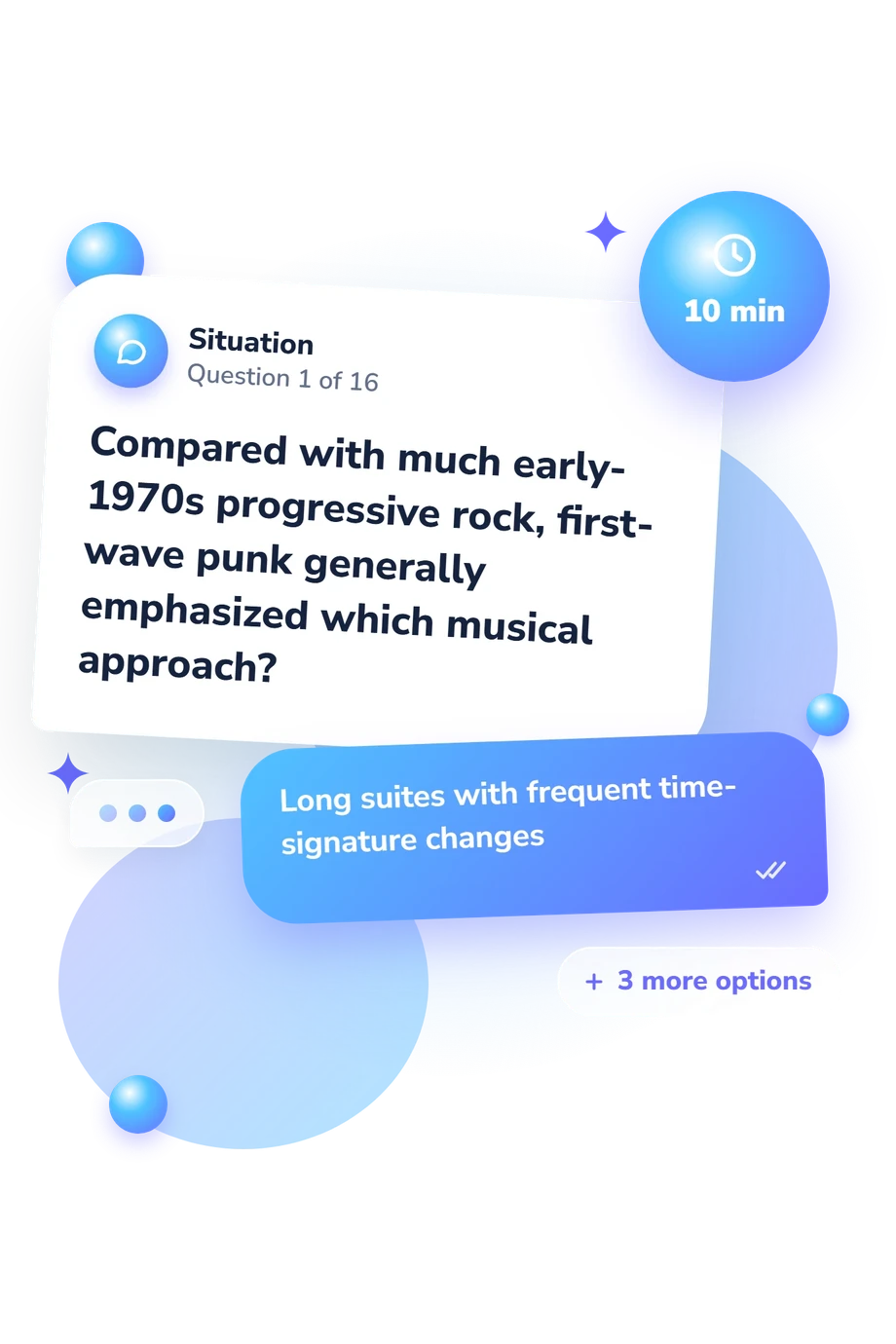
- Long suites with frequent time-signature changes
- Concept albums centered on fantasy narratives
- Extended instrumental solos supported by orchestras
- Shorter, more direct songs with economical arrangements
- The Damned
- The Clash
- Sham 69
- Buzzcocks
- Siouxsie and the Banshees
- The Slits
- The Adverts
- X-Ray Spex
Punk Rock Quiz - Description and methodology of the test
Listeners who want to understand punk in its historical and cultural context can use this punk rock quiz to decide where to begin or deepen their listening. As a punk rock music quiz, it suits newcomers deciding whether to build foundational knowledge and experienced fans identifying where further exploration would be useful. The result offers a focused picture of knowledge, not a judgment of taste, authenticity, or identity.
What This Assessment Explores
Rather than asking whether someone likes punk, the questionnaire tests recognition and interpretation of major features in its history. Items range from first-wave British and New York scenes to later styles, combining factual recall with brief musical and cultural descriptions. It suits newcomers mapping the genre and experienced listeners checking gaps in their background, because this punk rock knowledge test shows where their grounding is strongest.
The main areas represented by the questions are:
- Artists and recordings connect names to landmark songs, albums, and bands.
- Scenes and styles distinguish venues, cities, musical traits, and later developments.
- DIY culture links independent release, community organizing, activism, and punk values.
The displayed Punk Rock Knowledge scale runs from 0-16, with Foundations to Build (0-6), Developing Knowledge (7-12), and Strong Knowledge (13-16). These bands describe demonstrated breadth, not taste, status, or belonging.
Methodology and Scientific Basis
The multiple-choice format presents four alternatives for each prompt. This punk music quiz therefore tests recognition rather than free recall. Items mix recall of artists, records, venues, and scenes with tasks that match musical descriptions or community practices to a style or principle. The questionnaire reports a result on the displayed scale and shows its band.
McKay and Arnold connect punk’s music with scenes, values, and stylistic change. McKay’s work is especially relevant to DIY material, while Sabin treats punk as a cultural legacy as well as a sound. Their scholarship provides cultural context, not psychometric validation of this online questionnaire.
The displayed result is descriptive: it reflects recognition of history, musical distinctions, scenes, and cultural practices represented in the prompts. Prior listening, cultural exposure, memory, guessing, and wording can affect results. A strong result does not show complete knowledge of punk’s regional histories; a lower one can identify areas for exploration. Treat it as a focused learning prompt, not a complete account of punk knowledge or identity.
- McKay, George, and Gina Arnold, eds. The Oxford Handbook of Punk Rock. Oxford University Press, 2020. 10.1093/oxfordhb/9780190859565.001.0001
- McKay, George. “Was punk DIY? Is DIY punk? Interrogating the DIY/punk nexus, with particular reference to the early UK punk scene, c. 1976-1984.” DIY, Alternative Cultures & Society, vol. 2, no. 1, 2024, pp. 94-109. 10.1177/27538702231216190
- Sabin, Roger, ed. Punk Rock: So What? The Cultural Legacy of Punk. Routledge, 1999.
Updated: