
Protein Powder Quiz
How the Scales are Structured
Who Usually Takes This Test?
See How You Compare
Below is a preview of how scores are typically distributed across each scale.
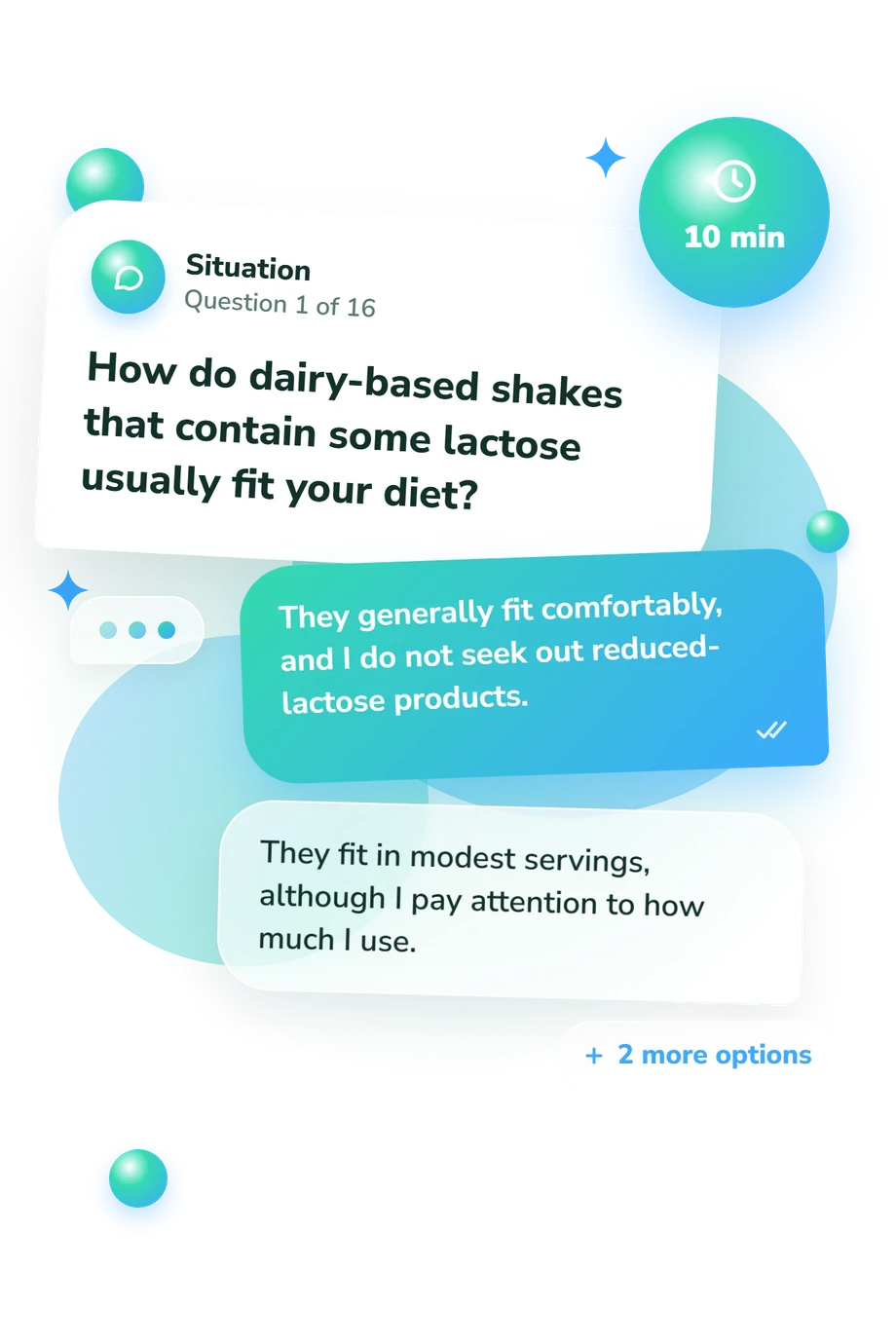
Example Questions From the Test
- A looser mixture with minimal change in texture.
- A dense, dessert-like bowl that thickens as it sits.
- A moderately creamy bowl that remains easy to stir.
- A recipe made only with plant-derived ingredients.
- A thick dairy shake or protein pudding that feels substantial.
- A standard creamy shake that works at almost any time.
- A very light drink that goes down quickly.
- A dairy-free blend, regardless of thickness.
- A blend of complementary plant sources such as pea and rice.
- A single plant source with a simple ingredient list.
- Either plant or dairy sources, depending on flavor and price.
- A milk-derived protein because that is my clear preference.
Protein Powder Quiz - Description and methodology of the test
People choosing a powder for smoothies, training, breakfast, or longer gaps between meals can use this questionnaire to clarify personal priorities rather than chase a universal recommendation. The protein powder quiz turns preferences about dairy, texture, price, and routine into a readable profile. As a protein powder decision guide, it helps readers compare likely fits before buying.
What This Assessment Explores: Which Protein Powder Is Best for Me Quiz
The result is a preference profile linking dairy tolerance, texture, flavor, price, label priorities, and timing with likely routine fit. The four displayed profiles in this protein powder preference quiz are:
- Casein Protein, 0-12, reflects interest in thick dairy for evenings or long gaps; Limited fit 0-4, Possible fit 5-8, Strong affinity 9-12.
- Plant-Based Blend, 0-12, reflects dairy avoidance and openness to blended plant sources; Limited fit 0-4, Possible fit 5-8, Strong affinity 9-12.
- Whey Concentrate, 0-12, reflects value, creamy dairy flavor, and versatility; Limited fit 0-4, Possible fit 5-8, Strong affinity 9-12.
- Whey Isolate, 0-12, reflects preference for concentrated dairy protein with typically less lactose; Limited fit 0-4, Possible fit 5-8, Strong affinity 9-12.
These bands describe affinity rather than nutritional need. Dairy-based results remain unsuitable for a milk allergy, and plant ingredients can vary by product, so labels still matter when allergens or medical nutrition needs are involved.
Methodology and Evidence Base
Each item presents a food-choice situation with four response options. The alternatives contrast dairy tolerance, milk avoidance, texture, price, protein concentration, flavor, and timing. Responses act as preference signals across parallel profiles rather than producing one universal winner. As a protein powder comparison quiz, it keeps the decision focused on routine fit.
The evidence is consumer-oriented rather than clinical. Harwood and Drake (2019) provides the closest conceptual reference for consumer desires around protein products, while Keefer, Racette, and Drake (2024) addresses motivations for protein choice. Rogers et al. (2024) adds context for plant-blend and whey comparisons, and Boirie et al. (1997) supports the distinction between slower- and faster-digested dietary proteins. These studies support the questionnaire's themes; they do not validate or establish authorship of this online version.
Interpret results as relative preference signals. The scoring is descriptive rather than standardized against a reference population. Because answers are self-reported, scores can shift with current diet, budget, training, taste, or ingredient concerns, and they cannot establish a milk allergy, intolerance, or medical protein requirement.
- Harwood, Will S., and MaryAnne Drake. "Understanding implicit and explicit consumer desires for protein bars, powders, and beverages." Journal of Sensory Studies 34, no. 3 (2019): e12493. 10.1111/joss.12493
- Keefer, Heather R. M., Clara M. Racette, and MaryAnne Drake. "Factors influencing consumer motivations for protein choice." Journal of Food Science 89, no. 1 (2024): 596-613. 10.1111/1750-3841.16805
- Rogers, Lucy M., Archie E. Belfield, Marie Korzepa, Ari Gritsas, Tyler A. Churchward-Venne, and Leigh Breen. "Postprandial plasma aminoacidemia and indices of appetite regulation following pea-rice blend, pea isolate and whey protein ingestion in healthy young adults." British Journal of Nutrition 132, no. 6 (2024): 691-700. 10.1017/S0007114524001958
- Boirie, Yves, Martial Dangin, Pierre Gachon, Marie-Paule Vasson, Jean-Louis Maubois, and Bernard Beaufrère. "Slow and fast dietary proteins differently modulate postprandial protein accretion." Proceedings of the National Academy of Sciences of the United States of America 94, no. 26 (1997): 14930-14935. 10.1073/pnas.94.26.14930
Updated: