
Present Perfect Quiz
How the Scales are Structured
Who Usually Takes This Test?
See How You Compare
Below is a preview of how scores are typically distributed across each scale.
Example Questions From the Test
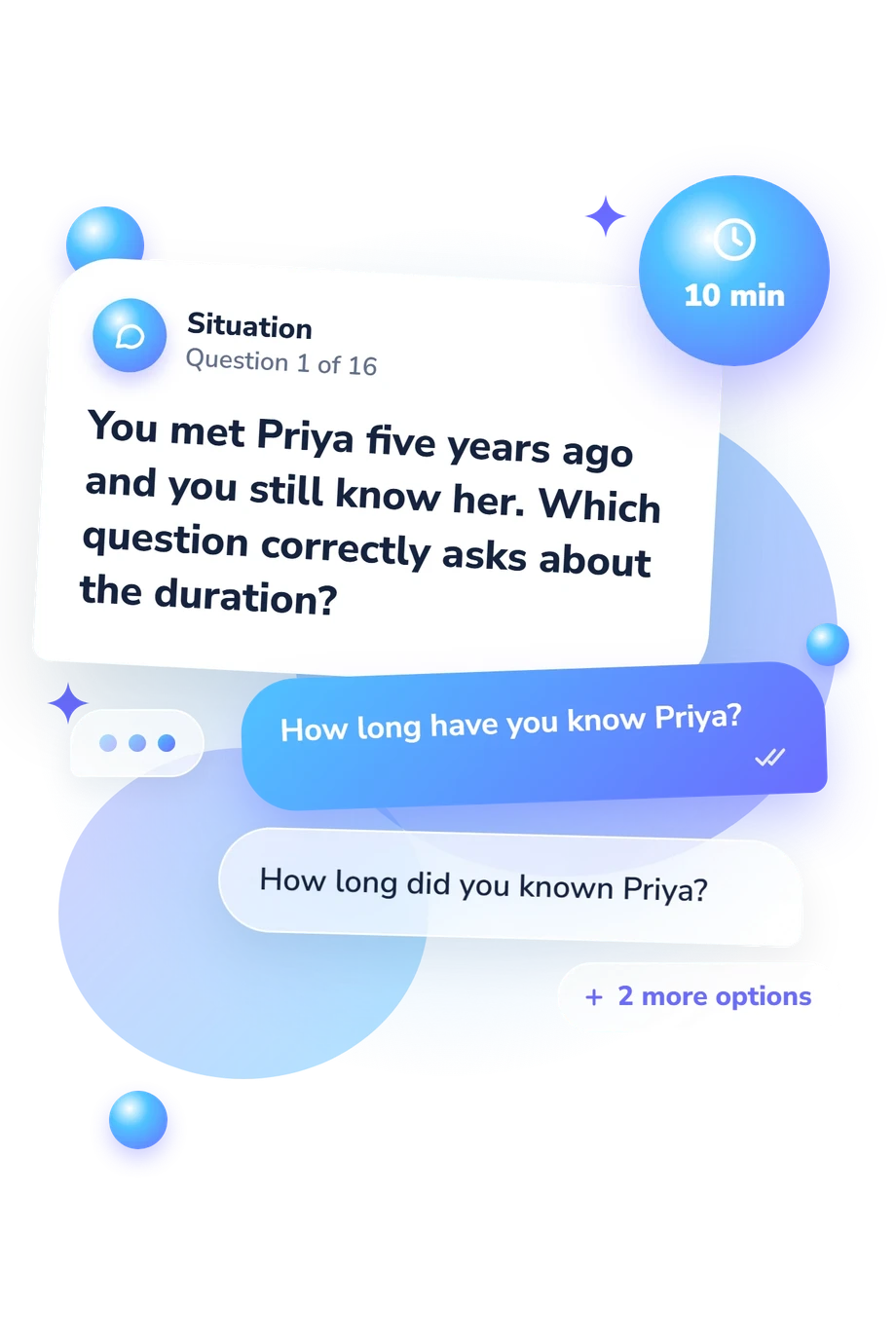
- How long have you know Priya?
- How long did you known Priya?
- How long have you known Priya?
- How long are you knowing Priya?
- I study English since I started high school.
- I have study English since I started high school.
- I am studied English since I started high school.
- I have studied English since I started high school.
- I have answer six emails today.
- I has answered six emails today.
- I have answered six emails today.
- I am answered six emails today.
Present Perfect Quiz - Description and methodology of the test
Designed for English learners who want a practical check of tense control, the present perfect quiz focuses on choices that often create confusion in real communication. It is suitable for students, self-directed learners, and teachers who want to identify whether a learner connects grammatical form with meaning. An online quiz on the present perfect gives a focused snapshot of accuracy rather than a broad measure of English ability.
What This Assessment Measures
It examines whether the respondent chooses the present perfect for experience up to now, an unfinished period, continuing duration, or a current result. It also checks auxiliaries, agreement, participles, and context.
The items include affirmative and negative statements, questions, just, yet, ever, already, and since. They contrast present perfect with the simple past after a finished time such as yesterday, and distinguish has been from has gone. A present perfect tense quiz helps learners who know rules but hesitate when context changes.
The result uses the Present Perfect Knowledge scale, ranging from 0-16, with these bands:
- Foundations to Review (0-6) indicates that core forms and time choices need practice.
- Developing Command (7-12) indicates that many standard uses are understood, but some distinctions remain inconsistent.
- Strong Command (13-16) indicates accurate use across tested forms and contexts, including simple-past contrasts and passives.
Methodology and Evidence Base
Each question presents a situation or sentence with four answer choices. The alternatives target errors in auxiliaries, participles, agreement, word order, and the choice between present relevance and a completed past time. As a quiz of present perfect usage, it asks the learner to connect form with context.
The displayed score is a summary of performance across the items; it has no stated separate weighting, external norm, reliability estimate, or diagnostic cutoff. A quiz about present perfect tense use can identify practice priorities, but it cannot show how consistently the tense appears in spontaneous speaking or extended writing.
Its content is conceptually consistent with Hundt and Smith (2009), which discusses present-perfect use in British and American English. Parrott supplies pedagogical guidance, while Huddleston and Pullum provide a descriptive framework for tense, aspect, auxiliaries, and participles. The questionnaire is not presented as an adaptation or standardized administration of those works.
Attention and familiarity with similar exercises may affect the result, so use it to choose practice targets rather than as a complete measure of English proficiency.
- Hundt, Marianne, and Nicholas Smith. 2009. The present perfect in British and American English: Has there been any change, recently? ICAME Journal, 33, 45-63.
- Parrott, Martin. 2010. Grammar for English Language Teachers, 2nd ed. Cambridge University Press. 10.1017/9781009406536.
- Huddleston, Rodney, and Geoffrey K. Pullum. 2002. The Cambridge Grammar of the English Language. Cambridge University Press. 10.1017/9781316423530.
Updated: