
Pre-Algebra Quiz
How the Scales are Structured
Who Usually Takes This Test?
See How You Compare
Below is a preview of how scores are typically distributed across each scale.
Example Questions From the Test
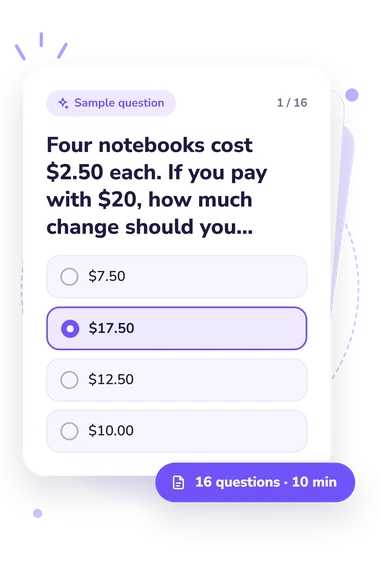
- $7.50
- $17.50
- $12.50
- $10.00
- 5°C
- -8°C
- -11°C
- 24°C
- 62
- 17
- 5
- 8
Pre-Algebra Quiz - Description and methodology of the test
Learners reviewing arithmetic foundations, preparing for a first algebra course, or checking where practice would help can use this pre algebra quiz as a focused skills snapshot. The pre algebra math quiz connects calculation, notation, and short word problems, highlighting concepts that appear secure in this sample and areas that deserve review. It suits students, independent learners, and anyone who wants a clearer starting point for targeted review.
What This Assessment Explores
This assessment bridges arithmetic and introductory algebra through signed numbers, fractions, decimals, percentages, powers, sequences, rates, equations, inequalities, proportions, and perimeter. It tests accurate operation choice and notation.
For learners preparing for coursework, this prealgebra quiz offers a snapshot of the sampled concepts rather than a complete measure of mathematical ability. Pre-Algebra Knowledge spans 0-16: Foundation to Build (0-6), Developing Knowledge (7-12), and Strong Knowledge (13-16). These bands distinguish skills needing reinforcement, developing performance, and consistent command.
The questions represent three recurring content areas within the sampled questions, contributing to one overall knowledge result:
- Numerical fluency shows how accurately you handle signs, decimals, fractions, percentages, and operations.
- Algebraic reasoning shows how well you evaluate expressions, simplify terms, solve equations, and interpret inequalities.
- Quantitative application shows how you use rates, proportions, patterns, and geometry in practical problems.
Methodology and Evidence Base
Each item presents a short problem with four answer choices. Selecting one response captures accuracy in calculation, symbolic manipulation, and everyday quantitative situations rather than extended written work. Results are grouped into the displayed bands; no item-weighting rule is documented.
The closest conceptual reference is the Mathematics Diagnostic Testing Project (MDTP), which uses targeted mathematics questions to reveal prerequisite strengths and gaps. This questionnaire is conceptually consistent with that approach, but it is not presented as an MDTP adaptation. MDTP and California placement research support using assessment information to identify preparation needs, while studies of fraction and decimal notation clarify why symbolic fluency matters for later pre-algebra ability.
After taking this pre algebra practice quiz, learners can inspect missed problem types and select review work. Guessing, concentration, unfamiliar notation, and current classroom exposure can affect performance. With no stated norm group, reliability estimate, or formal placement standard, the band describes these sampled tasks rather than universal mathematical ability.
- Betts, Julian R., Youjin Hahn, and Andrew C. Zau. (2017). Can testing improve student learning? An evaluation of the mathematics diagnostic testing project. Journal of Urban Economics, 100, 54-64. 10.1016/j.jue.2017.04.003
- CSU/UC Mathematics Diagnostic Testing Project. (2022). CSU/UC Mathematics Diagnostic Testing Project newsletter, fall 2022. University of California, San Diego.
- Huang, Chun-Wei, Jason Snipes, and Neal Finkelstein. (2014). Using assessment data to guide math course placement of California middle school students (REL 2014-040). U.S. Department of Education, Institute of Education Sciences, Regional Educational Laboratory West.
- Hurst, Michelle A., and Sara Cordes. (2018). Children’s understanding of fraction and decimal symbols and the notation-specific relation to pre-algebra ability. Journal of Experimental Child Psychology, 168, 32-48. 10.1016/j.jecp.2017.12.003