
Pokemon Gym Leader Quiz
How the Scales are Structured
Who Usually Takes This Test?
See How You Compare
Below is a preview of how scores are typically distributed across each scale.
Example Questions From the Test
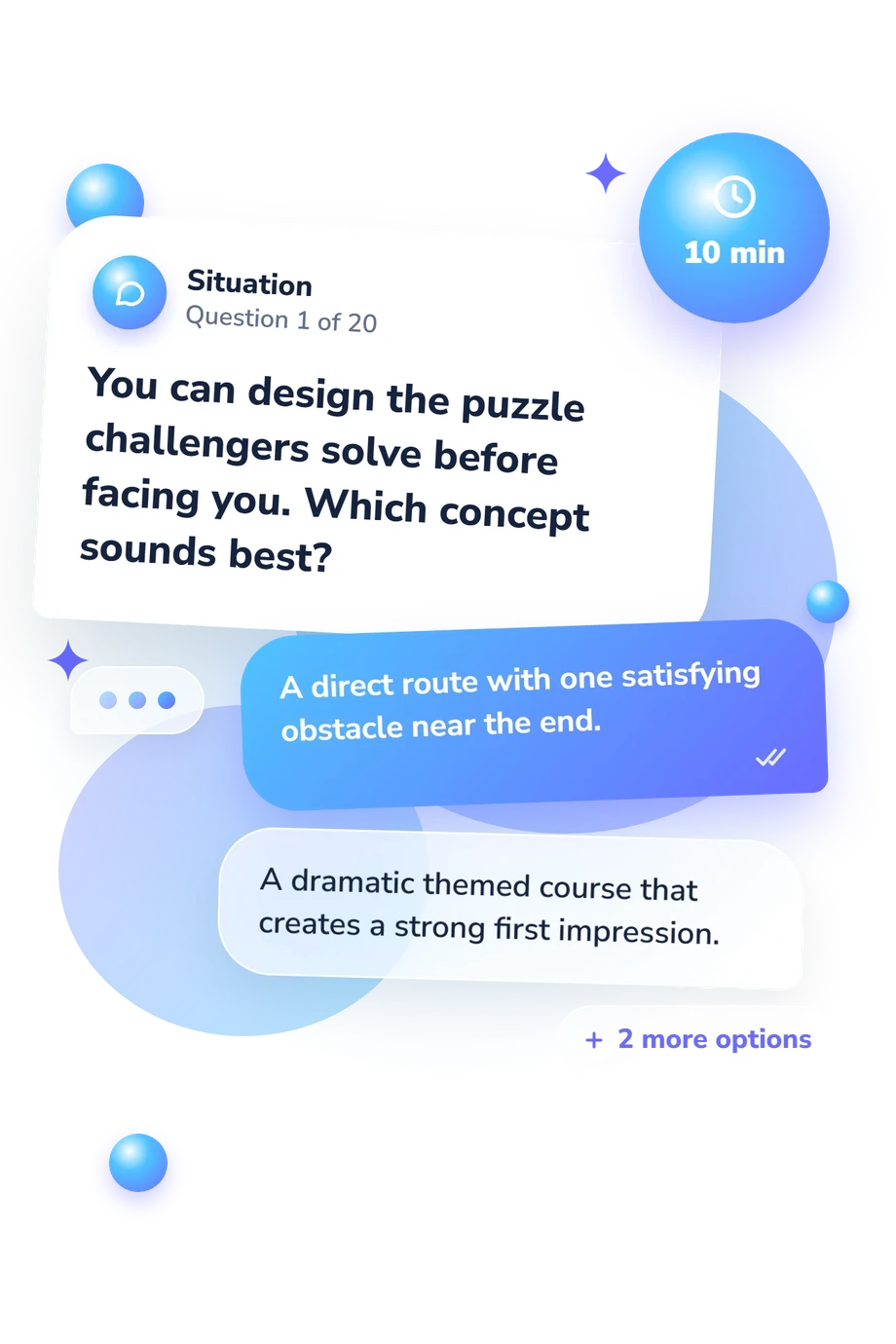
- A direct route with one satisfying obstacle near the end.
- A dramatic themed course that creates a strong first impression.
- A branching challenge where clues help observant players choose efficient routes.
- A puzzle with several workable solutions and some room for experimentation.
- Lean into the moment and turn the next exchange into the battle's centerpiece.
- Acknowledge the energy while keeping my normal battle rhythm.
- Add a little flourish if it does not distract from my next choice.
- Tune out the audience and focus entirely on the challenger.
- The exact sequence of choices that created the decisive opening.
- The one move I would most obviously change next time.
- The overall momentum and whether both sides enjoyed the contest.
- The main turning point and the alternatives available there.
Pokemon Gym Leader Quiz - Description and methodology of the test
Readers who want to imagine their own arena, battle philosophy, and relationship with challengers can use this assessment to turn preferences into a coherent Gym concept. The Pokemon Gym Leader Quiz suits Pokémon fans who want structured self-reflection about how they lead, teach, adapt, and create memorable challenges. It also works as a Pokémon gym type quiz, linking those choices to five distinct result dimensions.
What This Assessment Explores
This Pokémon gym leader type quiz sorts preferences into presentation, endurance, teaching, tactics, and environments.
- Showstopping Icon (0-12) measures theatrical flair, expressive themes, audience connection, and memorable presentation, with Quiet Presence (0-4), Themed Host (5-8), and Showstopping Icon (9-12).
- Steadfast Guardian (0-12) measures patience, endurance, consistency, and dependability, with Agile Responder (0-4), Reliable Anchor (5-8), and Steadfast Guardian (9-12).
- Supportive Mentor (0-12) measures teaching, calibrated challenge, constructive feedback, and investment in challenger growth, with Independent Evaluator (0-4), Encouraging Guide (5-8), and Supportive Mentor (9-12).
- Tactical Mastermind (0-12) measures analysis, prediction, team synergy, and carefully designed challenges, with Instinctive Battler (0-4), Flexible Planner (5-8), and Tactical Mastermind (9-12).
- Wild-World Explorer (0-12) measures curiosity about habitats, field discovery, environmental variety, and unconventional battle settings, with Home-Ground Specialist (0-4), Curious Pathfinder (5-8), and Wild-World Explorer (9-12).
Methodology and Scientific Basis
Each scenario offers four answer choices, asking which approach feels natural in a Gym setting. Items cover puzzle design, audience energy, team building, terrain, difficulty, feedback, and presentation, so this gym leader quiz reflects battle decisions and the challenger’s experience.
The five scale scores are compared: the highest indicates the strongest affinity, while scores within one point indicate a blended style. This comparison shows whether one tendency stands out or several preferences are closely matched.
This structure is conceptually consistent with the situational leadership framework described by Hersey and Blanchard, which views leadership as responsive to circumstances. For this gym leader type quiz, that framework is a lens, not evidence that the custom questionnaire is their published instrument or a validated adaptation.
This is a custom self-report profile with no demonstrated psychometric evidence, including established reliability, norms, or predictive validity. With no stated standardization or clinical cutoff, the pattern is best read as a snapshot of current preferences. Self-report may reflect mood, familiarity with Pokémon, or the image you wish to project.
- Hersey, Paul, and Kenneth H. Blanchard. "So You Want To Know Your Leadership Style? Measuring How You Behave in a Situational Leadership Framework." Training and Development Journal, vol. 28, no. 2, 1974, pp. 22-37.
- Hambleton, Ronald K., and Ray Gumpert. "The Validity of Hersey and Blanchard's Theory of Leader Effectiveness." Group & Organization Studies, vol. 7, no. 2, 1982, pp. 225-242. 10.1177/105960118200700210
- Graeff, Claude L. "The Situational Leadership Theory: A Critical View." Academy of Management Review, vol. 8, no. 2, 1983, pp. 285-291. 10.5465/AMR.1983.4284738
Updated: