
Pharmacy Quiz
How the Scales are Structured
Who Usually Takes This Test?
See How You Compare
Below is a preview of how scores are typically distributed across each scale.
Example Questions From the Test
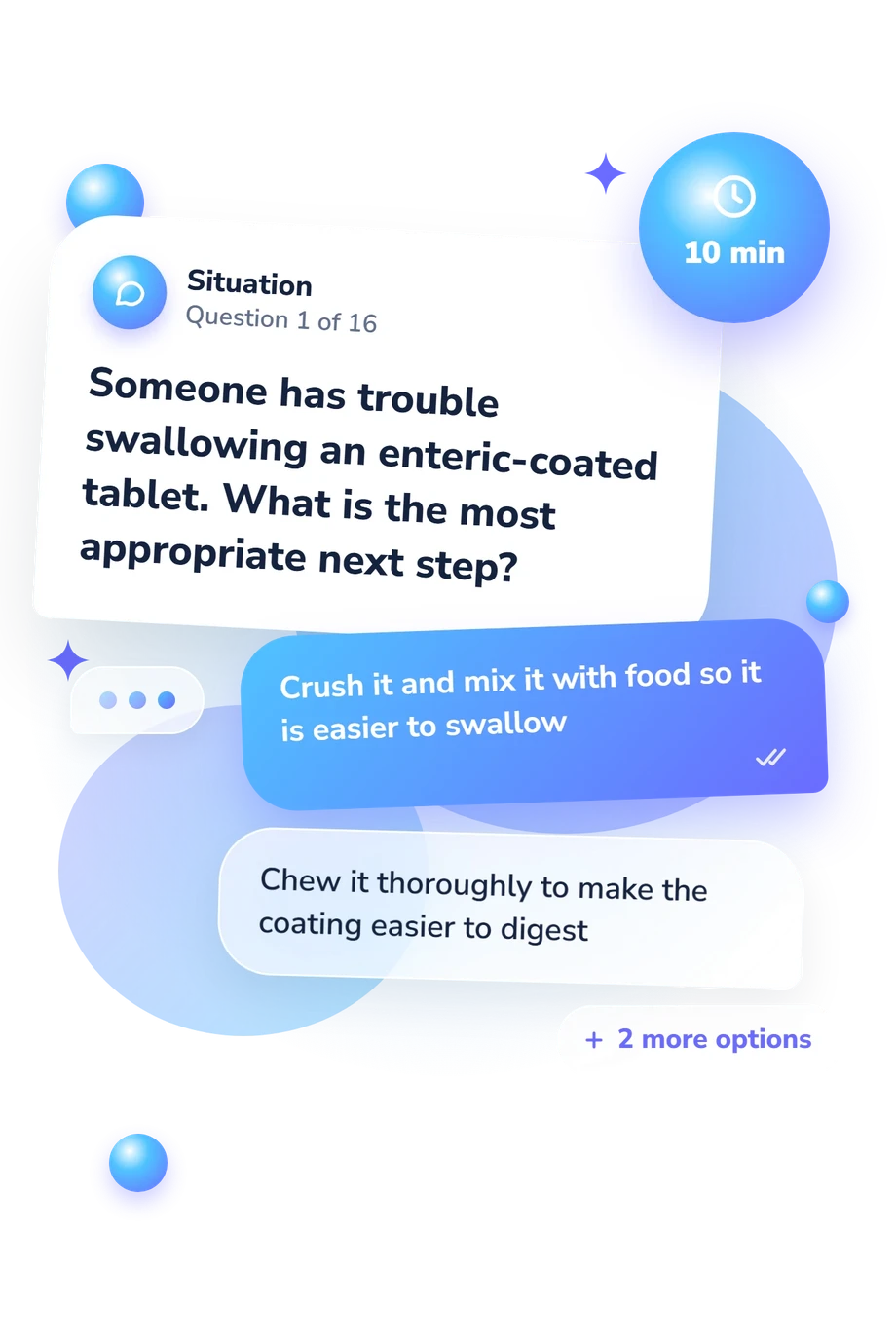
- Crush it and mix it with food so it is easier to swallow
- Chew it thoroughly to make the coating easier to digest
- Ask a pharmacist whether a suitable alternative or safe method is available
- Dissolve it in hot water before taking it
- A household teaspoon
- A standard drinking glass
- A properly marked oral syringe
- The bottle cap without measurement markings
- A refrigerator, because all medicines last longer when chilled
- A secured dry cabinet away from excess heat and moisture
- A bathroom cabinet beside the shower for convenient access
- A freezer compartment to prevent ingredient breakdown
Pharmacy Quiz - Description and methodology of the test
For people who use medicines, support someone who does, or want to revisit foundational concepts, this pharmacy quiz checks everyday medication understanding. Its pharmacist quiz format covers labels, medicine handling, and basic terms for learners, patients, and caregivers. The result provides a focused snapshot of foundational understanding to guide further learning.
What This Assessment Explores
The questionnaire checks foundational pharmacy knowledge and whether a person can apply medication concepts to ordinary situations. It covers active ingredients, generic medicines, half-life, pharmacokinetics, first-pass metabolism, narrow therapeutic index, storage, measuring devices, missed doses, disposal, duplicate ingredients, and allergic reactions. The focus is practical understanding of safe use.
Results appear on Pharmacy Knowledge, scored 0-16: Foundation to build (0-6), Developing knowledge (7-12), or Strong knowledge (13-16). These bands describe increasing grasp of foundational concepts and practical application.
Its main areas are:
- Medication fundamentals show understanding of ingredients, dosage forms, generic medicines, and drug behavior.
- Safe use reflects knowledge of measuring, storage, preparation, and missed-dose practices.
- Risk recognition indicates awareness of duplication, serious reactions, and situations needing advice.
- Pharmacy communication shows understanding of why a complete medication list matters and when to ask a pharmacist or prescriber.
Methodology and Evidence Base
The questionnaire's pharmacy-related quiz questions combine direct medication-concept questions with short practical scenarios and offer four answer choices, asking the respondent to select the best response. The format tests recognition and application of medication knowledge in context. Reviewing the answers after completion can help connect the result with the concepts that need more practice.
The questionnaire is conceptually consistent with medication-knowledge instruments, especially García Delgado et al. (2009), which illustrates assessment of what people know about their medicines. Sauceda et al. (2012) extends this area through medication-literacy measurement in Spanish and English. Gentizon et al. (2021) highlights the importance of examining reliability, validity, and other measurement properties when judging such instruments. It is not an adaptation of those published tools.
Results can identify areas for review, but they depend on attention, honest responding, prior experience, and current context. Interpret the band as an indication of which foundational concepts may merit review; the score does not establish professional competence or replace medication advice from a qualified healthcare professional.
- García Delgado P, Gastelurrutia Garralda MA, Baena Parejo MI, Fisac Lozano F, Martínez Martínez F. Validation of a questionnaire to assess patient knowledge of their medicines. Atención Primaria. 2009;41(12):661-668. 10.1016/j.aprim.2009.03.011
- Sauceda JA, Loya AM, Sias JJ, Taylor T, Wiebe JS, Rivera JO. Medication literacy in Spanish and English: psychometric evaluation of a new assessment tool. Journal of the American Pharmacists Association. 2012;52(6):e231-e240. 10.1331/JAPhA.2012.11264
- Gentizon J, Hirt J, Jaques C, Lang PO, Mabire C. Instruments assessing medication literacy in adult recipients of care: A systematic review of measurement properties. International Journal of Nursing Studies. 2021;113:103785. 10.1016/j.ijnurstu.2020.103785
Updated: