
Perfect Boyfriend Quiz
How the Scales are Structured
Who Usually Takes This Test?
See How You Compare
Below is a preview of how scores are typically distributed across each scale.
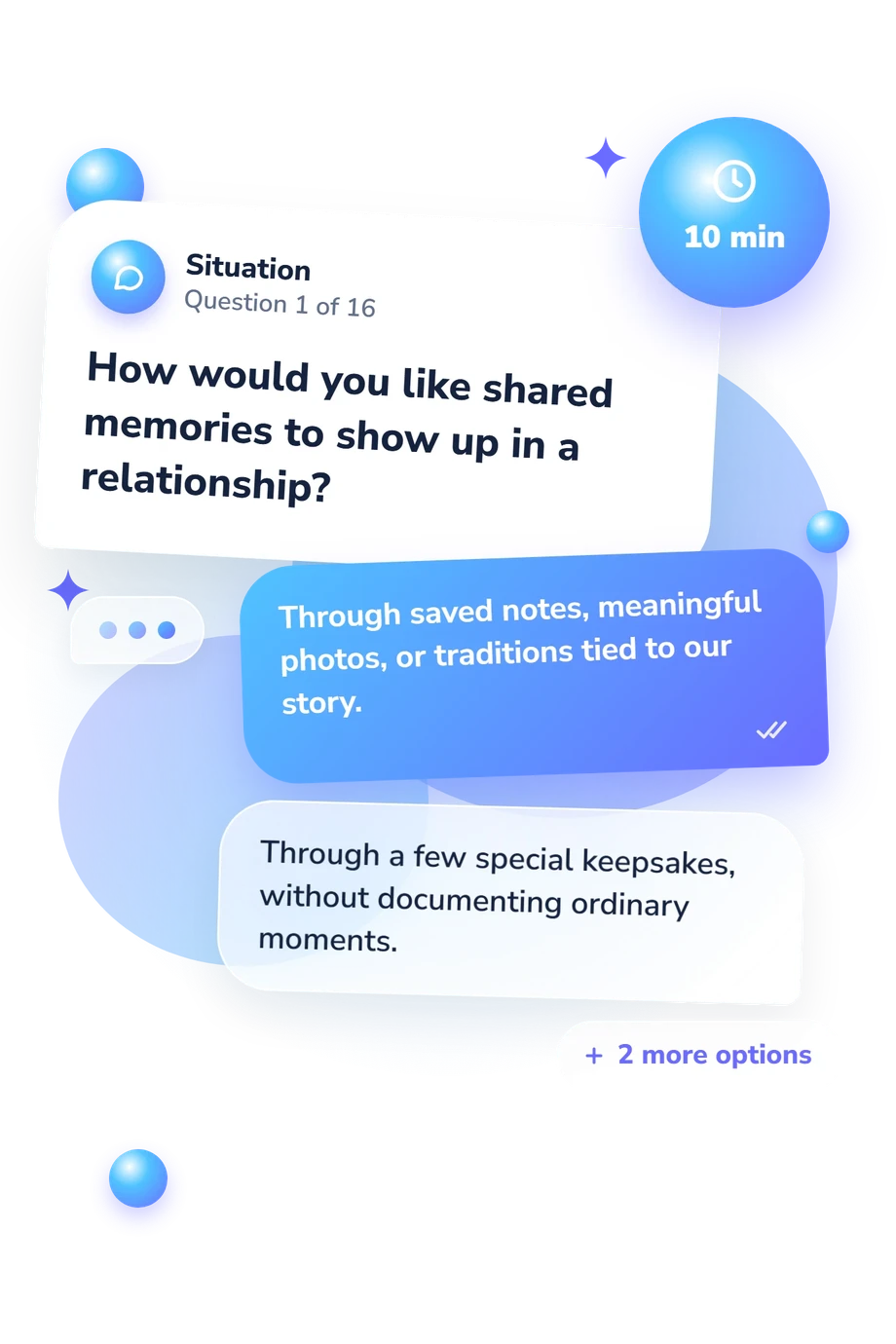
Example Questions From the Test
- Through saved notes, meaningful photos, or traditions tied to our story.
- Through a few special keepsakes, without documenting ordinary moments.
- Mostly through stories we tell rather than objects or rituals.
- I would rather focus on the present than preserve relationship memories.
- He gives me room and lets me decide whether to reconnect later.
- He suggests an entertaining distraction to shift the mood.
- He checks what I need and stays available without pressuring me.
- He sends one caring message, then continues with his own plans.
- He is happy to relax indoors and abandon the day’s agenda.
- He looks for a familiar indoor option with predictable comforts.
- He finds a few unusual alternatives and invites me to pick one.
- He turns the setback into a spontaneous mini-adventure.
Perfect Boyfriend Quiz - Description and methodology of the test
People who want to clarify what they value in a relationship can use the perfect boyfriend quiz as a structured prompt for self-reflection. The result is useful for anyone comparing preferences around support, shared ambition, novelty, and affection. An ideal boyfriend quiz can turn the vague idea of a good match into a profile of relationship dynamics that feel most compatible.
What This Assessment Explores
Items cover support, disagreement, goals, setbacks, memories, routine, and novelty. An ideal bf quiz clarifies preferences rather than judging a boyfriend. The focus is personal fit. The question behind my perfect boyfriend quiz is which qualities feel most appealing. These dimensions are:
- The Ambitious Teammate (0-12) measures shared goals and mutual growth: Separate-Paths Fit (0-4); Supportive Partnership (5-8); Ambitious Teammate Affinity (9-12).
- The Playful Adventurer (0-12) measures curiosity, novelty, and shared discovery: Familiar-Pace Fit (0-4); Selective Explorer (5-8); Playful Adventurer Affinity (9-12).
- The Steady Supporter (0-12) measures dependable presence and grounded support: Independent Fit (0-4); Welcome Stability (5-8); Steady Supporter Affinity (9-12).
- The Thoughtful Romantic (0-12) measures sentiment, meaningful detail, and intentional affection: Understated Affection Fit (0-4); Meaningful Moments Mix (5-8); Thoughtful Romantic Affinity (9-12).
The highest score is strongest; scores within one point blend.
Methodology and Scientific Basis
The format is a self-report preference exercise. Each item presents a relationship situation with four responses, ranging from independence or low-key connection to support, novelty, coordination, or romantic expression. Choosing the most appealing response creates a pattern across dimensions; this measures preferences, not factual knowledge or social skill.
The evidence framework is the Ideal Standards Model (Fletcher et al., 1999), which treats relationship ideals as standards for a desirable partner and relationship. Fletcher and Simpson (2000) describe ideals as organized dimensions guiding attention and evaluation, while Campbell et al. (2001) explain why ideals can remain flexible rather than rigid. This questionnaire is conceptually consistent with that work, not an adaptation of those published instruments.
This quiz turns how to find the perfect boyfriend into a question of fit: compare the profile with lived preferences and notice where context changes your answers. Displayed bands are descriptive categories, not population norms or clinical thresholds.
Because answers are self-reported and these scores have no published norms, mood, relationship history, and self-awareness can shape the pattern; it describes current preferences rather than fixed compatibility.
- Fletcher, G. J. O., Simpson, J. A., Thomas, G., & Giles, L. (1999). Ideals in intimate relationships. Journal of Personality and Social Psychology, 76(1), 72-89. 10.1037/0022-3514.76.1.72
- Fletcher, G. J. O., & Simpson, J. A. (2000). Ideal Standards in Close Relationships: Their Structure and Functions. Current Directions in Psychological Science, 9(3), 102-105. 10.1111/1467-8721.00070
- Campbell, L., Simpson, J. A., Kashy, D. A., & Fletcher, G. J. O. (2001). Ideal Standards, the Self, and Flexibility of Ideals in Close Relationships. Personality and Social Psychology Bulletin, 27(4), 447-462. 10.1177/0146167201274006
Updated: