
Past Perfect Quiz
How the Scales are Structured
Who Usually Takes This Test?
See How You Compare
Below is a preview of how scores are typically distributed across each scale.
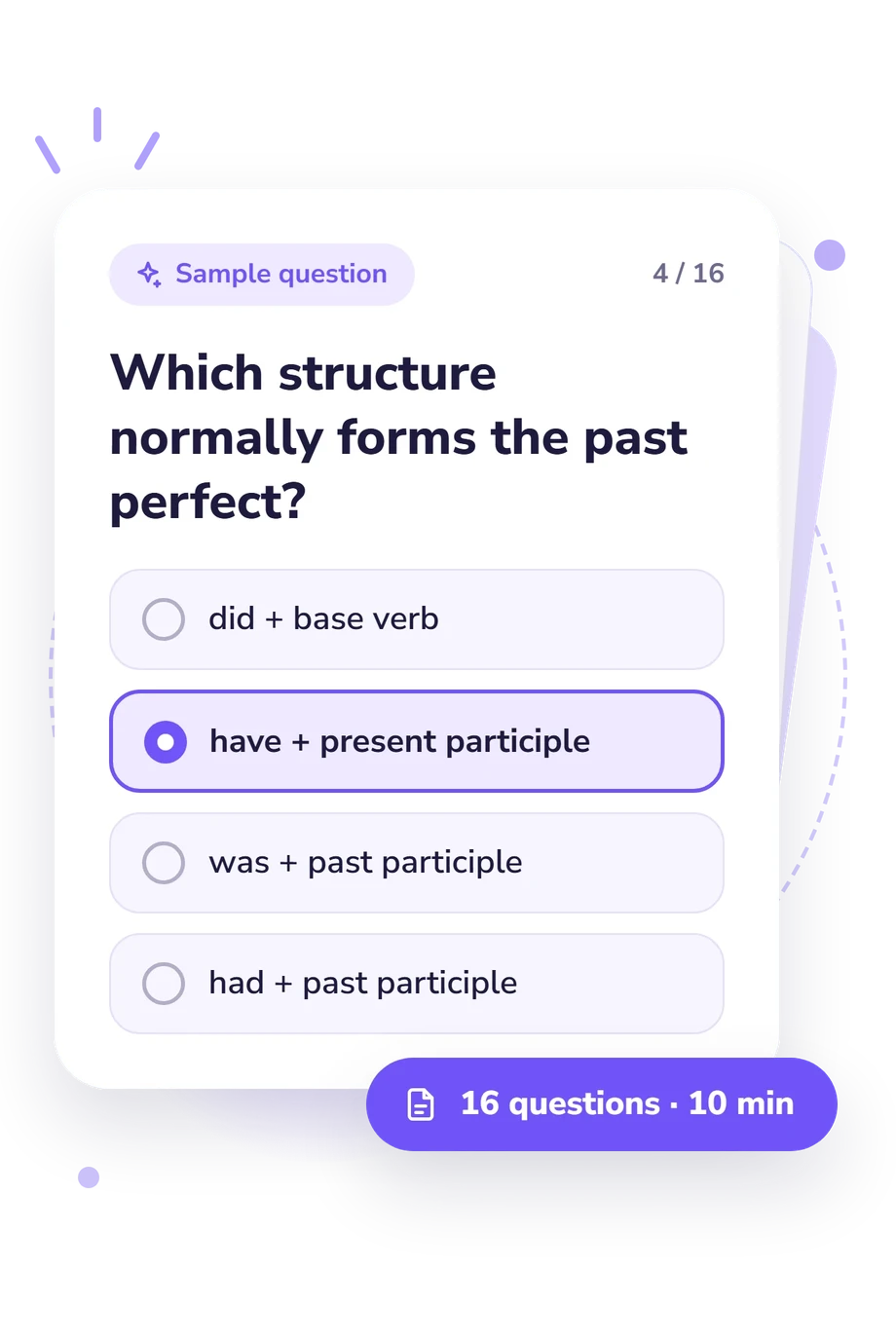
Example Questions From the Test
- Until that evening, I never saw snow before.
- Until that evening, I had never seen snow.
- Until that evening, I had never saw snow.
- Until that evening, I have never seen snow.
- When Sam had called at 9:00, I finish the report at 8:00.
- When Sam called at 9:00, I have finished the report.
- When Sam calls at 9:00, I had finished the report.
- By the time Sam called at 9:00, I had finished the report.
- Did they had met before the conference?
- Had they met before the conference?
- Had they meet before the conference?
- Have they met before the conference ended?
Past Perfect Quiz - Description and methodology of the test
Anyone deciding whether they can distinguish earlier and later past events can use this past perfect quiz to test that specific skill. It is suited to students seeking a focused review of form, meaning, and use before further study. Past perfect grammar practice can then show which constructions deserve more attention, giving the result a practical snapshot of current control.
What This Assessment Explores
Questions assess whether a learner can recognize, select, and interpret past-perfect forms when one completed event precedes another past reference point. They also cover affirmative, negative, question, contracted, passive, and conditional constructions, so the quiz on the past perfect tense tests recognition and interpretation across forms and timelines.
The items represent these skill groups:
- Form recognition shows whether the learner selects had plus a past participle correctly.
- Timeline sequencing shows whether the learner identifies which event happened first.
- Sentence control shows whether the learner handles questions, negatives, contractions, and passives.
- Past unreal conditions show whether the learner links a hypothetical condition to its imagined result.
The result is reported as Past Perfect Knowledge (0-16): Foundation (0-6) indicates emerging control, Developing (7-12) reflects the main pattern with some difficulty in complex forms, and Strong (13-16) indicates accurate use across timelines.
Methodology and Evidence Base
Each item presents four answer choices, and the learner selects the sentence or phrase that best fits the grammatical rule or timeline. The questions group around form, sequence, sentence type, and conditional meaning, so the score reflects performance across several uses rather than recall of one formula.
This past perfect practice test awards one point for each correct choice toward the raw total. The raw score is placed into the displayed band for its range.
Methodologically, the questionnaire is conceptually consistent with Vandenhoek (2018), whose work examines the tense in corpus and EFL/ESL materials; it is not an adaptation of that study. Carter and McCarthy’s grammar reference complements this account of forms and uses in spoken and written English.
Interpret the result as a focused learning snapshot. Attention, terminology, and study context can affect performance, and these items cannot represent overall grammar proficiency. A lower band identifies practice targets; a higher band shows stronger performance on these constructions, not mastery of English as a whole.
- Vandenhoek, Tim. 2018. The Past Perfect in Corpora and EFL/ESL Materials. Research in Language 16(1): 113-133. 10.2478/rela-2018-0005
- Carter, Ronald, and Michael McCarthy. 2006. Cambridge Grammar of English: A Comprehensive Guide to Spoken and Written English Grammar and Usage. Cambridge: Cambridge University Press
Updated: