
Parts of a Flower Quiz
How the Scales are Structured
Who Usually Takes This Test?
See How You Compare
Below is a preview of how scores are typically distributed across each scale.
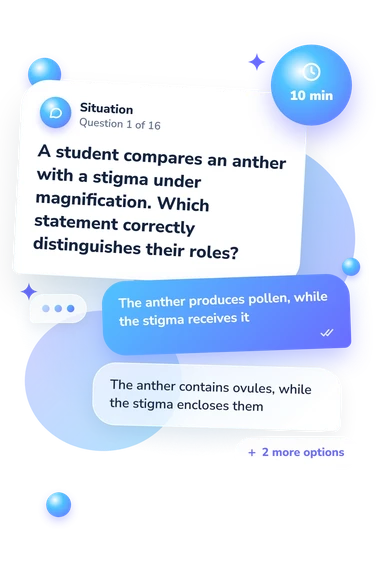
Example Questions From the Test
- Petals
- Anthers
- Seeds
- Sepals
- Ovule
- Style
- Filament
- Sepal
- Roots, stems, leaves, and flowers
- Petals, anthers, pollen, and nectar
- Sepals, petals, ovules, and fruit
- Sepals, petals, stamens, and carpels
Parts of a Flower Quiz - Description and methodology of the test
Students, gardeners, and curious readers can use this assessment to identify floral organs and connect classroom terms with their roles in pollination and seed formation. The Parts of a Flower Quiz links familiar labels to the reproductive sequence that leads from pollen transfer to fertilization and seed formation. The flower structure quiz connects named flower organs with their roles in pollination and seed formation.
What This Assessment Explores
Floral structures form a connected system rather than isolated vocabulary. Questions distinguish anther, stigma, filament, style, ovary, sepal, receptacle, and pedicel, then link each to its position or function. Recognition extends from naming organs to pollination, fertilization, and seed formation.
The flower parts quiz examines these connected knowledge areas:
- Structure identification shows whether you can locate the organs and supporting parts of a flower.
- Functional relationships show whether you can connect anthers, stigmas, ovaries, and other parts with their biological jobs.
- Pollination knowledge shows whether you understand how pollen reaches the receptive female surface.
- Reproduction knowledge shows whether you can follow fertilization and the development of ovules into seeds.
The single result is Flower Parts Knowledge, scored from 0-16. Its bands are Emerging (0-6), Developing (7-12), and Strong (13-16), describing increasing command of structures, functions, pollination, and fertilization.
Methodology and Scientific Basis
Each item presents a short identification or application problem with four answer choices. Some ask for a term matching a location; others require the reader to predict what changes when petals or anthers are removed, or to trace pollen from anther to ovule. The format tests selected-response knowledge and basic biological reasoning rather than extended written explanation.
The displayed total equals the number of correct answers. The resulting level summarizes performance across identifying structures, matching them with functions, and following the sequence from pollination to seed formation. Classroom exposure, revision, language familiarity, and attention on the day can all affect the result.
The questionnaire is conceptually consistent with the floral biology described by Glover (2014) and Evert and Eichhorn (2013), while Lord and Russell (2002) address the pollination and fertilization mechanisms represented here. Those sources support the biology represented by the questions, while the questionnaire presents that material through its own selected-response format. The flower anatomy quiz offers a snapshot of current understanding, not practical dissection skill or the full scope of plant biology.
- Glover, Beverley J. Understanding Flowers and Flowering: An Integrated Approach. 2nd ed. Oxford: Oxford University Press, 2014. 10.1093/acprof:oso/9780199661596.001.0001
- Evert, Ray F., and Susan E. Eichhorn. Raven Biology of Plants. 8th ed. New York: W. H. Freeman and Company, 2013.
- Lord, Elizabeth M., and Scott D. Russell. "The Mechanisms of Pollination and Fertilization in Plants." Annual Review of Cell and Developmental Biology 18 (2002): 81-105. 10.1146/annurev.cellbio.18.012502.083438
Updated: