
Pancake Day Quiz
How the Scales are Structured
Who Usually Takes This Test?
See How You Compare
Below is a preview of how scores are typically distributed across each scale.
Example Questions From the Test
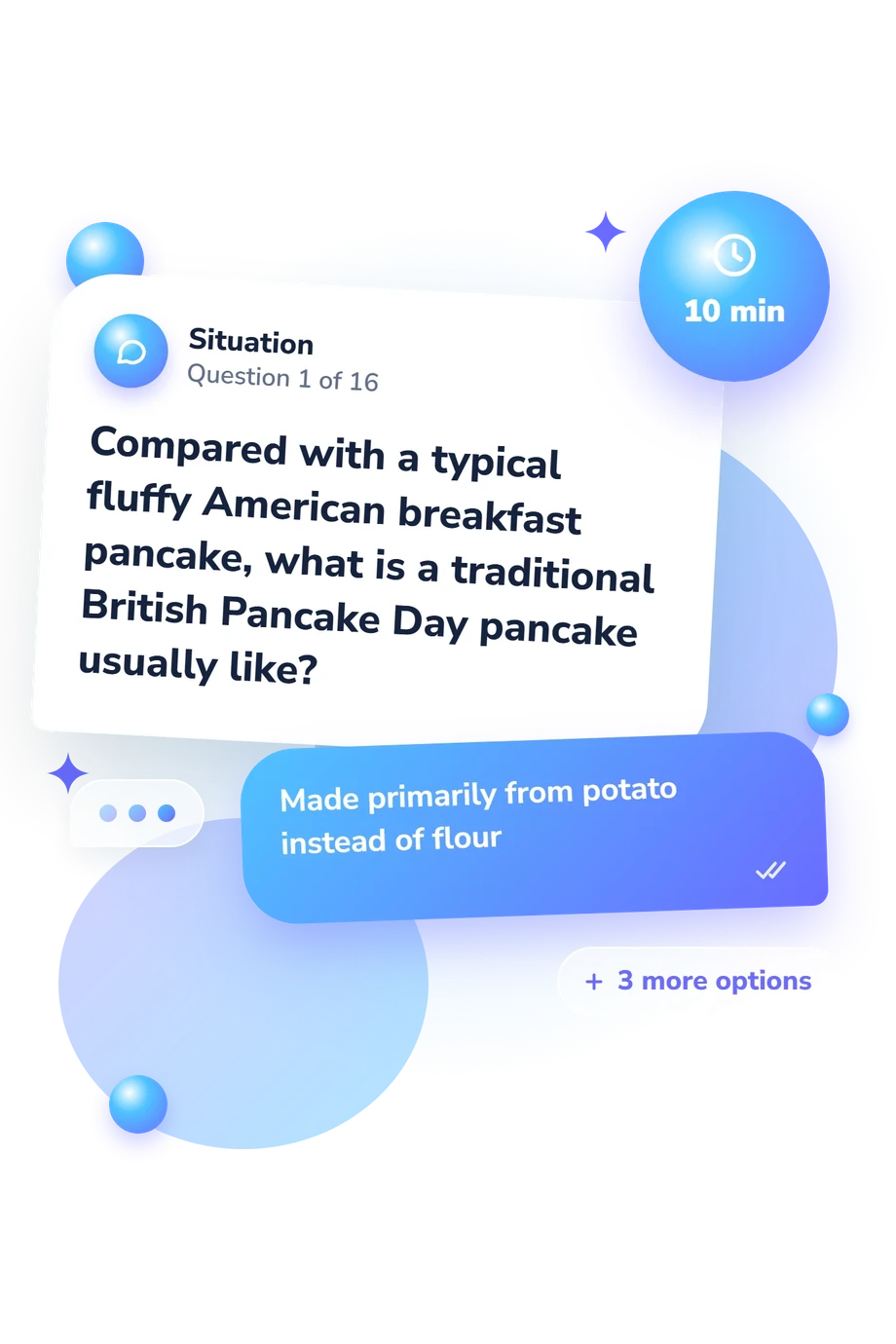
- Made primarily from potato instead of flour
- Thicker because it contains considerably more raising agent
- Baked in an oven rather than cooked in a pan
- Thinner and closer in style to a crêpe
- It must occur after the first full week of February
- Each country chooses a date based on its school calendar
- Its date is calculated in relation to the movable date of Easter
- It moves to the Tuesday with the most daylight before spring
- Palm Sunday
- Shrove Tuesday
- Maundy Thursday
- Easter Monday
Pancake Day Quiz - Description and methodology of the test
Curious readers who want to understand the traditions behind Shrove Tuesday can use this assessment to check their factual knowledge across history, religion, food, and public celebration. The Pancake Day Quiz turns those themes into a challenge for learners who enjoy connecting familiar customs with their wider cultural setting. It also works as a Pancake Day trivia activity, showing which areas deserve further exploration.
What This Assessment Explores
This general-knowledge questionnaire examines Pancake Day through its calendar setting, Christian traditions, British customs, food, and international celebrations. It is intended for curious learners; the result reflects knowledge of the subject rather than personal observance.
Its format combines historical recognition with practical and cultural details, making the assessment a useful pancake quiz for distinguishing related customs, ingredients, dates, and activities.
The result uses one scale:
- Pancake Day Knowledge (0-16) counts correct answers and assigns Tradition Starter (0-6), Knowledge Building (7-12), or Tradition Expert (13-16).
- Calendar items show understanding of Shrovetide, Lent, Easter, and Shrove Tuesday’s timing.
- Food items indicate recognition of British batter, toppings, and cooking cues.
- International and activity items measure familiarity with Mardi Gras, Fat Thursday, and pancake races.
Methodology and Evidence Base
Each item presents four answer options and asks the respondent to choose the best answer. Scoring is direct: the total reflects the number of correct responses, so higher results show stronger performance on this factual set. The bands describe knowledge levels within the questionnaire rather than population norms or clinical categories.
The content is conceptually consistent with Hutton (1996), whose discussion supports the treatment of Shrovetide’s timing, ritual transition, and British customs. Albala (2008) contributes context for pancakes as a food with varied cultural forms, while Simpson and Roud (2003) supports the terminology and folklore references. These sources support the subject matter, but this online questionnaire is not a reproduction or validated adaptation of a published instrument.
The assessment functions as a Pancake Day knowledge test that measures recall and recognition. Results may reflect prior education, family traditions, cultural exposure, and attention during completion. The score describes performance on this content set; it does not measure personal observance, cooking ability, or the celebration’s meaning to the respondent. Reviewing missed topics can guide further learning.
- Hutton, Ronald. “Shrovetide.” In The Stations of the Sun: A History of the Ritual Year in Britain, pp. 151-168. Oxford University Press, 1996. 10.1093/acprof:oso/9780198205708.003.0015
- Albala, Ken. Pancake: A Global History. Reaktion Books, 2008.
- Simpson, Jacqueline, and Steve Roud. A Dictionary of English Folklore. Oxford University Press, 2003.
Updated: