
Order of Operations Quiz
How the Scales are Structured
Who Usually Takes This Test?
See How You Compare
Below is a preview of how scores are typically distributed across each scale.
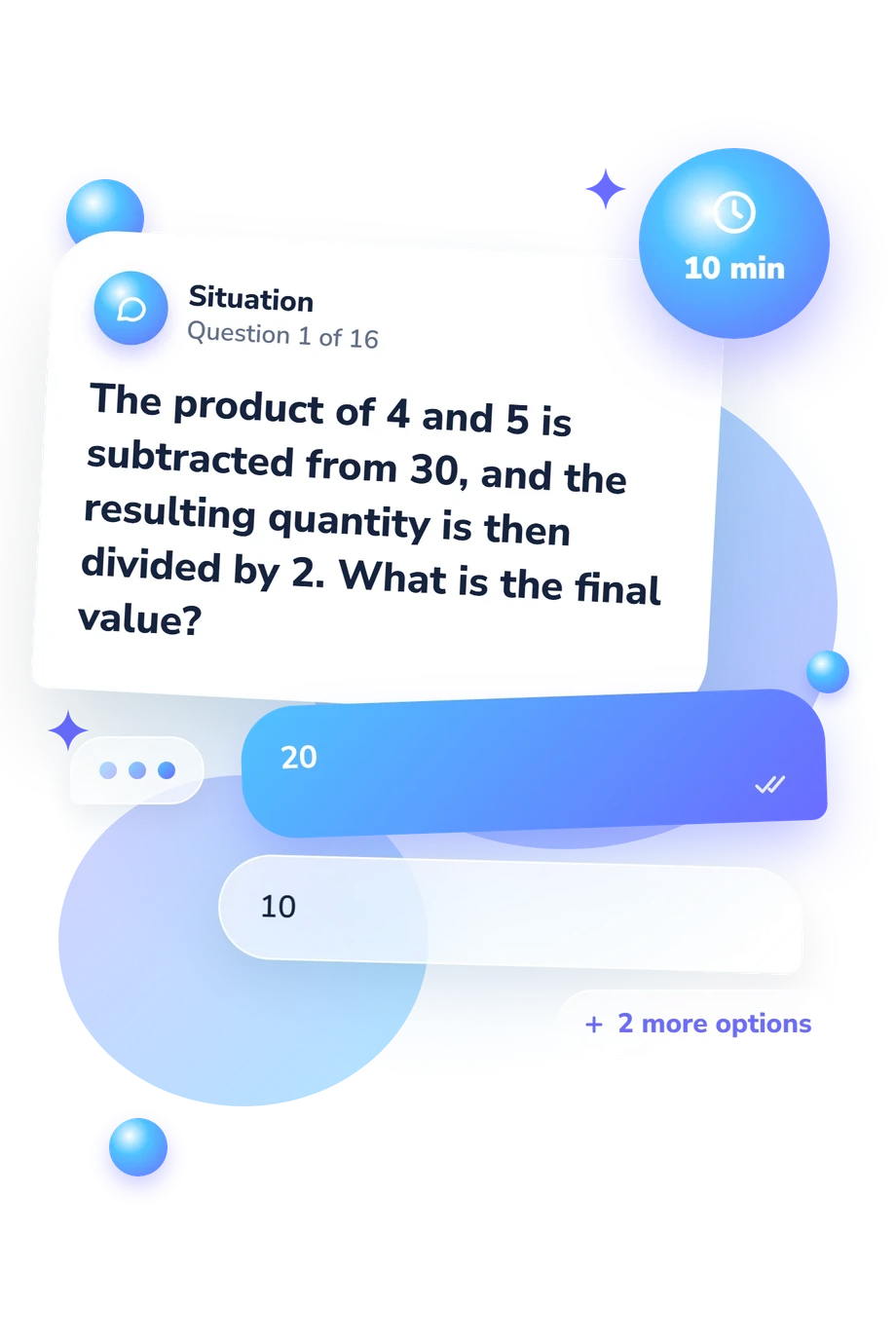
Example Questions From the Test
- 20
- 10
- 5
- 25
- 21
- 39
- 11
- 29
- 0
- 12
- 4
- 18
Order of Operations Quiz - Description and methodology of the test
Students, parents, tutors, and adults refreshing arithmetic skills can use this order of operations quiz to examine how they interpret multi-step expressions and explain their choices. This order of operations test is useful when errors come from mixing grouping, exponents, multiplication, division, addition, or subtraction rather than from calculation alone. The result identifies a current level of command and points toward practical review priorities.
What This Assessment Explores
The questionnaire examines whether a respondent can apply precedence rules, preserve grouping, and recognize why an alternative answer is incorrect. It suits learners and adults reviewing arithmetic, especially when errors appear in multi-step or verbal situations. The questionnaire uses an order of operations algebra quiz format, although its items chiefly assess arithmetic sequencing rather than symbolic algebra.
The main skill areas represented by the questions are:
- Precedence shows whether multiplication and division come before addition and subtraction.
- Grouping shows whether parentheses are resolved as a unit.
- Exponents show whether powers are evaluated at the correct stage.
- Left-to-right processing shows whether equal-priority operations follow their written order.
- Applied expressions show whether words become correctly structured calculations.
Together, these skills form the Order of Operations Knowledge scale (0-16): Foundations to Review (0-6), Developing Command (7-12), or Strong Command (13-16).
Methodology and Scientific Basis
Each item presents an expression, word problem, or statement about a method, followed by multiple-choice answers. Options may be numerical results or descriptions of the correct step sequence, so the format tests both execution and recognition of misconceptions. Some prompts ask the respondent to evaluate another solver’s reasoning, not merely calculate a final value. When this questionnaire is taken online as an order-of-operations quiz, selecting an answer requires attention to notation as well as arithmetic.
The study by Eaves, Attridge, and Gilmore on order-of-operations misconceptions offers the closest conceptual match because it examines misconceptions involving precedence and associativity. Zazkis and Rouleau explain how operation conventions are understood beyond mnemonic acronyms, while Glidden reports difficulties with these conventions among prospective elementary teachers. This questionnaire is conceptually consistent with those studies, not an adaptation of them.
Scoring condenses the selected responses into one knowledge result and provides descriptive bands for that score rather than a norm-referenced interpretation; performance can shift with attention, reading accuracy, and familiarity with conventional notation, so the result helps target practice and self-reflection without representing overall mathematical ability.
- Eaves, Joanne M., Nina Attridge, and Camilla Gilmore. (2025). Misconceptions of the order of operations and associativity use. Learning and Instruction, 97, 1-14, Article 102074. 10.1016/j.learninstruc.2024.102074
- Zazkis, Rina, and Annette Rouleau. (2018). Order of operations: On convention and met-before acronyms. Educational Studies in Mathematics, 97, 143-162. 10.1007/s10649-017-9789-9
- Glidden, Peter L. (2008). Prospective Elementary Teachers’ Understanding of Order of Operations. School Science and Mathematics, 108(4), 130-136. 10.1111/j.1949-8594.2008.tb17819.x
Updated: