
Old Wives Tales Gender Quiz
How the Scales are Structured
Who Usually Takes This Test?
See How You Compare
Below is a preview of how scores are typically distributed across each scale.
Example Questions From the Test
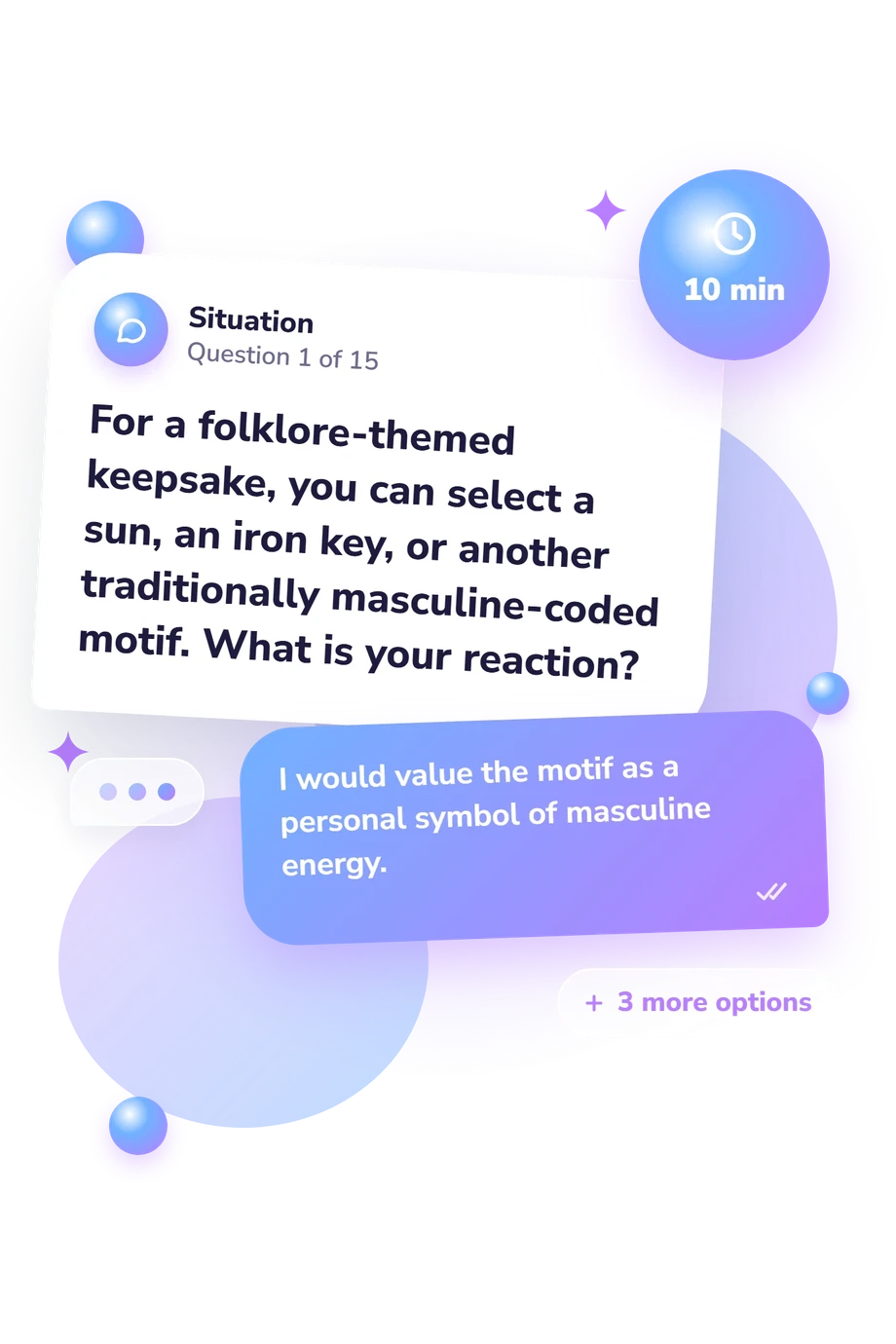
- I would value the motif as a personal symbol of masculine energy.
- I would enjoy its masculine association as one part of its meaning.
- I might choose it for the story or appearance rather than its gender association.
- I would prefer a motif without a masculine association.
- I would find the description strongly affirming and personally accurate.
- It would often fit, although not in every setting or mood.
- I could enjoy it as a loose metaphor without taking it as an identity statement.
- I would prefer that feminine language not be applied to me.
- Choose the type that fits me and enjoy the tale within that category.
- Choose the closer type while noting that neither captures everything.
- Combine parts of both types to make a more personal result.
- Rewrite the premise so people can fall between, beyond, across, or outside the two types.
Old Wives Tales Gender Quiz - Description and methodology of the test
People considering how they want gender language or presentation to feel in everyday settings can use this assessment before deciding whether its questions fit their interests. The Old Wives Tales Gender Quiz organizes those preferences into a profile without requiring a fixed label. Its folklore framing makes it a gender wives tales quiz exploring conventional and expansive expectations.
What This Assessment Explores
Items explore current affinity with feminine-coded, masculine-coded, and gender-expansive language, presentation, and symbolism. They cover forms of address, styling, labels, and flexibility around gender. Anyone reflecting on expression or identity language can use it without choosing a particular label.
Folklore is a prompt, not proof. As a gender expression quiz, the result describes resonance with patterns rather than assigning identity.
The result contains three dimensions:
- Feminine Energy (0-15) reflects feminine-coded language, presentation, and symbolism: Light resonance 0-5; Meaningful resonance 6-10; Strong resonance 11-15.
- Masculine Energy (0-15) reflects masculine-coded language, presentation, and symbolism: Light resonance 0-5; Meaningful resonance 6-10; Strong resonance 11-15.
- Gender-Expansive Energy (0-15) reflects affinity with fluid, nonbinary, agender, mixed, or otherwise self-defined ways of relating to gender and does not assign a specific identity label: Defined elsewhere 0-5; Open exploration 6-10; Strong expansion 11-15.
Methodology and Scientific Basis
Each item presents a situation with four response options. Choices range from strong identification to contextual or partial fit, symbolic appreciation without identity meaning, or preference for neutral and self-defined language. The format adds nuance, but it remains self-report and depends on respondent’s interpretation and current context.
Scale scores are compared. The highest is the strongest current affinity; scores within one point indicate a blended profile. The ranges are the catalogue’s descriptive result bands; the cited instruments do not standardize this online questionnaire.
Conceptually, the questionnaire is consistent with the Gender Self-Report, which treats gender as multidimensional, and with the Genderqueer Identity Scale, whose framework includes flexibility and self-definition. Its coded masculinity and femininity fit the role-oriented approach described by Kachel, Steffens, and Niedlich. These sources support the construct rationale; they do not make this questionnaire an adaptation or standardized administration of those instruments.
Read as a gender identity quiz, the result is a snapshot of present resonance. Mood, social context, changing language preferences, self-awareness, and response bias can influence it, so personal context is needed to interpret a score.
- Strang, J. F., Wallace, G. L., Michaelson, J. J., et al. (2023). The Gender Self-Report: A Multidimensional Gender Characterization Tool for Gender-Diverse and Cisgender Youth and Adults. American Psychologist, 78(7), 886-900. 10.1037/amp0001117
- McGuire, J. K., Beek, T. F., Catalpa, J. M., & Steensma, T. D. (2018). The Genderqueer Identity (GQI) Scale: Measurement and Validation of Four Distinct Subscales with Trans and LGBQ Clinical and Community Samples in Two Countries. The International Journal of Transgenderism, 20(2-3), 289-304. 10.1080/15532739.2018.1460735
- Kachel, S., Steffens, M. C., & Niedlich, C. (2016). Traditional Masculinity and Femininity: Validation of a New Scale Assessing Gender Roles. Frontiers in Psychology, 7, 956. 10.3389/fpsyg.2016.00956
Updated: