
Nutrition Quiz for Kids
How the Scales are Structured
Who Usually Takes This Test?
See How You Compare
Below is a preview of how scores are typically distributed across each scale.
Example Questions From the Test
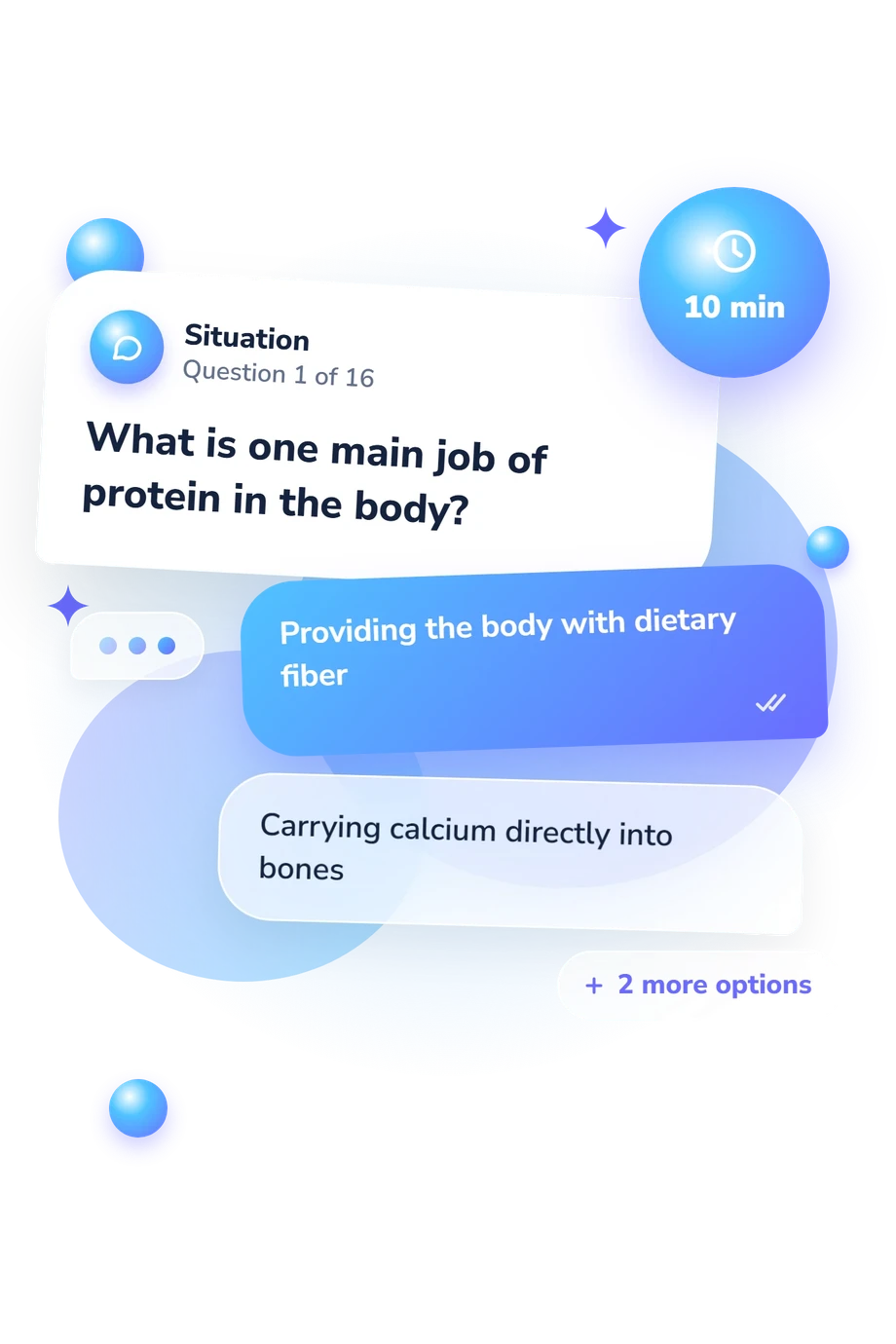
- Providing the body with dietary fiber
- Carrying calcium directly into bones
- Helping the body grow and repair tissues
- Replacing the body's need for water
- Calcium
- Sodium
- Vitamin C
- Iron
- Added sugar
- Fiber
- Sodium
- Caffeine
Nutrition Quiz for Kids - Description and methodology of the test
For children who are learning to make sense of everyday food choices, this assessment offers a structured way to check what they know. The nutrition quiz for kids can give a child and trusted adult a shared starting point for a supportive learning conversation about the overall result. This focus on food knowledge for children keeps the assessment educational rather than centered on weight or appearance.
What This Assessment Explores
Questions cover knowledge about food and the body in situations children may meet at home, school, or during activities. The score indicates broad childhood nutrition knowledge; it does not identify strengths or gaps. The questions address healthy eating for kids through decisions about food, not weight or appearance.
The areas below describe topics covered by the questions:
- Questions about nutrients ask what protein, calcium, fiber, iron, and vitamin C do.
- Balanced choices examine how variety and food combinations support meals and snacks.
- Labels and hydration involve comparing added sugars, recognizing whole-grain wording, and choosing ordinary drinks.
- Safety and body signals address reactions, storage, thirst, and comfortable fullness.
The displayed scale is Childhood Nutrition Knowledge (0-16): Foundations to build (0-6), Developing knowledge (7-12), or Strong knowledge (13-16). This broad educational result cannot show personal dietary needs, growth, or allergies.
Methodology and Scientific Basis
Each item presents a familiar situation or question with four answer choices, asking the respondent to select the best answer. This multiple-choice nutrition test for children checks recognition and application of basic ideas rather than a complete dietary record. The score summarizes responses across the items as an educational summary of questionnaire performance. It does not estimate a child's nutrient intake or judge whether a particular food is appropriate for that child.
The evidence base is conceptually consistent with the CNK-AU, a published child nutrition-knowledge measure described by de Vlieger and colleagues in 2022, but this online questionnaire is not that instrument or a validated adaptation of it. Research on food-label literacy, including work by Reynolds and colleagues in 2012, supports the relevance of label-reading tasks, while Carraway-Stage and colleagues reported in 2015 that structured food-based teaching can improve nutrition knowledge.
Interpretation is most useful when the result guides review and conversation about unfamiliar topics. This online version is an educational questionnaire; its displayed score should not be used to infer personal dietary needs, growth, or allergies. Guessing, reading ability, recent lessons, and current context may affect responses.
- Nienke de Vlieger, Nicholas Riley, Andrew Miller, Clare Collins, and Tamara Bucher. Development and Reliability Testing of a Nutrition Knowledge Questionnaire for Australian Children (the CNK-AU). Journal of Nutrition Education and Behavior 54(4) (2022): 335-345. 10.1016/j.jneb.2021.10.004
- Virginia Carraway-Stage, Jana Hovland, Carissa Showers, Sebastián Díaz, and Melani W. Duffrin. Food-Based Science Curriculum Yields Gains in Nutrition Knowledge. Journal of School Health 85(4) (2015): 231-240. 10.1111/josh.12243
- Jesse S. Reynolds, Judith A. Treu, Valentine Njike, Jennifer Walker, Erica Smith, Catherine S. Katz, and David L. Katz. The Validation of a Food Label Literacy Questionnaire for Elementary School Children. Journal of Nutrition Education and Behavior 44(3) (2012): 262-266. 10.1016/j.jneb.2011.09.006
Updated: