
Nursing Quiz
How the Scales are Structured
Who Usually Takes This Test?
See How You Compare
Below is a preview of how scores are typically distributed across each scale.
Example Questions From the Test
- Slow the transfusion and reassess the patient in five minutes
- Stop the transfusion and maintain IV access according to protocol
- Give the prescribed antipyretic before contacting anyone
- Finish the current unit, then send the blood bag for testing
- Performing the initial assessment after admission
- Obtaining and reporting routine vital signs
- Teaching the patient about a newly prescribed medication
- Evaluating whether a treatment plan is effective
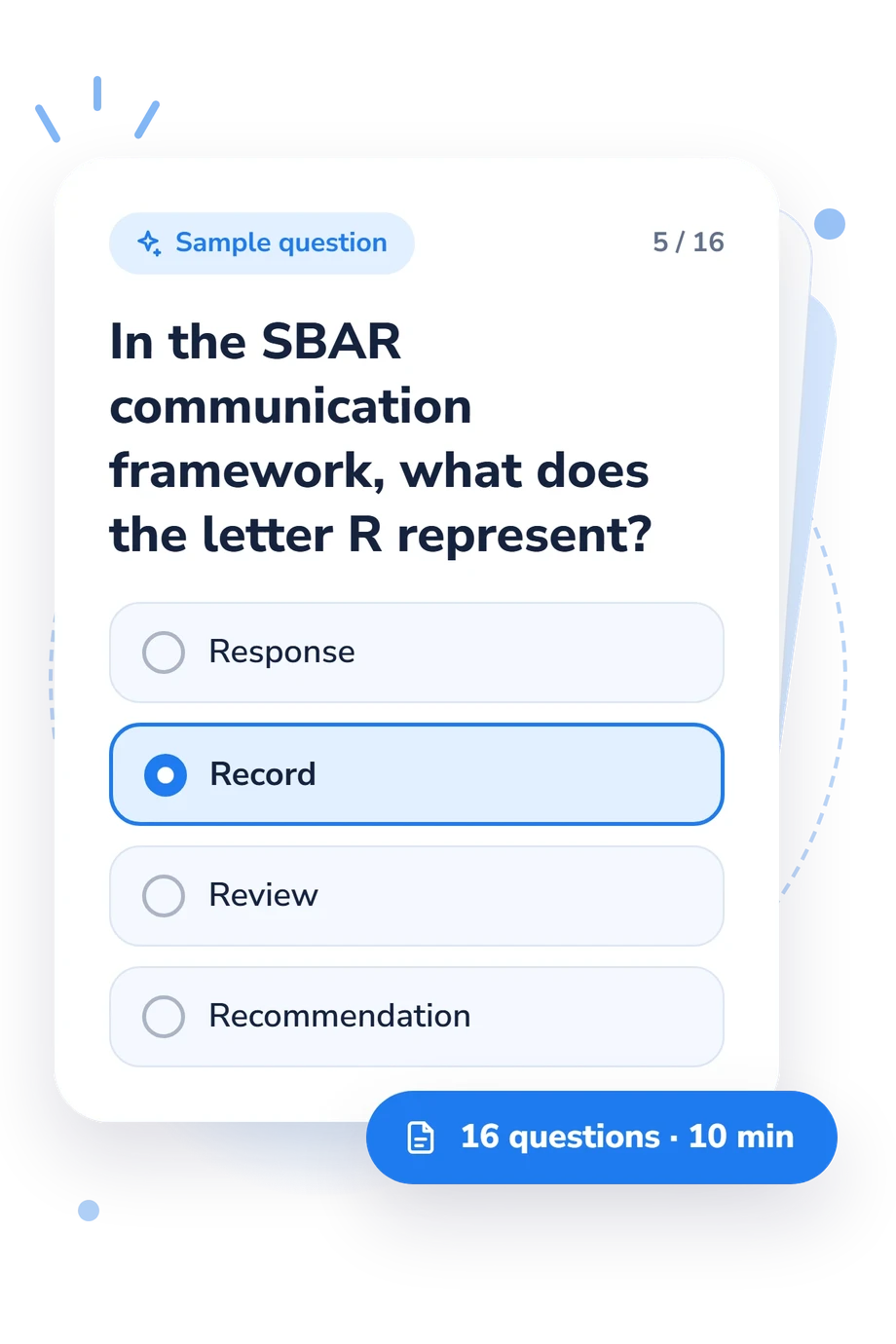
- Response
- Record
- Review
- Recommendation
Nursing Quiz - Description and methodology of the test
People reviewing foundational clinical decisions may find this nursing quiz useful before study or supervised practice. The format suits learners checking how they approach core nursing decisions without assuming a particular job title. Questions and answers in a quiz for nursing learners make the review concrete, while the result points to concepts that may deserve further attention.
What This Assessment Measures
The items assess nursing knowledge in prioritization, safety, communication, infection prevention, medication use, and changes in condition.
The tested items fall into four groups, represented by questions in this quiz for nursing learners:
- Safety and infection control show how you select precautions, use hand hygiene, and protect sterile fields.
- Assessment and escalation indicate whether you recognize deterioration and seek help.
- Communication and delegation reflect safe handoffs, consent, teaching, and task assignment.
- Medication and basic care show how you respond to allergies, glucose changes, opioids, transfusions, fluids, and catheters.
The result uses one Nursing Knowledge scale, scored from 0-16: Foundation Building (0-6) marks concepts to review; Developing Knowledge (7-12) indicates essentials with areas to revisit; Strong Foundation (13-16) reflects broad command of the tested concepts. It is an unvalidated educational score, not a clinical, licensing, or competency assessment.
Methodology and Evidence Base
The questionnaire contains 16 questions with four alternatives, covering factual recognition, calculations, safety principles, and priority decisions. The quiz for nursing learners with answers presents fixed alternatives rather than open prompts, so the respondent selects one response for each item.
The displayed total summarizes performance on those choices. It reflects only the concepts represented by these questions and can guide targeted review of those areas.
The subject areas are conceptually consistent with the NCSBN 2026 NCLEX-RN Test Plan, particularly its organization of nursing content and clinical judgment; this source provides context for the topics, not validation of this online questionnaire.
Viewed as a nursing safety assessment, it is an online educational questionnaire. Guessing, prior study, current context, wording, and local protocols can affect performance, so use the result to target review while real care follows current policy and qualified supervision.
- National Council of State Boards of Nursing. (2025). Report of Findings from the 2024 RN Nursing Knowledge Survey. Chicago: Author.
- National Council of State Boards of Nursing. (2026). 2026 NCLEX-RN Test Plan. Chicago: Author.
- Karen Domínguez Cancino, Marisol Arias, Erika Caballero, and Eliana Escudero. (2020). Development of a safe drug administration assessment instrument for nursing students. Revista Latino-Americana de Enfermagem, 28, e3246. 10.1590/1518-8345.2989.3246
- American Educational Research Association, American Psychological Association, and National Council on Measurement in Education. (2014). Standards for Educational and Psychological Testing. Washington, DC: AERA.
Updated: