
Norse Mythology Quiz
How the Scales are Structured
Who Usually Takes This Test?
See How You Compare
Below is a preview of how scores are typically distributed across each scale.
Example Questions From the Test
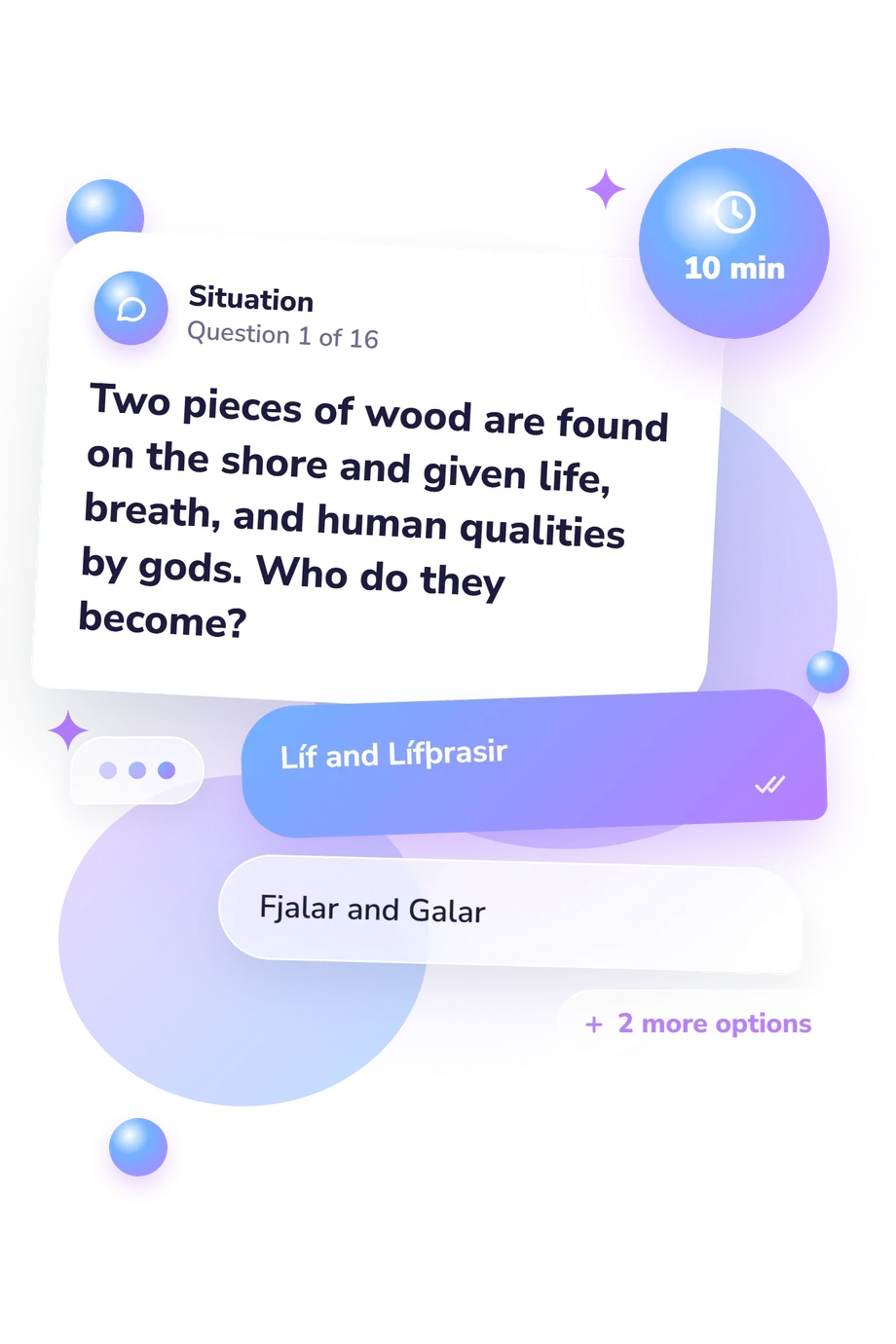
- Líf and Lífþrasir
- Fjalar and Galar
- Ask and Embla
- Sól and Máni
- Baldr
- Njord
- Bragi
- Tyr
- Mjölnir, the hammer
- Gungnir, the spear
- Skíðblaðnir, the ship
- Gjallarhorn, the horn
Norse Mythology Quiz - Description and methodology of the test
Readers who want to check their grasp of Scandinavian myths can use this assessment to identify what they recognize and where their knowledge is thinner. The Norse Mythology Quiz suits curious learners, casual readers, and fans revisiting familiar stories. Questions about deities and divine relationships make this a Norse god quiz, while additional items cover realms, objects, creatures, and turning points. The result offers a practical snapshot for choosing what to read next.
What This Assessment Measures
The questions sample widely attested episodes and relationships from Norse tradition. They cover figures such as Odin, Thor, Baldr, Tyr, Freyja, and Njord; places and structures such as Asgard, Hel, Bifröst, and Yggdrasil; and objects, creatures, and events including Mjölnir, Fenrir, Ragnarök, and the Mead of Poetry. A Norse mythology test of this kind checks factual familiarity and links among stories, not belief or literary interpretation.
The result uses one knowledge dimension. The displayed Norse Mythology Knowledge scale runs from 0-16 and has these bands:
- Foundation to build (0-6) indicates recognition of some core material while pointing to principal gods, realms, and stories worth revisiting.
- Developing knowledge (7-12) shows familiarity with many central narratives while leaving room for less familiar relationships and details.
- Strong knowledge (13-16) reflects a well-developed command of major myths and connections across stories, while allowing for variation among source traditions.
Methodology and Evidence Base
Each item presents a short mythological prompt with four answer choices. The set uses recognition-based multiple choice, so the result depends on selecting the option that best matches a named episode, figure, object, place, or outcome. These four-option recognition items produce a descriptive knowledge result for this question set, reflecting how many mythological details the respondent identifies correctly.
The item content is conceptually consistent with the Prose Edda, especially its accounts of gods, cosmology, heroic episodes, and Ragnarök. Larrington’s translation supplies a complementary poetic source tradition, while Lindow’s guide helps situate names, motifs, and variant tellings. These works support the subject matter; they do not make the online questionnaire an adaptation of any one published instrument. Its format turns Norse mythology trivia into a structured recall exercise.
Interpret the result as a snapshot of performance under fixed wording. Different translations, spellings, and mythic variants can affect familiarity, while guessing and uneven exposure may influence answers. The score therefore describes performance on this knowledge set, not the entirety of Norse tradition or a permanent level of expertise.
- Sturluson, Snorri. The Prose Edda of Snorri Sturluson: Tales from Norse Mythology. Selected and translated by Jean I. Young. University of California Press, 1964.
- Larrington, Carolyne, translator. The Poetic Edda. 2nd ed. Oxford University Press, 2014. 10.1093/owc/9780199675340.001.0001.
- Lindow, John. Norse Mythology: A Guide to the Gods, Heroes, Rituals, and Beliefs. Oxford University Press, 2002. 10.1093/oso/9780195153828.001.0001.
Updated: