
Nihilism Quiz
How the Scales are Structured
Who Usually Takes This Test?
See How You Compare
Below is a preview of how scores are typically distributed across each scale.
Example Questions From the Test
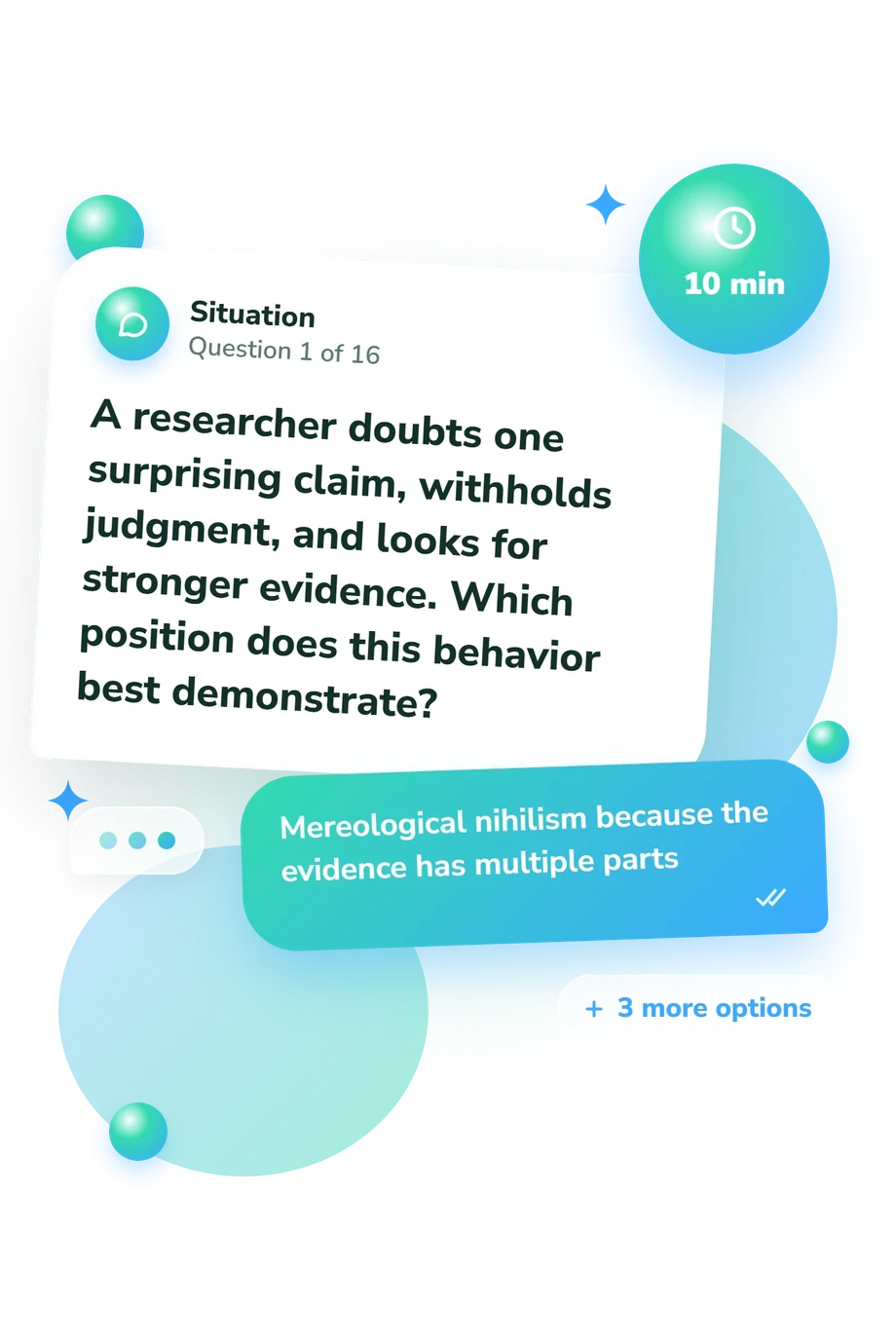
- Mereological nihilism because the evidence has multiple parts
- Existential nihilism because the researcher lacks a life purpose
- Moral nihilism because the researcher avoids judging conduct
- Methodological skepticism rather than a nihilistic denial of knowledge
- That people can experience happiness or satisfaction
- That human life has an inherent or objectively given meaning
- That physical objects exist independently of perception
- That governments can exercise legitimate authority
- Whether genuine knowledge or justified truth claims are possible
- Whether governments deserve obedience
- Whether moral action should maximize happiness
- Whether artworks can be objectively beautiful
Nihilism Quiz - Description and methodology of the test
Readers preparing to study philosophy can use this nihilist quiz to check their grasp of core distinctions before further study. The nihilism quiz is intended for students, curious readers, and anyone revisiting questions about meaning, morality, knowledge, and agency. Reviewing the covered concepts can help you decide which areas to read about next.
What This Assessment Explores
For readers comparing neighboring positions, the nihilism test examines whether you recognize what nihilism does and does not claim. Items cover existential, moral, epistemological, and mereological nihilism, while distinguishing them from skepticism, pessimism, existentialism, absurdism, determinism, and relativism. Short scenarios ask you to identify a position or detect a logical error.
The main areas are:
- Conceptual distinctions show whether you separate nihilism from neighboring positions.
- Meaning and value show how you understand purpose, morality, and chosen commitments.
- Knowledge, reality, and agency show how you connect justified belief, composite objects, choice, responsibility, and meaninglessness.
Your result is reported as Nihilism Knowledge: 0-16, with Foundational (0-6), Developing (7-12), or Strong (13-16) bands. It reflects overall performance across the concepts covered, while reviewing the question topics can suggest areas for further reading.
Methodology and Scientific Basis
Each item presents a brief claim or situation with answer options; you choose the response that best matches the relevant philosophical distinction. Scoring is knowledge-based: each correct choice adds one point, and the total is interpreted through the displayed performance bands rather than a clinical severity model. As a philosophy quiz, it rewards precise distinctions, not agreement with a particular life stance.
The framework is conceptually consistent with the Existential Nihilism Scale (Forsythe & Mongrain, 2023), especially its treatment of meaning, value, and existential negation. This questionnaire is not an adaptation or digital administration of that published scale. Crosby’s 1988 analysis provides broader context for modern nihilism and contrasts among nihilism, existential responses, and the absurd.
The online questionnaire tests conceptual knowledge through fixed questions on meaning, morality, knowledge, and agency. The result shows how accurately you handled the ideas represented here, not how nihilistic your personality is. Performance can reflect prior reading, educational background, language comfort, and guessing, while philosophical labels vary across traditions. Treat the score as a snapshot of conceptual knowledge and a guide to further study.
- Forsythe, Jeremy, and Myriam Mongrain. "The Existential Nihilism Scale (ENS): Theory, Development, and Psychometric Evaluation." Journal of Psychopathology and Behavioral Assessment 45, no. 3 (2023): 865-883. 10.1007/s10862-023-10052-w
- Crosby, Donald A. The Specter of the Absurd: Sources and Criticisms of Modern Nihilism. Albany: State University of New York Press, 1988. 10.2307/jj.18255035
Updated: