
Never Have I Ever Quiz
How the Scales are Structured
Who Usually Takes This Test?
See How You Compare
Below is a preview of how scores are typically distributed across each scale.
Example Questions From the Test
- They should have had the experience more often than anyone else
- They should not have had the experience named in their statement
- They should know in advance which players have had the experience
- They should be willing to prove the statement with evidence
- Ask them to explain which experiences they are avoiding
- Remove them from the round whenever they skip a prompt
- Allow a pass only if most of the group approves
- Agree that anyone may pass without having to justify the choice
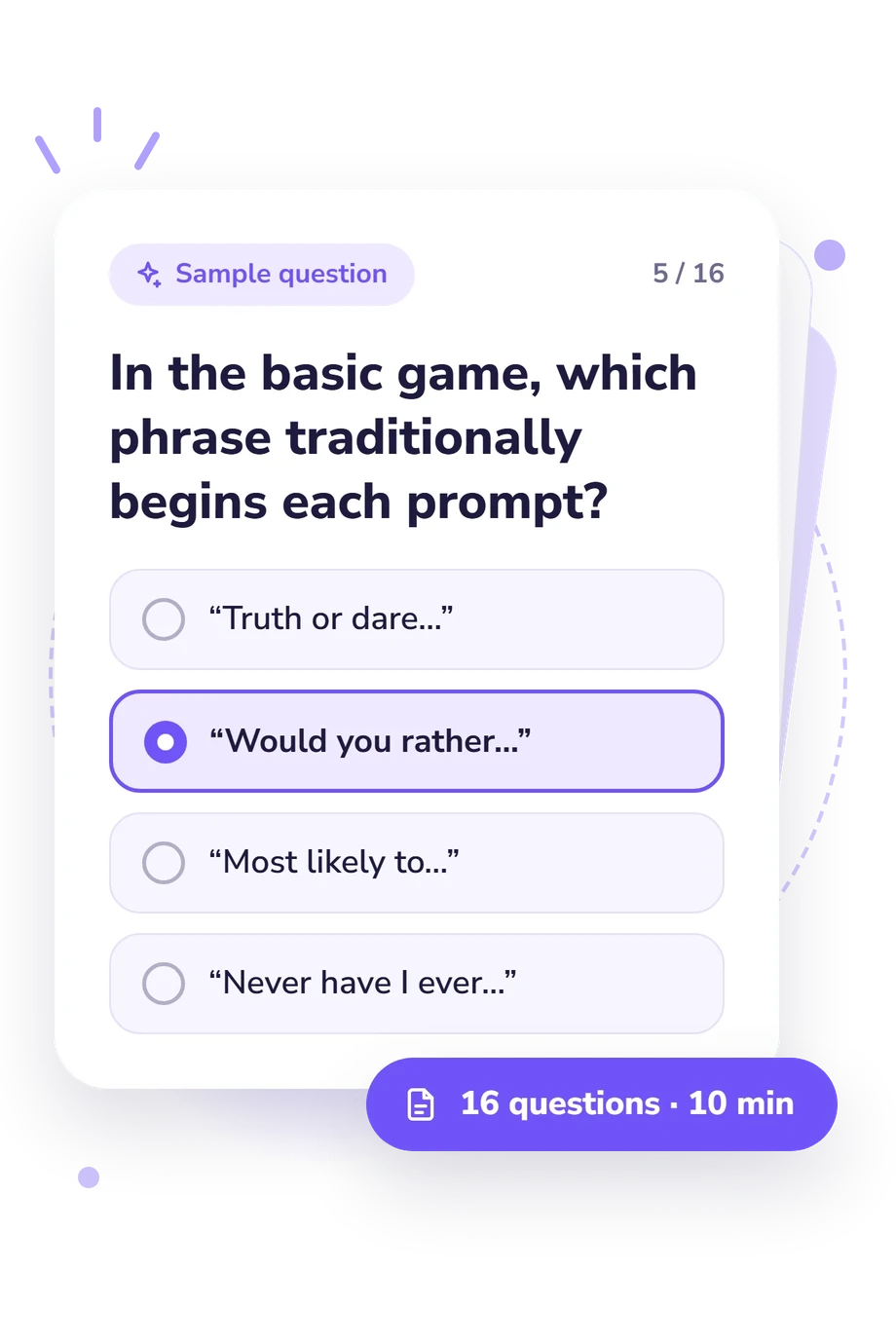
- “Truth or dare…”
- “Would you rather…”
- “Most likely to…”
- “Never have I ever…”
Never Have I Ever Quiz - Description and methodology of the test
Designed for people who want to understand the game before joining, hosting, or adapting a round, the Never Have I Ever Quiz turns familiar play into a focused knowledge check. It also serves as a never have i ever rules quiz for readers who want to distinguish the traditional format from casual variations. The result summarizes practical rule knowledge rather than personal experience.
What This Assessment Explores
The questions examine whether a player can recognize the defining mechanics of the classic game and apply them to ambiguous or unfamiliar situations. The questions also make this a quiz about Never Have I Ever questions, focusing on prompt wording, response rules, finger counting, passes, turns, inclusive choices, and house rules.
The main content falls into three practical areas:
- Prompt design shows whether the player can identify clear, assessable experiences and avoid wording that singles someone out.
- Response mechanics measure recognition of the traditional phrase, finger-counting sequence, and one-response-per-prompt logic.
- Group procedure reflects understanding of passes, shared definitions, inclusive choices, and agreed variants.
The displayed scale is Never Have I Ever Knowledge (0-16): Rule Starter (0-6), Capable Player (7-12), and Game Guide (13-16). A higher band indicates stronger familiarity with structured play; it does not measure creativity, sociability, or live hosting skill.
Methodology and Evidence Base
The method is a multiple-choice knowledge assessment. Each item presents a short rule or play situation followed by four answer choices. The respondent selects the best answer, and the displayed score awards one point for each correct response. The result is therefore a knowledge total, not a frequency rating or judgment about how often someone plays.
The INI, LLC game instructions provide a direct source for the Never Have I Ever game rules covering traditional wording, finger mechanics, passes, and house rules. The 2013 study by LaBrie, Ehret, and Hummer places Never Have I Ever among recognizable drinking-game formats, providing context for one common version. Inclusive play is addressed through the questionnaire’s own items about passes, clear prompts, and mixed groups.
Interpret the result as guidance for what to review next. Lower results may point to response mechanics and etiquette; higher ones suggest command of prompts, boundaries, and hosting structure. Because house rules vary, scores may reflect a particular version as well as general understanding. The displayed bands are catalogue categories of game knowledge, not comparisons with a normative sample.
- INI, LLC. (2022). Never Have I Ever Pocket Edition: Game Instructions. INI, LLC.
- LaBrie, Joseph W., Phillip J. Ehret, and Justin F. Hummer. (2013). Are they all the same? An exploratory, categorical analysis of drinking game types. Addictive Behaviors, 38(5), 2133-2139. 10.1016/j.addbeh.2012.12.002
- Villanova University. (n.d.). Community Building Icebreakers. Villanova University.
Updated: