
Music Recommendations Quiz
How the Scales are Structured
Who Usually Takes This Test?
See How You Compare
Below is a preview of how scores are typically distributed across each scale.
Example Questions From the Test
- A current pop track with an immediate chorus everyone can join
- A melodic crowd-pleaser that builds gradually into its hook
- A familiar genre mix with one or two obvious singalongs
- A deeper cut chosen for atmosphere rather than recognition
- Catching the internal rhymes, wordplay and shifts in flow
- Hearing how the delivery locks into the beat
- Returning to the melodic hook between verses
- Finding a related track with more singing or instrumentation
- I replay the song immediately and enjoy how quickly it landed
- I save it, then check whether the verses are equally satisfying
- I enjoy the hook but wait to see whether it lasts
- I move toward something less immediate and more unpredictable
Music Recommendations Quiz - Description and methodology of the test
Curious listeners can use this music recommendations quiz to build a practical map of musical preferences from their responses. It also works as a song recommendations quiz for comparing familiar favorites with unexplored styles, while producing a useful personal guide. The result points toward musical directions and example tracks that match the qualities you notice most, without requiring specialist knowledge.
What This Assessment Explores
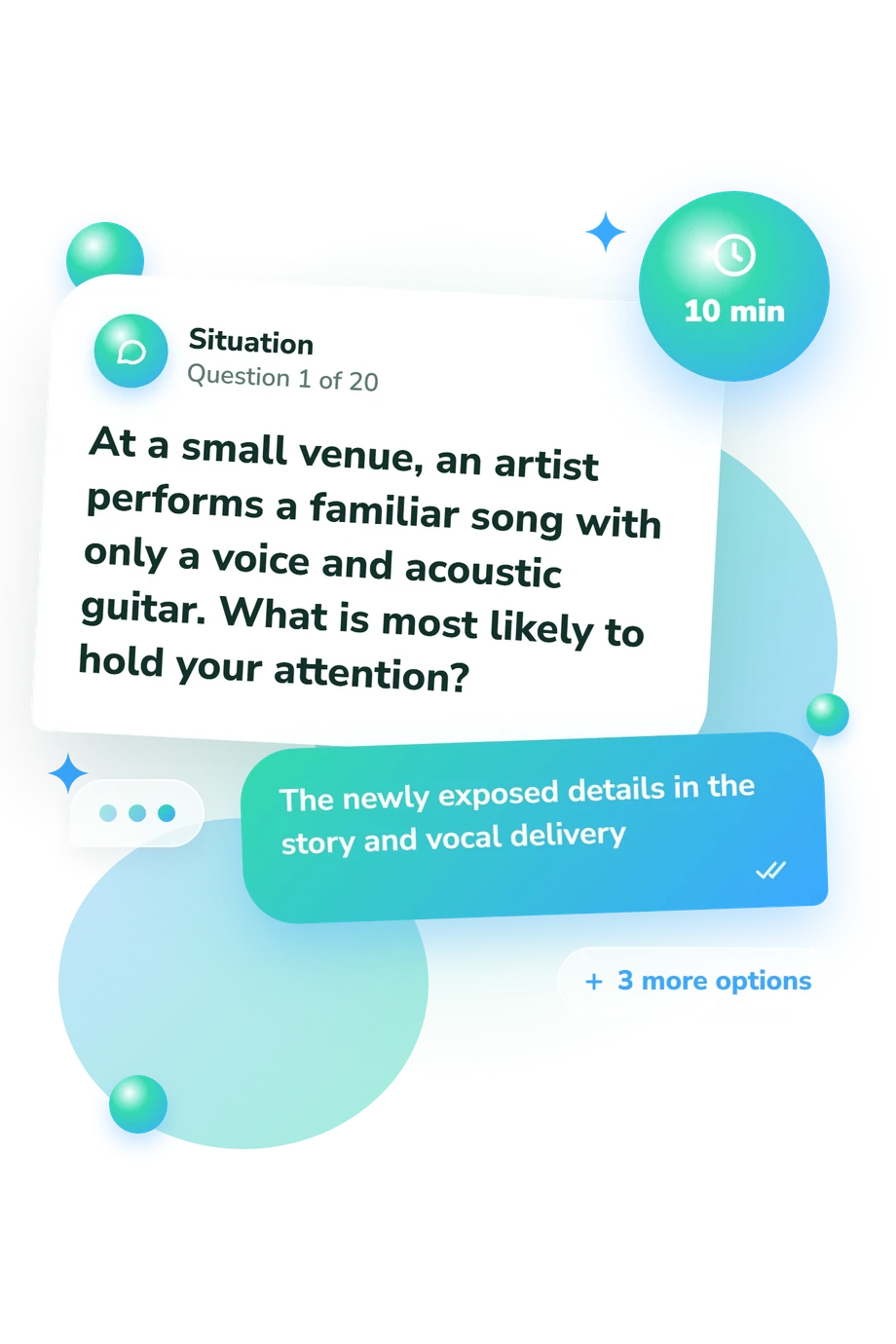
These scenarios cover storytelling, vocals, flow, hooks, production, buildup, and guitar-driven release. Together, they show a music taste profile that can guide listening choices. The five dimensions are:
- Acoustic Storytelling Mix (0-12) measures lyric-led intimacy and narrative detail; Occasional Listener (0-4), Story-Curious (5-8), Dedicated Story Seeker (9-12).
- Electronic and Dance Mix (0-12) measures beats, sound design, repetition, and evolving rhythm; Occasional Beat Visitor (0-4), Production Explorer (5-8), Electronic Immersion Seeker (9-12).
- Hip-Hop and R&B Mix (0-12) measures flow, expressive singing, and beat-driven storytelling; Occasional Groove Visitor (0-4), Rhythm-and-Voice Explorer (5-8), Flow and Soul Devotee (9-12).
- Hook-Rich Pop Mix (0-12) measures choruses, vivid production, and replay value; Selective Pop Visitor (0-4), Chorus Collector (5-8), Pop Repeat Specialist (9-12).
- Rock and Alternative Mix (0-12) measures guitars, dynamic drumming, and cathartic performance; Occasional Guitar Guest (0-4), Alternative Explorer (5-8), Amplified Enthusiast (9-12).
Methodology and Evidence Base
Each item presents a listening situation with four response choices. Options contrast lyrics, vocal nuance, groove, hooks, textures, buildup, arrangement, and live energy, so specialist knowledge is unnecessary. Responses create five separate profiles, not one overall ranking.
Conceptually, the questionnaire aligns with the Short Test of Music Preferences (STOMP), the five-factor model of musical preferences, and the replicated MUSIC model described by Rentfrow and colleagues. Those works support broad preference patterns in their own instruments and models; they do not establish norms or validation for this online questionnaire, which is presented as neither a direct adaptation of those instruments nor a standardized administration.
Higher displayed bands indicate that related qualities were more prominent in responses, while lower bands point toward different music discovery options. The exact point contribution for each answer is not specified, so the displayed bands should be read as profile descriptions rather than a reconstructed formula. Self-report can shift with mood, context, recent listening, and self-awareness; treat the result as a prompt for experimentation, not a complete identity.
- Rentfrow, P. J., & Gosling, S. D. (2003). The do re mi's of everyday life: The structure and personality correlates of music preferences. Journal of Personality and Social Psychology, 84(6), 1236-1256. 10.1037/0022-3514.84.6.1236
- Rentfrow, P. J., Goldberg, L. R., & Levitin, D. J. (2011). The structure of musical preferences: A five-factor model. Journal of Personality and Social Psychology, 100(6), 1139-1157. 10.1037/a0022406
- Rentfrow, P. J., Goldberg, L. R., Stillwell, D. J., Kosinski, M., Gosling, S. D., & Levitin, D. J. (2012). The Song Remains the Same: A Replication and Extension of the MUSIC Model. Music Perception, 30(2), 161-185. 10.1525/mp.2012.30.2.161
Updated: