
Moral Scrupulosity OCD Test
How the Scales are Structured
Who Usually Takes This Test?
See How You Compare
Below is a preview of how scores are typically distributed across each scale.
Example Questions From the Test
- Never
- Sometimes
- Often
- Almost always
- Never
- Rarely
- Frequently
- Nearly constantly
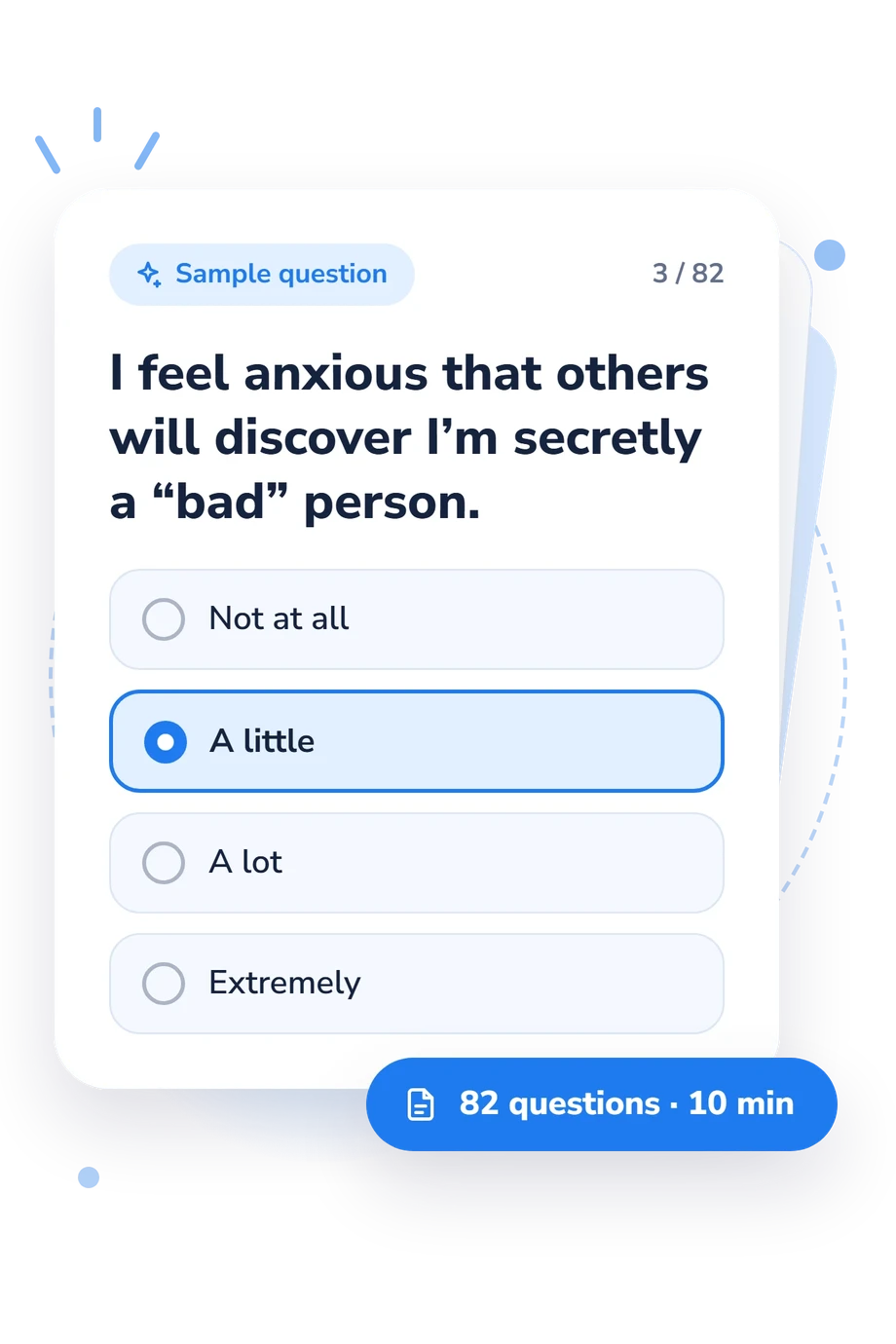
- Not at all
- A little
- A lot
- Extremely
Moral Scrupulosity OCD Test - Description and methodology of the test
For readers facing persistent moral doubt, guilt, or fear of being ethically harmful, the Moral Scrupulosity OCD Test offers a structured way to organize these experiences. It is designed for self-reflection by people who notice intrusive ethical concerns and repeated attempts to obtain certainty. For readers whose fears involve faith, sin, honesty, or personal values, its religious OCD test focus may feel especially relevant. The result highlights patterns that may deserve attention.
What This Assessment Measures
Items examine intrusive doubts about being bad, dishonest, selfish, harmful, or morally responsible, alongside responses used to settle them. They ask about reviewing interactions, checking intentions, confessing, reassurance, researching rules, avoidance, delayed choices, guilt, shame, sleep, and interference with daily tasks.
As a scrupulosity OCD test, it separates moral obsessions, certainty-seeking responses, and their effects. The displayed dimensions are:
- Compulsions & Reassurance (0-20) shows reliance on reviewing, rumination, confessing, intention-checking, reassurance, or avoidance; Low 0-6, Moderate 7-13, High 14-20.
- Distress & Life Impact (0-20) shows emotional distress and disruption in work, relationships, decisions, or time; Low impact 0-6, Moderate impact 7-13, High impact 14-20.
- Moral Obsessions Frequency (0-20) shows how often intrusive moral doubts, fears, and self-questioning occur; Low 0-6, Moderate 7-13, High 14-20.
Together, the profile shows whether thoughts, coping responses, or daily consequences are most prominent.
Methodology and Evidence Base
Each item offers four response choices, but anchors vary: some assess frequency, while others rate truth, distress, or disruption. The format therefore captures graded self-report rather than correct or incorrect moral answers.
Responses feed three displayed scores. Interpret each range alongside its catalogue definition; the range does not show how many points every answer contributes, so the profile should not be reduced to one invented total.
Its conceptual reference is Scrupulosity Obsessions and Compulsions Scale (Borgogna et al., 2024), which frames scrupulosity within OCD. This questionnaire is conceptually consistent with that instrument, not an adaptation of it. The Scrupulosity Inventory (Miller et al., 2024) and Penn Inventory of Scrupulosity (Olatunji et al., 2007) offer related evidence on obsessional doubt and compulsive responses.
As a moral scrupulosity questionnaire, it is an online self-reflection measure rather than a standardized clinical assessment. Those studies do not establish norms, reliability, validity, or diagnostic cutoffs for this version. Current anxiety, memory, self-awareness, and response pressure may also influence self-report, so results describe experiences reported at completion.
- Johnson, David A. L., Nicholas C. Borgogna, Paul B. Ingram, Craig Warlick, Samuel D. Spencer, Callie E. Mims, Kiana L. Bunnell, and Jared A. Nielsen. “The Scrupulosity Obsessions and Compulsions Scale: A Measurement of Scrupulosity Within an OCD Framework.” Journal of Obsessive-Compulsive and Related Disorders 43 (2024): 100918. 10.1016/j.jocrd.2024.100918
- Miller, Chris H., Dawson W. Hedges, Bruce Brown, Joseph Olsen, and Elijah C. Baughan. “Development of the Scrupulosity Inventory: A Factor Analysis and Construct Validity Study.” Journal of Behavior Therapy and Experimental Psychiatry 83 (2024): 101926. 10.1016/j.jbtep.2023.101926
- Olatunji, Bunmi O., Jonathan S. Abramowitz, Nathan L. Williams, Kevin M. Connolly, and Jeffrey M. Lohr. “Scrupulosity and Obsessive-Compulsive Symptoms: Confirmatory Factor Analysis and Validity of the Penn Inventory of Scrupulosity.” Journal of Anxiety Disorders 21, no. 6 (2007): 771-787. 10.1016/j.janxdis.2006.12.002
Updated: