
Mitosis and Meiosis Quiz
How the Scales are Structured
Who Usually Takes This Test?
See How You Compare
Below is a preview of how scores are typically distributed across each scale.
Example Questions From the Test
- Prophase of mitosis
- Metaphase II of meiosis
- Prophase I of meiosis
- Telophase I of meiosis
- Sister chromatids separate and move toward opposite poles
- Homologous chromosomes pair to form tetrads
- Crossing over occurs between homologous chromosomes
- The chromosome number is reduced when homologous pairs separate
- Two diploid cells with matching chromosome sets
- Four diploid cells that are genetically identical
- Four haploid cells, often genetically different from one another
- Two haploid cells containing identical chromosome combinations
Mitosis and Meiosis Quiz - Description and methodology of the test
Before an exam or another revision round, this assessment helps you judge whether you can distinguish the purposes, stages, and chromosome outcomes of mitosis and meiosis. The mitosis and meiosis quiz turns that decision into a focused knowledge check. Its mitosis vs meiosis quiz format puts the processes side by side and helps you decide what to revise.
What This Assessment Explores
At its core, the assessment measures conceptual understanding, not isolated vocabulary. Items ask learners to reason about homologous chromosomes, sister chromatids, ploidy, replication, spindle action, and division sequence. They connect these ideas with growth, repair, gamete formation, and inherited variation.
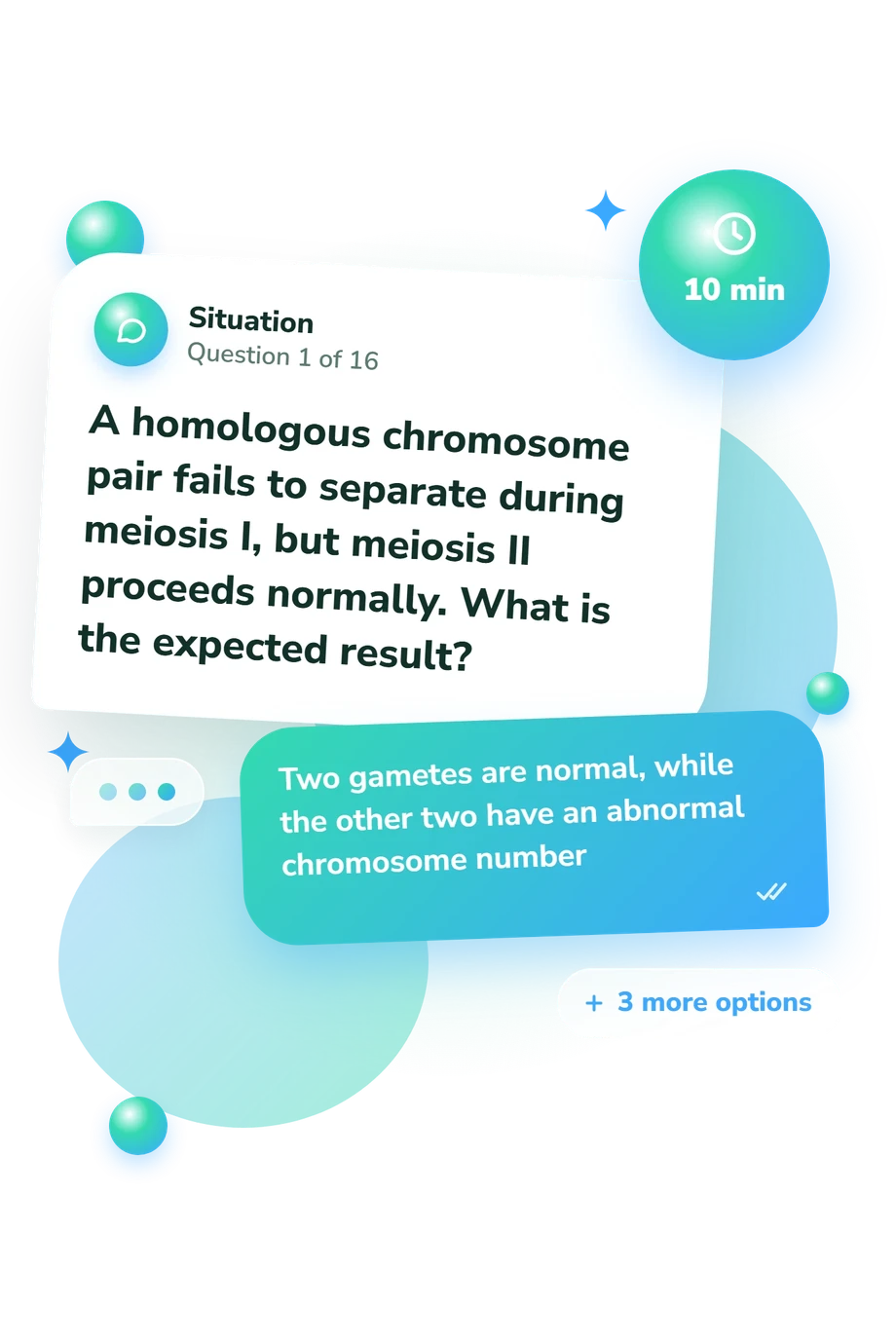
Short scenarios make the mitosis and meiosis practice quiz useful for applying concepts about stages, chromosome partners, and each division’s purpose.
The questions cover four linked learning areas:
- Chromosome identity distinguishes homologous pairs, sister chromatids, diploid cells, and haploid gametes.
- Division stages show when chromosomes replicate, align, separate, and move toward opposite poles.
- Genetic variation explains how crossing over and independent assortment create different gamete combinations.
- Biological application connects mitosis with growth and repair and meiosis with sexual reproduction.
Results appear as Mitosis and Meiosis Knowledge, a 0-16 scale: Foundation to build (0-6), Developing knowledge (7-12), or Strong knowledge (13-16).
Methodology and Scientific Basis
Each item presents a short question with four answer choices. Respondents select the option that fits the biological situation, whether calculating chromosome number, identifying a stage, or predicting a separation error. This mitosis and meiosis test uses four-choice items for conceptual recognition and application to chromosome calculations and short biological scenarios.
The evidence base is conceptually consistent with the Meiosis Concept Inventory (Kalas et al., 2013), which targeted common misunderstandings about meiotic processes; this questionnaire is not an adaptation of that published instrument. It also aligns with findings discussed by Williams et al. (2012) on how learners connect cell division with genetic inheritance. Alberts et al. (2022) supply biological context for chromosome behavior, mitotic and meiotic division, and variation.
The displayed result is overall, not divided into separate scores for chromosome identity, stages, variation, and application. Performance can be affected by prior instruction, wording interpretation, test anxiety, and whether the learner notices distinctions such as homologous chromosomes versus sister chromatids. Use the result to guide review, then confirm understanding with coursework, diagrams, or an explanation in your own words.
- Pamela Kalas, Angie O'Neill, Carol Pollock, and Gülnur Birol (2013). Development of a meiosis concept inventory. CBE-Life Sciences Education, 12(4), 655-664. 10.1187/cbe.12-10-0174
- Michelle Williams, Angela Haydel DeBarger, Beronda L. Montgomery, Xuechun Zhou, and Erika Tate (2012). Exploring middle school students' conceptions of the relationship between genetic inheritance and cell division. Science Education, 96(1), 78-103. 10.1002/sce.20465
- Bruce Alberts, Rebecca Heald, Alexander D. Johnson, David Morgan, Martin Raff, Keith Roberts, and Peter Walter (2022). Molecular Biology of the Cell (7th ed.). W. W. Norton & Company.
Updated: