
Missing Link Quiz
How the Scales are Structured
Who Usually Takes This Test?
See How You Compare
Below is a preview of how scores are typically distributed across each scale.
Example Questions From the Test
- light
- flower
- rise
- beam
- work
- town
- land
- page
- time
- sheet
- room
- frame
Missing Link Quiz - Description and methodology of the test
People who enjoy language puzzles can use the Missing Link Quiz to examine how readily they recognize a word that completes two familiar expressions. The task suits anyone curious about verbal association, flexible pattern finding, or performance on compound-word problems. Across the missing-link quiz questions, accuracy matters more than speed, so the result describes success on this set rather than a broad judgment of ability.
What This Assessment Explores
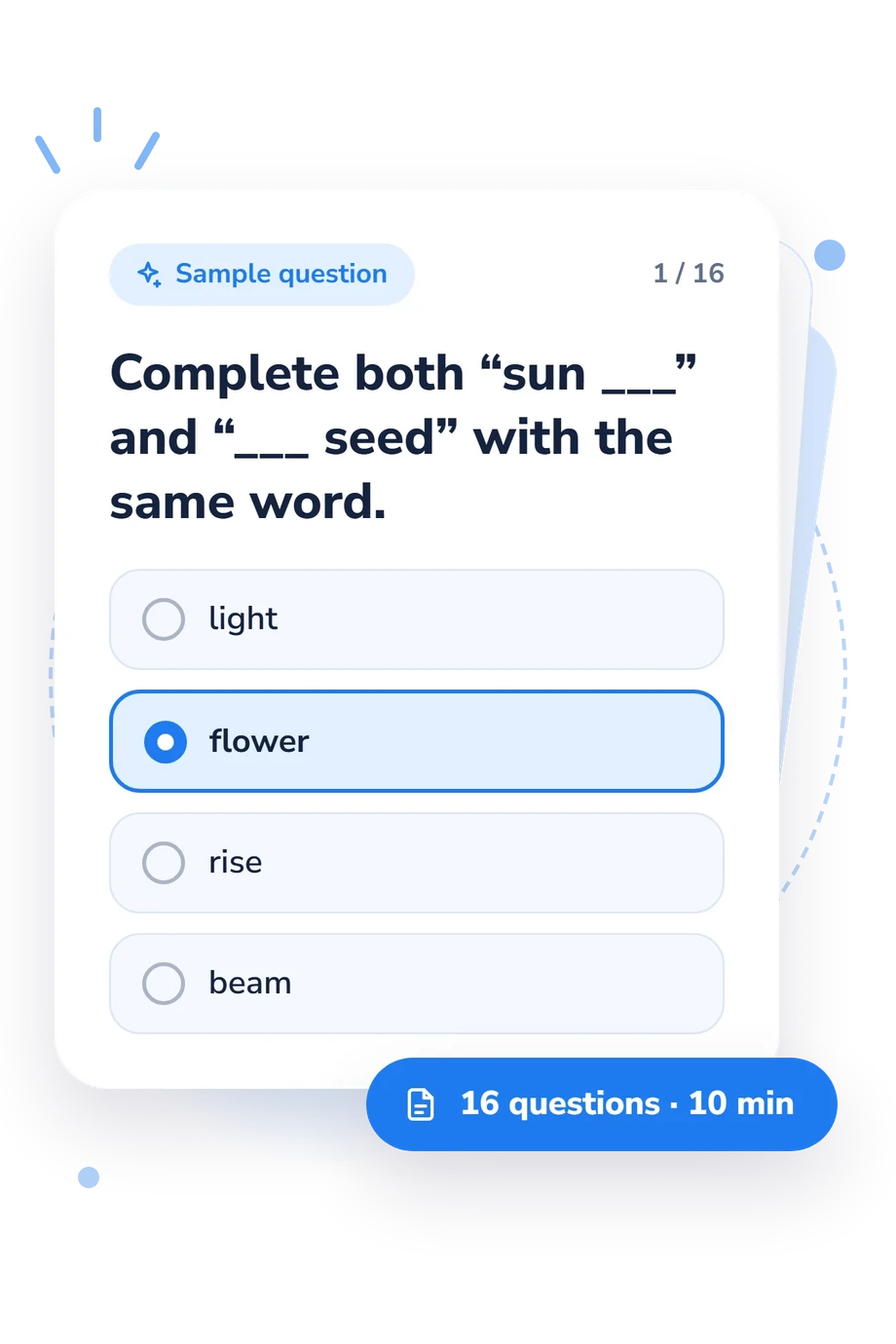
Rather than testing isolated vocabulary recall, the questionnaire examines whether one word can bridge two contexts. Across the missing link questions, each item pairs incomplete expressions such as “sun _” and “_ seed,” asking the respondent to choose the shared compound or familiar expression from plausible alternatives. The result suits anyone curious about language-based pattern recognition.
The displayed scale is Missing Link Knowledge (0-16), which counts correct links and groups performance into three bands:
- Building connections (0-6) indicates that some familiar compounds were recognized, while less obvious links were harder.
- Developing linker (7-12) indicates that many shared words were identified with a solid grasp of common expressions.
- Strong linker (13-16) indicates that nearly all or all word pairs were connected accurately.
These bands describe accuracy on these 16 puzzles, not general intelligence, overall language proficiency, or a fixed personal trait.
Methodology and Scientific Basis
Each item presents two incomplete expressions and four answer choices. One option supplies the same word in both blanks; selecting it earns one point, and the total is the number of correct links. The structure tests convergent association: several cues must lead to one familiar connection rather than merely evoke any related word.
The conceptual comparison is Compound Remote Associate Problems (Bowden & Jung-Beeman, 2003), which also uses separate cues that converge on a common answer. This questionnaire is conceptually consistent with that work; it is not a standardized administration of the published instrument. Its broader rationale also aligns with Mednick’s Remote Associates Test and his associative account of creative thinking, where useful connections emerge between initially separate ideas.
Used as a missing link test, the result is best interpreted as performance on this particular vocabulary-and-compound format. It does not establish a normed level of creativity, intelligence, or language skill. Familiarity with common expressions, attention, current fatigue, and guessing can affect a fixed-choice score, so broader conclusions require additional evidence beyond this result.
- Bowden, Edward M., and Mark Jung-Beeman. (2003). Normative data for 144 compound remote associate problems. Behavior Research Methods, Instruments, & Computers, 35(4), 634-639. 10.3758/bf03195543.
- Mednick, Sarnoff A., and Sharon Halpern. (1968). The Remote Associates Test. The Journal of Creative Behavior, 2(3), 213-214. 10.1002/j.2162-6057.1968.tb00104.x
- Mednick, Sarnoff A. (1962). The associative basis of the creative process. Psychological Review, 69(3), 220-232. 10.1037/h0048850
Updated: