
Migraine vs Headache Quiz
How the Scales are Structured
Who Usually Takes This Test?
See How You Compare
Below is a preview of how scores are typically distributed across each scale.
Example Questions From the Test
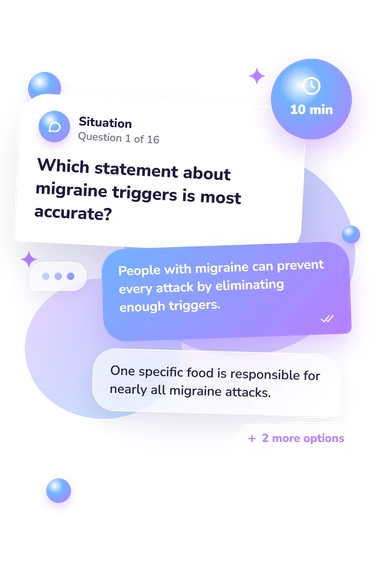
- People with migraine can prevent every attack by eliminating enough triggers.
- One specific food is responsible for nearly all migraine attacks.
- A suspected trigger confirms that the headache is migraine.
- Possible triggers vary between people and may contribute to an attack without being the underlying cause of migraine.
- Wait several days to see whether the same pattern returns
- Seek urgent medical assessment
- Assume it is migraine because physical activity can worsen migraine
- Record it in a diary but take no other action
- Treat it as an ordinary tension-type headache
- Obtain urgent medical help
- Wait until the fever resolves before seeking advice
- Use light sensitivity alone to decide whether it is migraine
Migraine vs Headache Quiz - Description and methodology of the test
Readers who want to understand recurring head pain, distinguish common patterns, or prepare better questions for a clinician can use the Migraine vs Headache Quiz as a focused knowledge check. The format also works as a migraine quiz for people reviewing what they know before tracking symptoms or discussing them with a healthcare professional.
What the Test Measures
The questions cover distinctions among migraine, tension-type, cluster, medication-overuse, and potentially urgent secondary headaches. They use situations involving triggers, aura, movement sensitivity, nausea, light sensitivity, nasal symptoms, caffeine, medicine use, headache diaries, injury, and new neurological or infectious features.
The questions address four practical topics:
- Headache patterns: the questions test whether you recognize features that separate common primary headache presentations.
- Migraine features: they test understanding of aura, associated symptoms, triggers, and overlapping signs.
- Safety recognition: they address whether you notice warning situations needing urgent assessment.
- Management knowledge: they test medication overuse, caffeine effects, and useful diary details.
Someone wondering whether their symptoms could fit migraine can use this as a do i have migraine quiz to review relevant concepts; it cannot settle the cause of an individual headache.
Methodology and Scientific Basis
Each item presents a factual question or clinical-style scenario with four answer choices. Selecting the best-supported response makes the score reflect correct answers, not symptom severity or likelihood of migraine. Migraine vs Headache Knowledge (0-16) appears in three educational bands: Foundation to build (0-6), Developing distinction (7-12), and Strong knowledge (13-16). These are unvalidated educational descriptions, not clinical cutoffs.
This structure is conceptually consistent with MigKAT-12 (Gordon et al., 2019), a published migraine-knowledge measure, but this questionnaire is not an adaptation of it. Goodhew (2019) addresses migraine literacy, while Eigenbrodt et al. (2021) and the ICHD-3 classification supply clinical context for distinguishing migraine from other headache presentations.
Readers may approach it when wondering what kind of headache they have and use it as a what kind of headache do i have quiz to choose topics for review. Because recall, wording, prior beliefs, and changing symptoms can affect answers, the score reflects educational knowledge and highlights topics for further review.
- David Lee Gordon, Claire Delpirou Nouh, Michael Bellew, Joshua Santucci, and Chao Xu. "Development and Validation of the Migraine Knowledge Assessment Tool-MigKAT-12© (P3.10-005)." Neurology 92(15 Suppl) (2019): P3.10-005. 10.1212/WNL.92.15_supplement.P3.10-005
- Stephanie C. Goodhew. "Migraine Literacy and Treatment in a University Sample." SN Comprehensive Clinical Medicine 1 (2019): 749-757. 10.1007/s42399-019-00124-y
- Anna K. Eigenbrodt, Håkan Ashina, Sabrina Khan, Hans-Christoph Diener, Dimos D. Mitsikostas, Alexandra J. Sinclair, Patricia Pozo-Rosich, Paolo Martelletti, Anne Ducros, Michel Lantéri-Minet, Mark Braschinsky, Margarita Sanchez del Rio, Oved Daniel, Aynur Özge, Ayten Mammadbayli, Mihails Arons, Kirill Skorobogatykh, Vladimir Romanenko, Gisela M. Terwindt, Koen Paemeleire, Simona Sacco, Uwe Reuter, Christian Lampl, Henrik W. Schytz, Zaza Katsarava, Timothy J. Steiner, and Messoud Ashina. "Diagnosis and management of migraine in ten steps." Nature Reviews Neurology 17(8) (2021): 501-514. 10.1038/s41582-021-00509-5
- Headache Classification Committee of the International Headache Society (IHS). "The International Classification of Headache Disorders, 3rd edition." Cephalalgia 38(1) (2018): 1-211. 10.1177/0333102417738202