
Metric Conversion Quiz
How the Scales are Structured
Who Usually Takes This Test?
See How You Compare
Below is a preview of how scores are typically distributed across each scale.
Example Questions From the Test
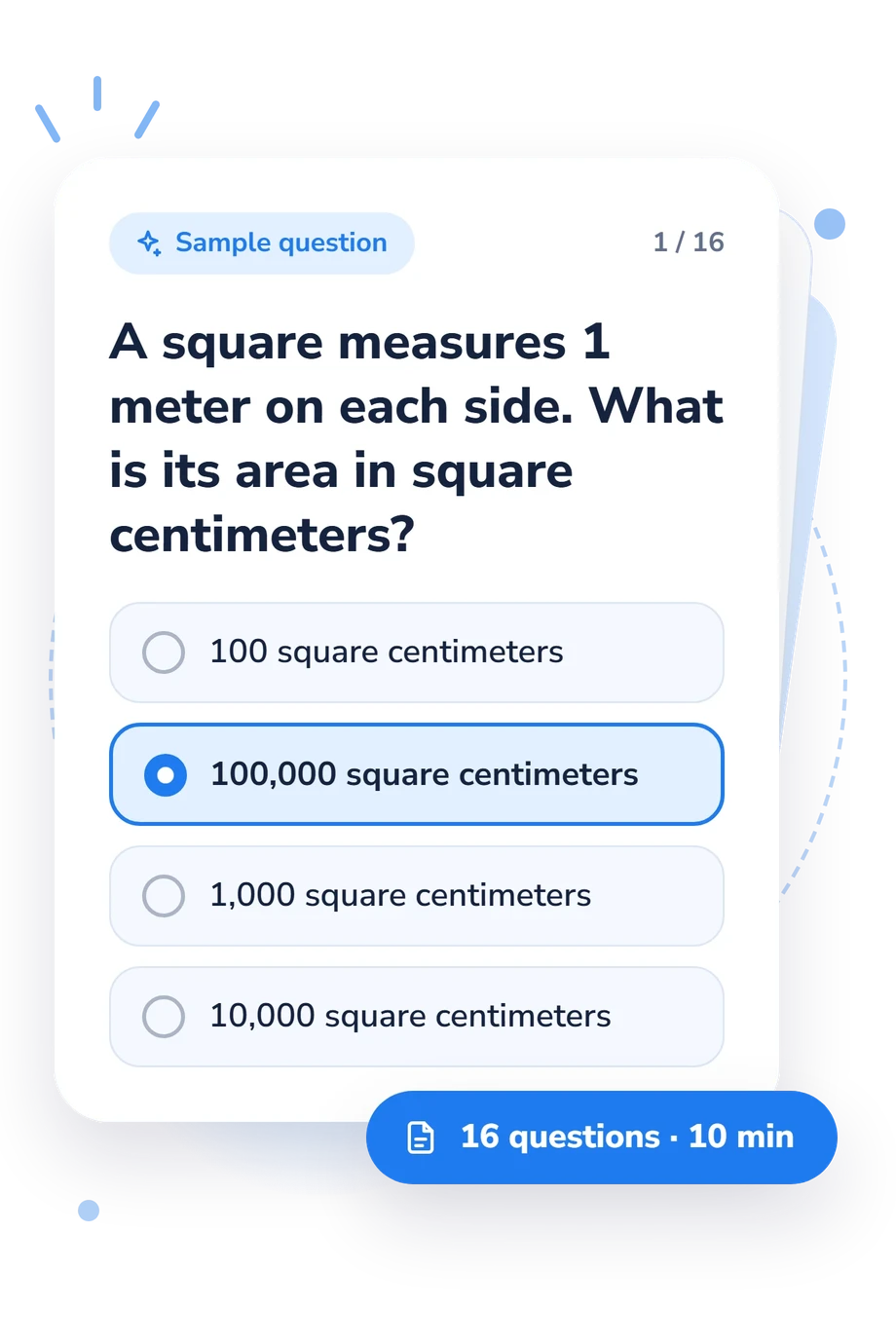
- 100 square centimeters
- 100,000 square centimeters
- 1,000 square centimeters
- 10,000 square centimeters
- 32 grams
- 320 grams
- 32,000 grams
- 3,200 grams
- 150 microliters
- 15,000 microliters
- 1,500 microliters
- 0015 microliter
Metric Conversion Quiz - Description and methodology of the test
People who want to check their practical grasp of metric units can use the Metric Conversion Quiz to identify topics for targeted revision. It suits learners, tutors, and anyone reviewing SI notation before study or everyday calculations. Performance on this unit conversion quiz becomes a concise guide to which conversion skills deserve more practice.
What This Assessment Explores
Questions combine prefix recall with calculations involving length, mass, volume, area, speed, and ordered quantities. The result reflects metric-conversion knowledge and your ability to apply prefixes and unit relationships across different measurements.
Learners can use this assessment as a metric conversion practice quiz to review foundations, refresh SI conventions, or locate a gap before technical work. Its focus falls into these themes:
- Metric Conversion Knowledge (0-16) summarizes performance as Foundation to build (0-6), Developing command (7-12), or Strong command (13-16).
- Prefix and symbol recognition shows whether you connect kilo-, milli-, and micro- with powers of ten.
- Unit relationships show whether you move between related measures without losing scale.
- Applied reasoning shows how well you compare quantities and complete multi-step conversions.
The result is a snapshot of conversion competence, not general mathematical ability.
Methodology and Scientific Basis
Each item is a multiple-choice problem with four choices. Some identify prefixes or symbols; others require conversion, comparison, division into equal quantities, or a multi-step change such as meters per second to kilometers per hour. This format tests factor selection and calculation.
As a metric conversion test, it uses objective answers rather than opinions or self-ratings. The result is presented as a banded summary and should be read as a broad indication of item performance across recall, calculations, comparisons, and multi-step conversions rather than a fine-grained estimate.
The conventions are conceptually consistent with NIST SP 1038 (Butcher et al., 2006), which supplies SI conversion factors, and NIST SP 811 (Thompson and Taylor, 2008), which explains SI units, prefixes, and symbols. The BIPM SI Brochure provides an international reference for the same conventions. These standards establish the measurement conventions tested here, while the questionnaire remains a separate online assessment rather than an adaptation of those publications.
No normative sample, reliability estimate, or clinical standard is stated. Results can vary with prior instruction, attention, and guessing, so interpret them as a knowledge snapshot.
- Butcher, Kenneth S., Linda D. Crown, and Elizabeth J. Gentry. (2006). The International System of Units (SI) - Conversion Factors for General Use. NIST Special Publication 1038, National Institute of Standards and Technology, Gaithersburg, MD. 10.6028/NIST.SP.1038
- Thompson, Ambler, and Barry N. Taylor. (2008). Guide for the Use of the International System of Units (SI). NIST Special Publication 811, National Institute of Standards and Technology, Gaithersburg, MD. 10.6028/NIST.SP.811e2008
- Bureau International des Poids et Mesures. (2026). The International System of Units (SI), 9th edition (2019), updated in 2026. BIPM. 10.59161/AUEZ1291
Updated: