
Metal Quiz
How the Scales are Structured
Who Usually Takes This Test?
See How You Compare
Below is a preview of how scores are typically distributed across each scale.
Example Questions From the Test
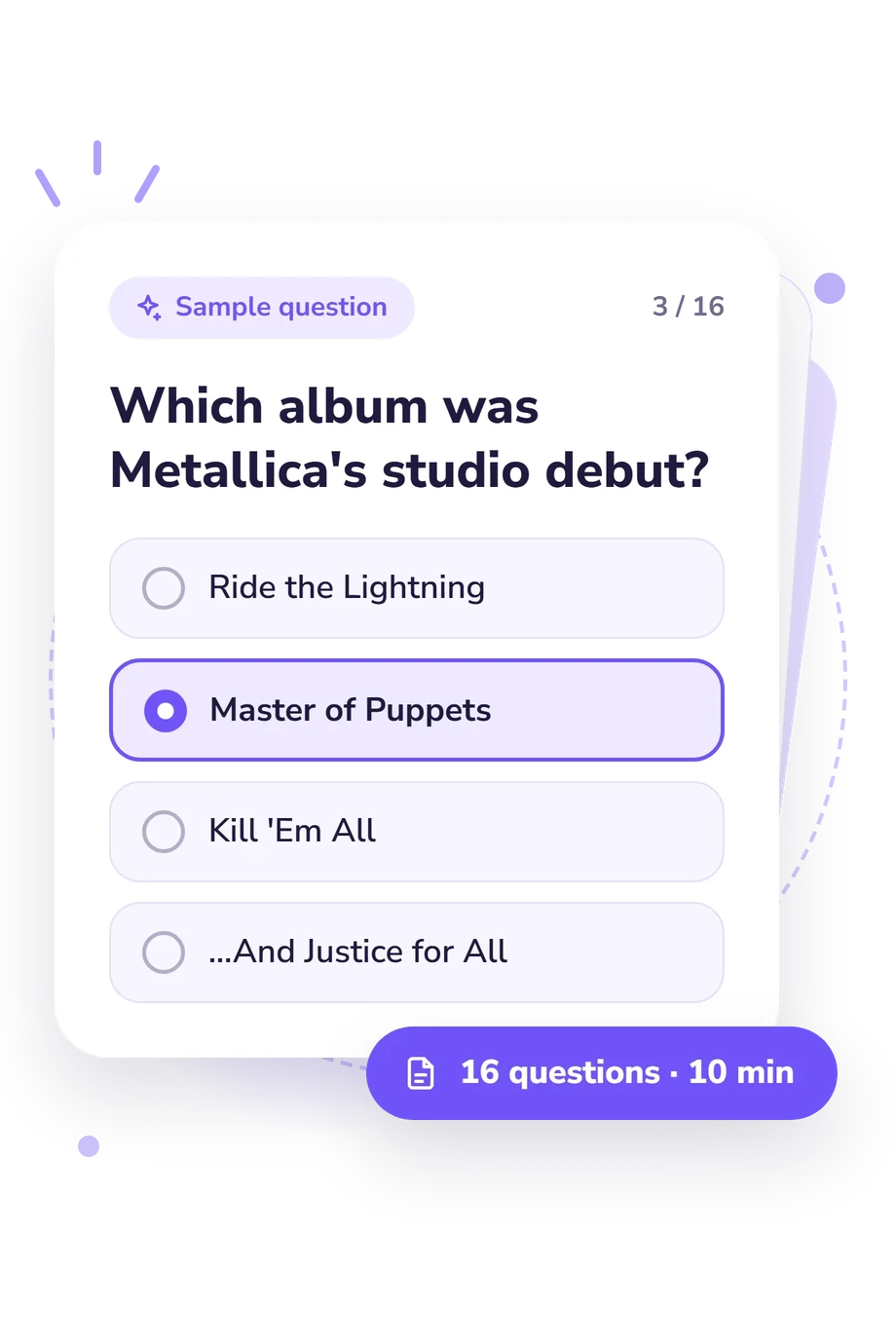
- Ride the Lightning
- Master of Puppets
- Kill 'Em All
- ...And Justice for All
- Judas Priest
- Deep Purple
- Diamond Head
- Uriah Heep
- New Wave of British Heavy Metal
- Northern Wave of British Hard Music
- New World Order of Heavy Metal
- National Wave of British Heavy Music
Metal Quiz - Description and methodology of the test
Designed for listeners who want to test more than their ability to name a favorite band, this metal quiz turns broad familiarity with the genre into a knowledge check. It suits newcomers building familiarity and experienced listeners checking what they remember. For someone treating it as a quiz about heavy metal, the result shows which parts of metal culture feel secure and where further listening may be rewarding.
What This Assessment Explores
Recognition of metal history, vocabulary, sound, performers, and playing techniques is central. As a metal knowledge test, it suits newcomers building familiarity and experienced listeners checking what they remember.
Items ask you to match riffs, vocals, tempos, or structures to subgenres, or to identify bands, albums, musicians, cities, abbreviations, and performance terms. The result combines factual recall with interpretation of musical clues.
The displayed scale is Heavy Metal Knowledge (0-16). Its bands are Foundations to build (0-6), Developing knowledge (7-12), and Strong knowledge (13-16). A higher band means more correct answers on this material, not complete musicianship.
The question themes are:
- Subgenre recognition shows how you connect musical clues with styles.
- History and discography indicate familiarity with bands, albums, origins, and scenes.
- Terminology, technique, and landmarks show whether performance concepts, musicians, and recordings are recognizable.
Methodology and Evidence Base
Each question presents four answer choices. Some require direct recall, such as identifying an album or a band's city; others apply musical vocabulary to a described riff, vocal style, rhythm, or production technique.
The scoring rule is criterion-based: each correct answer contributes one point. This makes the questionnaire a knowledge check, not a standardized psychological scale or norm-referenced ranking. Guessing, uneven exposure to subgenres, and familiarity with the examples can influence the outcome.
Freeborn (2002) is the closest subject-specific reference for its attention to heavy metal artists, recordings, and genre knowledge. Weinstein (2009) and Walser (1993) add historical, musical, and cultural context, while Riches, Snell, Bardine, and Walter (2016) connect heavy metal studies with popular culture. These works support the questionnaire's vocabulary and subject matter, but it is not an adaptation or validated edition of any one of them.
As a metal trivia test, the result is a snapshot of recall and recognition. It can suggest topics for further listening or reading, but it cannot capture listening history, interpretive ability, or practical musicianship.
- Freeborn, Robert. "Confronting the dark side of the beat: A guide to creating a heavy metal music collection." Music Reference Services Quarterly, vol. 8, no. 2, 2002, pp. 25-37. 10.1300/J116v08n02_03.
- Weinstein, Deena. Heavy Metal: The Music and Its Culture. Grand Central Publishing, 2009.
- Walser, Robert. Running with the Devil: Power, Gender, and Madness in Heavy Metal Music. Wesleyan University Press, 1993.
- Riches, Gabby, Dave Snell, Bryan Bardine, and Brenda Gardenour Walter, editors. Heavy Metal Studies and Popular Culture. Palgrave Macmillan, 2016.
Updated: