
Mermaid Quiz
How the Scales are Structured
Who Usually Takes This Test?
See How You Compare
Below is a preview of how scores are typically distributed across each scale.
Example Questions From the Test
- A shell used in traditional mermaid legends
- A pouch of air carried by a marine mammal
- An egg case produced by certain sharks, skates, or rays
- A cluster of pearls enclosed by seaweed
- A river spirit becomes a horse on moonlit nights
- A winged singer becomes human when someone answers a riddle
- A sailor grows a fish tail after entering an enchanted cave
- A seal sheds its skin and takes human form
- Welsh folklore
- Greek folklore
- Inuit folklore
- Japanese folklore
Mermaid Quiz - Description and methodology of the test
Readers who want to separate traditional water beings from the blended imagery of popular culture can use this mermaid quiz as a focused knowledge exercise. It suits learners, folklore enthusiasts, and anyone using this mermaid folklore quiz to explore traditions rather than fictional identity. The result indicates the breadth and accuracy of your knowledge of mermaid traditions and related beings.
What This Assessment Measures
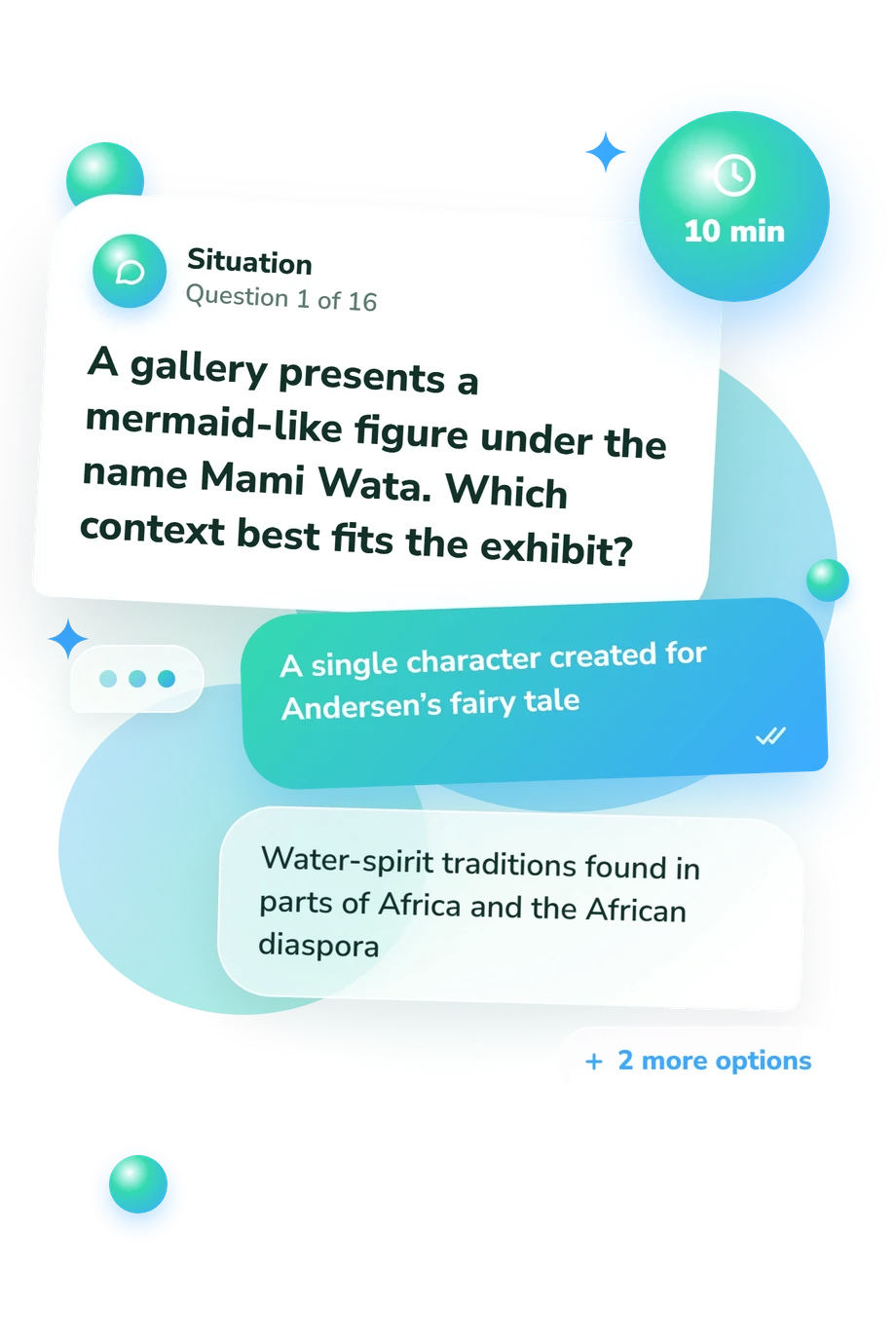
This assessment measures knowledge of mermaid folklore, literature, symbolism, and related water beings. Its questions distinguish traditions and motifs that popular retellings often blend, including Mami Wata, rusalki, selkies, ningyo, Sirens, Andersen’s tale, European art, and dugong theories.
Readers may approach this folklore knowledge quiz with identity-style curiosity-wondering which mermaid they are-but its result reflects folklore knowledge, not a personality or supernatural-identity assessment.
The result uses one scale and three descriptive bands:
- Mermaid Knowledge (0-16) measures understanding of folklore, literature, symbolism, and related beings.
- Shoreline Starter (0-6) indicates recognition of central ideas, with some neighboring traditions still confused.
- Lore Navigator (7-12) reflects solid knowledge across several areas, with room to deepen cultural distinctions.
- Deep-Sea Scholar (13-16) shows broad, accurate command of the covered traditions and stories.
Methodology and Evidence Base
Each item presents a scenario or factual prompt with four answer choices. Respondents identify a cultural context, correct a conflation, recognize a literary detail, or match a creature with a traditional description. This multiple-choice method tests recall and discrimination among related traditions rather than self-rating.
The questionnaire’s multiple-choice method keeps the task focused as a mermaid knowledge test, while its scoring algorithm is unspecified; no finer rules about answer weighting or item-level calculation should be inferred.
Research on fairy-tale retellings by Bacchilega and Brown provides a close reference for the folklore and literary comparisons. Drewal’s Mami Wata exhibition volume supports the Mami Wata item, while Andersen’s tale anchors the literary questions. The questionnaire is conceptually consistent with these sources, not an adaptation or validated reproduction of any one.
The online version lacks established or documented standardization and psychometric evidence. Results may reflect memory, wording interpretation, current context, and prior exposure to particular traditions, so the bands are descriptive rather than diagnostic.
- Bacchilega, Cristina, and Marie Alohalani Brown, eds. The Penguin Book of Mermaids. Penguin Classics, 2019. ISBN 978-0-14-313372-8.
- Drewal, Henry John. Mami Wata: Arts for Water Spirits in Africa and Its Diasporas. Fowler Museum at UCLA, distributed by University of Washington Press, 2008. ISBN 978-0-9748729-9-5.
- Drewal, Henry John, with contributions by Marilyn Houlberg, Bogumil Jewsiewicki, John W. Nunley, and Jill Salmons. Mami Wata: Arts for Water Spirits in Africa and Its Diasporas. African Arts, vol. 41, no. 2, 2008, pp. 60-83. 10.1162/afar.2008.41.2.60.
- Andersen, Hans Christian. The Little Mermaid. 1837. Translated by Jean Hersholt. Hans Christian Andersen Center, University of Southern Denmark.
Updated: